Continued from The Influencers: inspirational visitors, part 1
Brian Eno famously said that while the first Velvet Underground record allegedly only sold 10,000 copies in its first five years, every person who bought one of those 10,000 copies formed a band.
But it would be more than a decade before the influence of The Velvet Underground became an audible presence in New Zealand music. For one thing, their 1967 debut was not released here until 1971. Any copies in circulation before that were US or European imports, and few and far between.
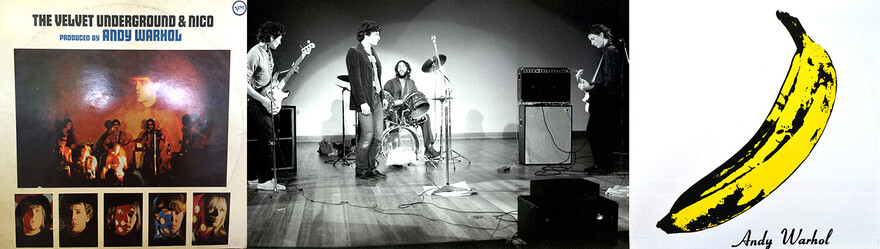
A very early Clean at Logan Park High School, Dunedin, 1979 (L-R): Peter Gutteridge, Hamish Kilgour, Lindsay Hooke and David Kilgour; photo by Jeff Batts. Flanking them is the first New Zealand issue of the 1967 Velvet Underground and Nico album (Verve/PolyGram NZ, 1971), and its 1980 reissue by PolyGram NZ.
A 19-year-old, music-obsessed Chris Knox arrived in Dunedin from Invercargill the same year The Velvet Underground and Nico became locally available, and with its transgressive subject matter (sadomasochism, drugs) and thrilling dissonances (feedback guitars, electric violas) the album quickly took a place among his favourites, alongside The Beatles and The Incredible String Band. All three would be audible influences in the music he would make in the decades to come.
But by the time Lou Reed paid his first visit to New Zealand in 1974, the Velvets were long disbanded, and their founder-frontman was several years into an erratic solo career. The first tour only brought Reed as far south as Christchurch, so Knox eagerly travelled up the island to see him. He wasn’t disappointed. Though he noted in a journal entry at the time that the musicians accompanying Reed were “more refined satin than velvet,” Reed impressed Knox as a performer, especially in a 15-minute version of ‘Heroin’: “He sings it long and so slow with aching pauses as he winds the mic cable round and round his straining arm and you could swear he’s going to shoot up or has he already?”
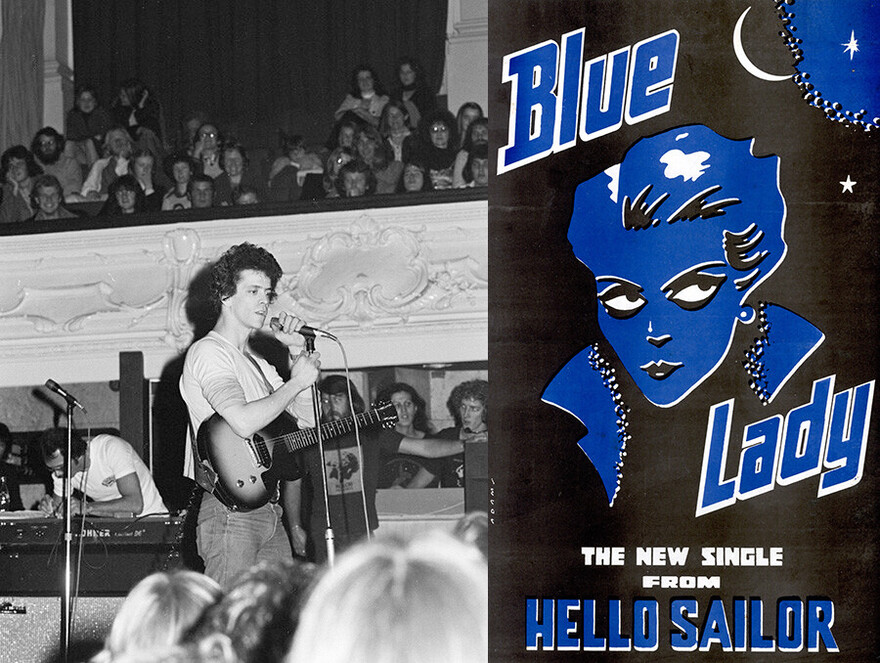
Lou Reed performing at Auckland Town Hall, 7 August 1975. The 1957 Les Paul Junior guitar was later owned by Johnny Volume (photo by Roy Emerson, Auckland Libraries Heritage Collections, 1959-018-10); poster for Hello Sailor’s Blue Lady single, by Peter Adams, 1977 (Ian Morris Archive)
Reed’s 1974 tour, and subsequent visits in 1975 and 1977, had a profound effect on local musicians, musicians-to-be, and the culture in general, yet were almost entirely separate from the influence of the Velvet Underground. Followers such as Knox, who knew Reed’s early work with the Velvets, were in a minority. For most, Reed was the sub-glam artist of Transformer (with its edgy single ’Walk On The Wild Side’) and the live Rock’n’Roll Animal, which remade Velvets songs such as ‘Heroin’, ‘Sweet Jane’, ‘White Light/White Heat’ and ‘Rock’n’Roll’ as high-octane arena rock. It would be these versions rather than the Velvets’ prototypes that provided the model for the covers played on the pub circuit around this time by groups including Dragon and Hello Sailor.
Reed’s visits may have influenced more than just the music, though. In what could be seen as a perfect storm, he arrived here, the epitome of wasted chic, at the same time as a flood of imported heroin courtesy of the “Mr Asia” drug ring. How many fans were inspired by Reed to seek out heroin is indeterminable, but its influence certainly crept into the music. Hello Sailor’s Graham Brazier would mythologise the drug in songs like ‘Blue Lady’, and he later recorded an ironic paen to Marty Johnstone, the so-called Mr Asia, in which he employed a droll black humour not dissimilar to Lou Reed’s (“Oh what a calamity / business closed due to death in the family …”).
As for the Velvets, it is hard to find examples of their influence prior to the first records of The Clean in the early 1980s, but their impact on this band is notable. In his Clean biography, In the Dreamlife You Need a Rubber Soul, Richard Langston quotes a 1977 entry from the dairy of Hamish Kilgour noting that he has just bought the first Velvet Underground album – presumably second-hand – from Roy Colbert’s record store in Dunedin; that’s 10 years after its release. The Clean formed the following year. As Kilgour would later tell Langston: “I realised that you didn’t have to be able to play anything particularly well and you could play. I heard the Velvet Underground’s double live album 1969, and Moe Tucker played a single snare beat all through ‘What Goes On’ and I thought, that’s kind of magical and that’s possible and I could do that.”
By the time other Velvets alumni – John Cale and Nico – made solo tours here in the mid-80s, a full-scale discovery of The Velvet Underground was underway and it was their connection to that long-disbanded group that drew cultish crowds to hear them.
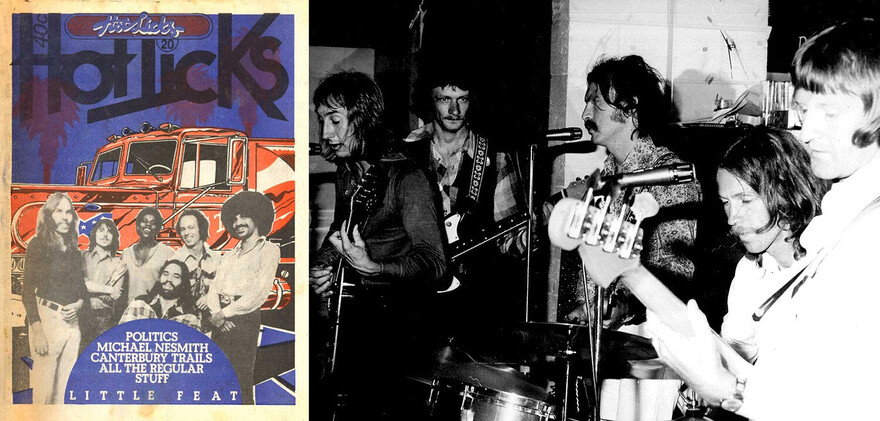
Little Feat on the cover of Hot Licks (issue 20), 1976; Wellington’s Country Flyers, c. 1975 (L-R): Midge Marsden, Kevin Watson, Martin Hope, Jim Lawrie, Richard Nicholson
“There are just a few places in the world people ask about my father,” Inara George told me in 2007. “In America most people my age don’t know who he is. You see it in different countries, how much respect people have for him.”
Inara, who is half of the duo The Bird and the Bee, is the daughter of the late Lowell George, leader of Little Feat, who toured New Zealand in 1976. It is one of the places where the Hollywood-born musician and his band enjoyed a respect bordering on worship. Their albums saw only a fraction of the sales commanded by contemporaries like the Eagles and The Doobie Brothers, but their impact on musicians here was out of proportion to their sales figures. Local admirers fixated on their intricate New Orleans-inspired polyrhythms and Lowell George’s masterful slide-guitar playing, and would go to great lengths to emulate these. Yet until they had seen the group up close they wouldn’t have known that Lowell played his slide with a metal socket wrench and achieved his distinctive sustain by using two compressor pedals, or that drummer Richie Hayward attacked his second-line rhythms with the force of a John Bonham.
Little Feat played shows in Auckland, Wellington and Christchurch, and local guitarists including Mike Farrell, Bill Lake and Martin Hope studied them from the front rows. Afterwards, all of them would sound a lot more like Lowell George. Martin Hope met George when several members of Little Feat visited the Auckland nightclub where he was resident. George encouraged him to try his luck in Los Angeles, which he eventually did, paying a visit to George at Sunset Sound studios in Hollywood where the group was working on their Time Loves A Hero album.
Auckland-based group Waves had an even closer encounter. Singer, guitarist and songwriter Graeme Gash recalled: “I gate-crashed the hotel where they were holding their press conference, went up to Lowell George’s table, looked him in the eye and asked him to produce our next album. It was possibly the scariest thing I’ve ever done. Lowell was gracious. He took a cassette of five of our new songs away with him and Little Feat flew out to Australia. We thought that was the end of it until he rang from Melbourne a few days later to say there were three potential charters on that tape and, yes, he would come back to work with us.”
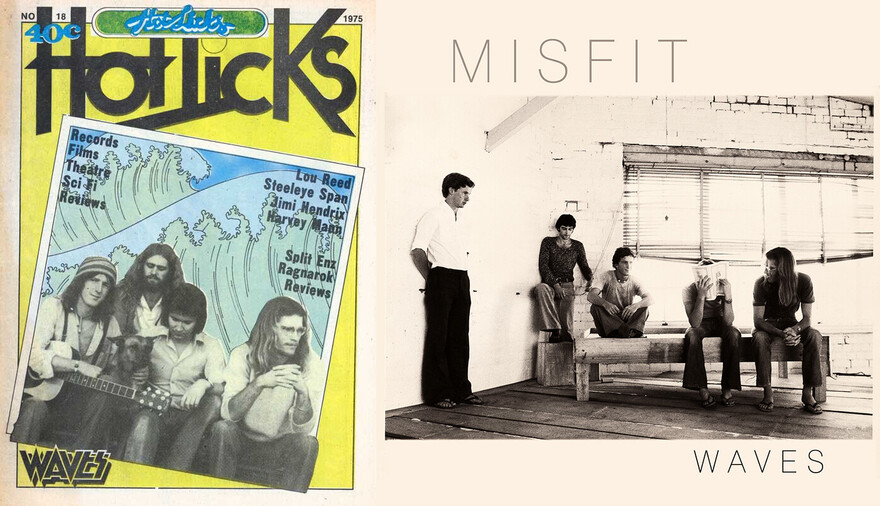
Auckland band Waves on the cover of Hot Licks (issue 18), 1975; and their second album Misfit, not released until 2013.
Unfortunately subsequent communications between Waves and the Little Feat leader faltered, for which Graeme blames WEA NZ’s managing director Tim Murdoch, who was in charge of the project. Returning from one of his periodic trips to Los Angeles, Murdoch informed the group that Lowell George professed to have no memory of them. Disappointed, Waves would record the follow-up to their self-titled debut, without George’s input. Not long after, they played a support slot for touring American singer Maria Muldaur. After the show, her guitarist Amos Garrett came up to the band and informed them that Lowell George had been asking after them and wanted him to pass on his regards.
But by then Waves had already decided to break up. Their second album would remain unreleased until 2013, decades after the group had last played together. Listening to it now, the Little Feat influence is apparent, even without Lowell George’s input. It is audible in the country funk of the track ‘Vegas’ and in guitarist Kevin Wildman’s slide playing throughout.
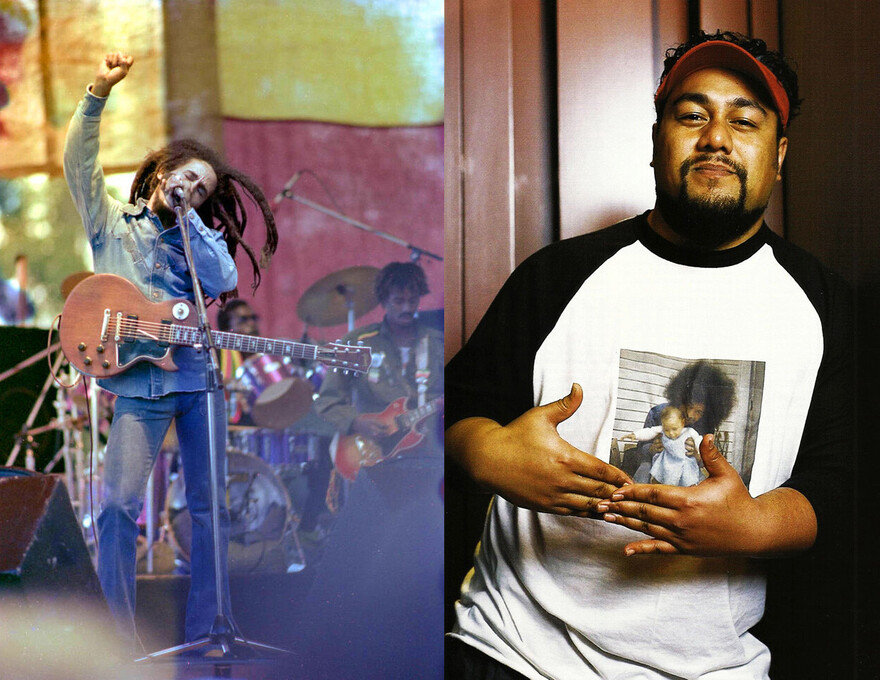
Bob Marley at Western Springs, 1979 - photo by Bruce Jarvis, Auckland Libraries Heritage Collections, 1704-1958D-10; Che Fu in 2001, with a T-shirt showing him as a baby with his father, Tigilau Ness - photo by Gary Brandon
Through the late 70s there were visits from some of the world’s biggest stars – Bob Dylan and David Bowie at the capacious Western Springs, James Brown at the intimate Shoreline Cabaret – but it would be hard to claim that these glimpses of gods changed the course of New Zealand music; that had already happened through their records. Dylan alone has seen over 150 cover versions by New Zealand artists.
By contrast, a single performance by Bob Marley and the Wailers in April 1979 reached down to the grassroots. A five-year old Che Ness, later to become Che Fu, saw the concert from side-stage with his parents. Future members of Herbs watched from the crowd. It was as though the seed for Aotearoa reggae was planted that day. (The footage above was shot by my brother Tim Bollinger on Super 8 film.)
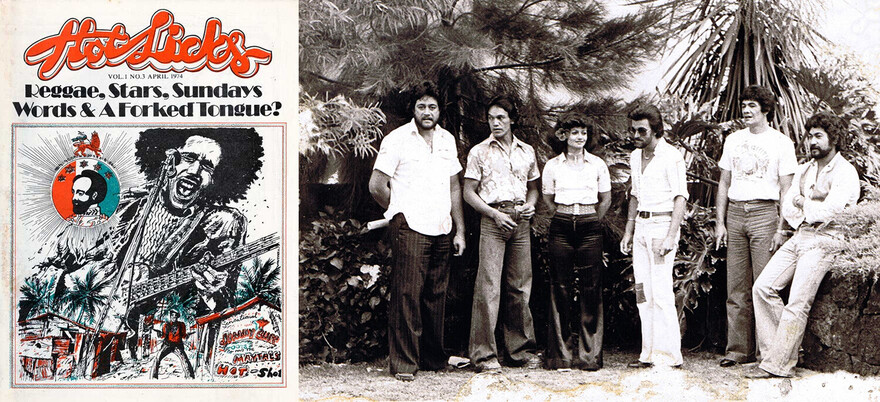
Bob Marley on the cover of Hot Licks, April 1974; early Auckland reggae band Papa, 1974 (L-R): Dilworth Karaka, Alec Hawke, Corina & Bruno Berens, Malcolm Edwards, Eddie Te Amo (Alec Hawke Collection)
Reggae groups had existed in New Zealand from the mid-1970s, among them Backyard, Unity (featuring Tigilau Ness, Che’s father), and Papa. But the immediate wake of Marley’s visit saw a proliferation of local reggae bands, starting with Herbs, closely followed by Survival, Dread Beat and Blood, Sticks and Shanty, The Twelve Tribes of Israel, Diatribe and Aotearoa. The wave would continue to the end of the decade and beyond, with Che Fu, Fat Freddy’s Drop, Katchafire, The Black Seeds, Salmonella Dub, and countless others. There would also be a surge of interest in Rastafarianism, the Jamaican-originated movement centred on the supposed divinity Ethiopian Emperor Haile Selassie and espoused by Bob Marley.
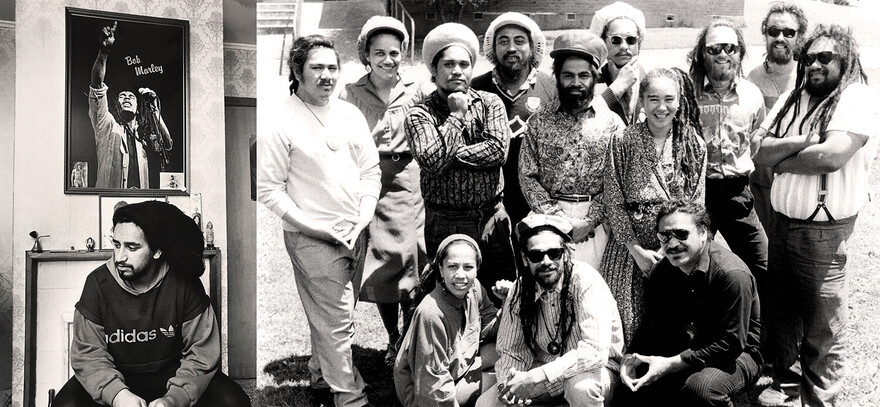
David Grace of Dread, Beat & Blood sitting beneath a poster of Bob Marley, 23 August 1986; The Twelve Tribes of Israel. Grace photo: Dominion Post Collection, Alexander Turnbull Library, Wellington, Ref: EP/1986/4098/31A-F; Twelve Tribes photo: Kane Massey
The crowd of roughly 22,000 that turned out to see Marley at Western Springs was notable for its diversity. Māori and Pākehā, patched gang members and stoned hippies, even a smattering of punks, stood shoulder to shoulder in the mellow afternoon. Though the NZ Herald warned that “Marley’s repertoire is strewn with songs demanding vengeance and war” and “there are songs exhorting people to all sorts of civil disorder in pursuit of their ‘rights’,” the vibe was relaxed, perhaps in part because of the amount of marijuana in the air. Joints were passed between subcultural groups that didn’t normally fraternise. As Gareth Shute would later note, the Herald reporter seemed almost disappointed that violence hadn’t broken out at the show.
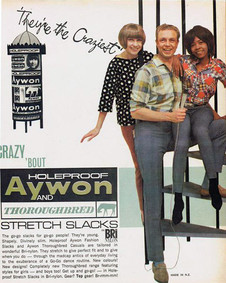
Dinah Lee, Max Cryer, and Millie Small advertise Aywon stretch slacks in Playdate magazine, 1966.
But if Bob Marley’s visit showed that reggae had reached critical mass in Aotearoa, it was an influence that had been building for more than a decade. Reggae’s precursor, ska, had been introduced to this country in the mid-60s by local singer Dinah Lee, whose ska simulacrum ‘Do The Bluebeat’ was a huge hit on both sides of the Tasman. (Bluebeat was sometimes used as an alternative name for ska.) It coincided almost exactly with ‘My Boy Lollipop’, Millie Small’s global hit, which brought the pixie-voiced Jamaican teenager here in 1966 to tour with fellow Jamaican Jackie Edwards and Lee herself. By the time Millie’s compatriot Desmond Dekker had his worldwide hit ‘Israelites’ (No.7 in New Zealand in 1969) the term reggae was beginning to supplant ska as a descriptor for this music with its distinctive offbeat-accentuating rhythm. Two years later, Paul Simon used top reggae musicians to give an authentic Jamaican bounce to his international hit ‘Mother and Child Reunion’.
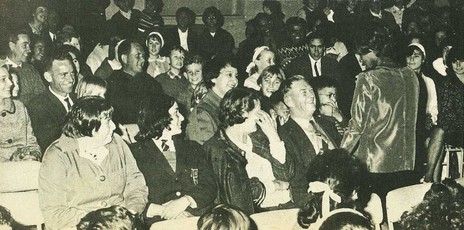
Millie Small looking for her boy lollipop in the audience, RSA Hall, Gisborne, 1967. - Gisborne Photo News, 6 September 1967
But such outbreaks of reggae were still regarded as exotic novelties rather than evidence of a major musical genre. It wasn’t until long-playing reggae albums began to appear here that listeners and musicians realised the music’s breadth and possibilities. At first, most of these came via the British-based Island (locally released by Festival), the same label that had spawned ‘My Boy Lollipop’ in the 60s. One of the earliest was the soundtrack to the film The Harder They Come, which introduced Jimmy Cliff and Toots and the Maytals to local ears in 1973, though the film itself would not be seen in New Zealand until the mid-70s at film society screenings.
The following year, Festival began to release Bob Marley’s Island albums, though in a somewhat jumbled order. First to appear, in mid-1974, was Natty Dread, his third album for Island, followed closely by Burnin’ (his second) and eventually his debut, Catch A Fire, nearly two years after its British release.
These albums were championed by Auckland rock magazine Hot Licks, and local rock groups would begin seasoning their sets with reggae. One such group was the Porirua-based Chaos, who by 1977 were interspersing Bob Marley songs with hard rock covers and the occasional original. Another was Auckland-based Bamboo, fronted by Malaysian immigrant Hamin Derus and featuring guitarists Louis Rawnsley and Wayne Baird, who brought a reggae-inspired groove to almost everything they played, from The Beatles to The Meters. Yet, as Rawnsley noted, Bamboo struggled to cultivate an audience for this music at the time. “The punk/new wave thing was everywhere and reggae wasn’t really hot until after the Bob Marley concert, and I think we’d split up by then.”
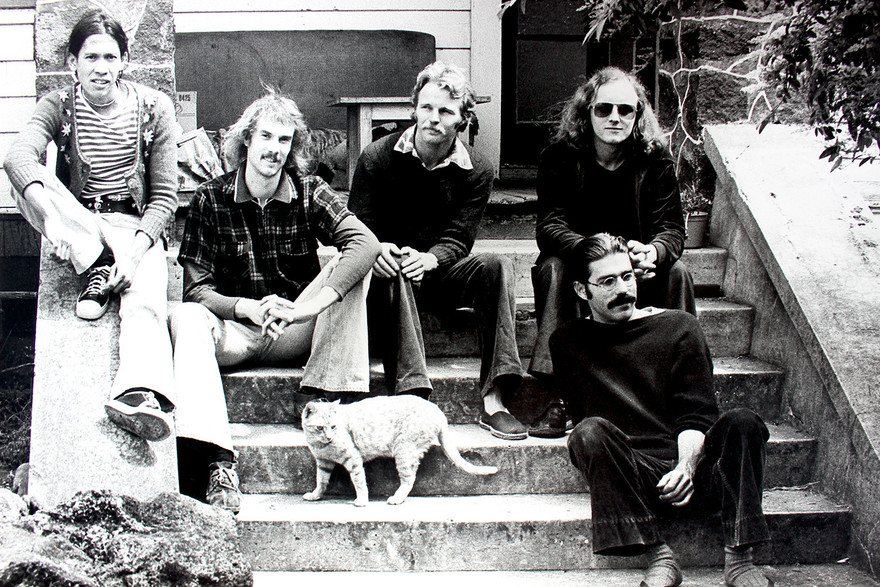
Bamboo on the steps of their practice house in Woodford Road, Mount Eden, 1977. Left to right: Hamin Derus, John Dodd, Wayne Baird, Bud Hooper (top), Louis Rawnsley (bottom).
If Bob Marley brought a message of resistance that especially resonated with Māori and Pasifika, his visit also marked the beginnings of reggae as Aotearoa’s party music of choice, which would eventually lead to the pejorative term “barbecue reggae”. But a visit that same year by Keskidee, a London-based theatre collective incorporating a trio of Rastafarian musicians, not only reinforced reggae’s political possibilities but may also have sown the idea of a music drawing not on reggae but on Aotearoa’s indigenous themes.
Keskidee Aroha was initiated by activist and Black Power member Denis O’Reilly, and saw the visiting actors and musicians performing at marae and cultural centres around the country for several weeks in 1979. A documentary on the tour, co-directed by Merata Mita and Martyn Sanderson, can be viewed below courtesy of NZ On Screen:
Keskidee’s musicians, the Ras Messengers, made a particular connection with some of their local audiences. Academic Robbie Shilliam suggests this may have been “due to the reverence for African ‘roots’ within Rastafari worldviews, a reverence that acted as the common thread effectively tying together Black, Māori and Pacific yearnings for self-determination.”
Shilliam gives as an example the impact Ras Messengers had on Whakahou, an Ōtara-based youth group “looking to find a way to navigate the urban corridor of newly developed Ōtara and, in this context, to assess what of their inherited cultures they wanted to hold onto and what they needed to change.”
He continues: “The use of ‘roots’ instruments and song forms heavily influenced by Rastafari, but practiced in a professional and public setting, inspired a resolve in Whakahou to henceforth publicly promote art forms indigenous to Aotearoa New Zealand and the South Pacific.”
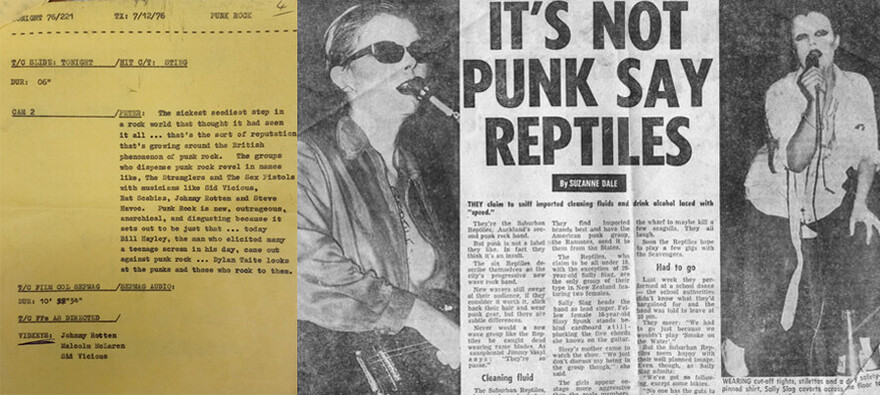
The intro script for the broadcast of Dylan Taite's September 1976 interview and live footage of the Sex Pistols (courtesy of Mark Hutchings, Ngā Taonga); The Suburban Reptiles tell big lies to the Sunday News, June 1977
When punk arrived circa 1977, New Zealanders had few more primary sources to draw on than at the start of rock’n’roll two decades earlier. Many locals cite the galvanising effect of local journalist Dylan Taite’s televised interview with the Sex Pistols, filmed outside Buckingham Palace in late 1976, but otherwise elements of the style were pieced together from reports in overseas magazines and the handful of records the aspirant punks could get their hands on.
The early Kiwi punks thrived on the realisation they could shock a conservative society with little more than three chords and an attitude. But this was done with a strong streak of humour (The Normals, The Dentists), and a closer connection to 60s pop than was fashionable to acknowledge (The Enemy, The Spelling Mistakes).
By the time New Zealand finally got a visit from first-generation English punk band The Clash in 1982 most of the country’s original punk groups had already broken up. Meanwhile, The Clash had matured into cosmopolitan rockers, and a succession of visiting post-punk acts had variously expanded the musical landscape.
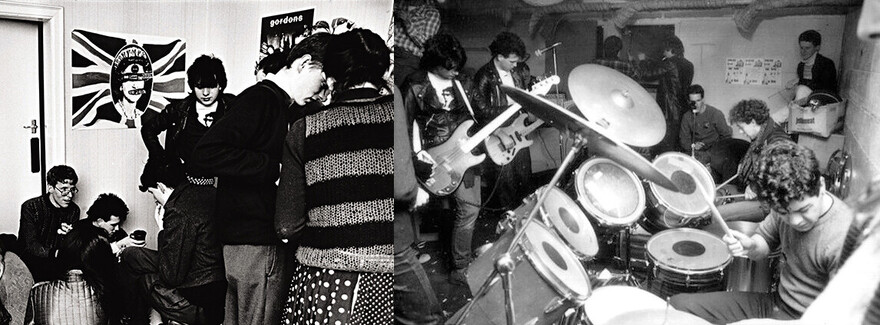
Post-punk summit: The Cure and Wellington musicians party after the August 1981 concert. From left, Domestic Blitz singer Dave Maclennan (with glasses at back), Sherryn Congdon (back to camera; singer with Domestic Blitz), Robert Smith (crouching with cup), Nigel Elder (Neoteric Tribesmen guitarist, sitting, back to camera), Simon Gallup (The Cure bassist, standing in corner), Stephen Norris and Kate Walker (Naked Spots Dance). At right, The Cure jamming with Wellington musicians in the basement of Mt Victoria's Clyde Quay School in August 1981. From left: Simon Gallup, Robert Smith, and drummer Lol Tolhurst. - Photos by Charles Jameson, Dave Maclennan Collection
Between 1979 and 1982, groups as diverse as Talking Heads, XTC, The Police, Echo and the Bunnymen, The Cure, and The Fall all toured. One particular occasion is often cited, when The Cure spent a night partying and jamming with local bands in the basement of a Wellington primary school. Whether or not any priceless musical secrets were passed on that night, the local bands present – Naked Spots Dance, Beat Rhythm Fashion, Neoteric Tribesmen and Domestic Blitz – would all pursue, in their different ways, the ideal of a music that is original, eclectic, and reflects the particular existential issues involved with living in a South Pacific colony. Perhaps the most valuable lesson of post-punk was that it could be cool to simply be yourself.
A postscript to the post-punk invasion is the visit in May 1983 of The Birthday Party, then in the throes of a drug-fuelled disintegration. Nick Cave’s fearless brand of physical theatre was on full display for short sets at Auckland’s Mainstreet, Wellington’s Victoria University, and Sandridge and Gladstone in Christchurch. But the group’s musical lynchpin Mick Harvey had already left, so New Zealand drummer Des Hefner (Scavengers/ Marching Girls) was drafted in with a single rehearsal, which only added to the chaos. The group played its final gig in Australia a month later.
The first signs of hip-hop’s influence in Aotearoa could be seen in streets and malls in the early 80s, where mostly Māori and Pasifika kids would practise the breakdance moves they had picked up from glimpses of this African-American movement on television and in movies like Flashdance and Beat Street. A few of those kids appeared in the video for Pātea Māori Club’s 1984 hit ‘Poi E’, Dalvanius Prime’s visionary fusion of funk and kapa haka.
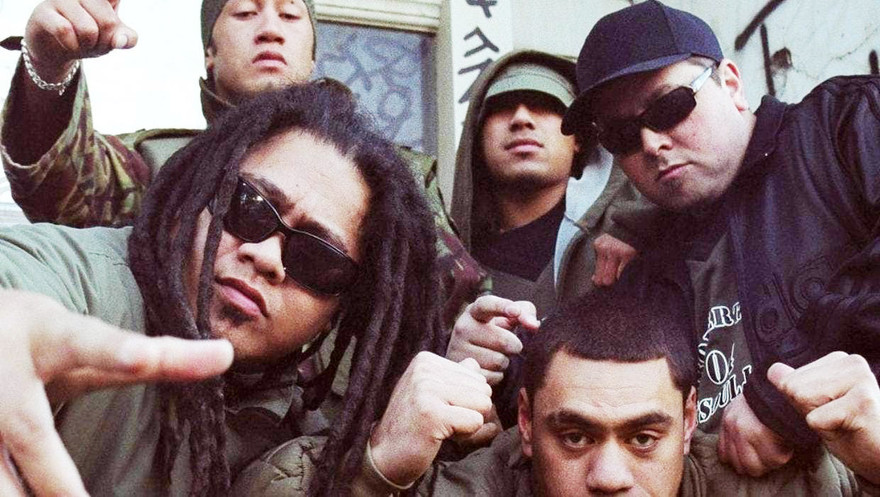
Footsouljahs, clockwise from top left: Pomby'ia (Ali Cabano), Shogun, DJ Raw (Ian Seumanu), Flowz (Fiso Siloata) and K.O.S 163 (Kosmo Faalogo).
Wellington-born Samoan Kosmo Faalogo had spent time with family in south Los Angeles and, along with the dance moves, had picked up on the graffiti art and MCing styles that were a part of this urban street-art culture. Returning to Wellington, he shared his discoveries with likeminded locals such as Kas Futialo and Bill Urale (who would reinvent themselves as MCs Feelstyle and King Kapisi, respectively), and Dean Hapeta and Darryl Thomson (who would form Upper Hutt Posse), while Faalogo started his own hip-hop group, Noise’n’Effect.
Another direct transmitter was Kenny McFadden, an African-American basketball player who arrived in the country in 1982 to play for Wellington’s Exchequer Saints. Looking for the local funk scene, he befriended Wellington DJ Tony Pene, alias Tee Pee, then spinning discs at Dr John’s nightclub. As Martyn Pepperell recounts in his AudioCulture profile of Tee Pee, McFadden would slip Pene cassettes of US radio shows sent to him by his brother, a New York City DJ, and coach him in the techniques of beatmatching, scratching and rapping.
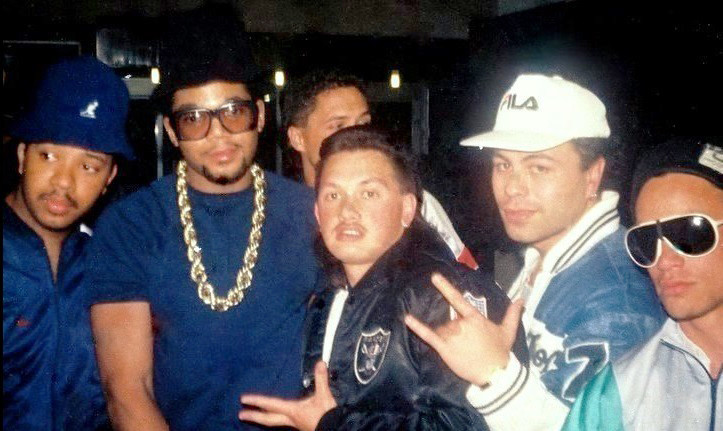
DJ Tee Pee (in white cap) and Run DMC
Some of McFadden’s tapes would find their way onto the local airwaves, via Radio Active’s Uncut Funk Show, which Tee Pee co-hosted with cultural polymath Mark Cubey. These sounds then travelled from the airwaves back to the streets of Te Aro, the Hutt Valley, and beyond, where they could be heard booming out of ghetto blasters while young breakdancers showed off their skills.
Upper Hutt Posse released the first local hip-hop record in 1987. By the time Run DMC played Auckland’s Powerstation in November 1988 – the first major international hip-hop act to tour New Zealand – Aotearoa hip-hop had taken root. Local DJs and rappers, including Tee Pee and Upper Hutt Posse, came to pay their respects to the New York rappers (and study their stagecraft), while young Manurewa group Semi MCs won a competition to open the show.
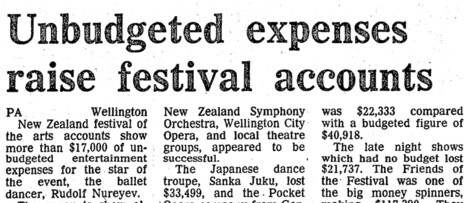
Rudolf Nureyev blows the budget for the 1988 New Zealand International Festival of the Arts. “A French conductor, Pierre Boulez, and the Ensemble Intercontemorain, lost $71,954.” Chairman of the Festival Trust, Sir David Beattie, said “Philosophically, some events must be carried in any cultural festival.” – The Press, 11 August 1988.
The French composer Pierre Boulez was one of the towering figures of 20th modernism, as well as a prominent conductor of the world’s top orchestras in Paris, New York and London. New Zealand composer Jenny McLeod had studied with him in Switzerland in the 1960s. Visiting Wellington in 1988 he took a workshop where he conducted an open rehearsal of Auckland composer Eve de Castro-Robinson’s Interpolations. In addition to the revelation of “his meticulous work on my own score,” de Castro-Robinson would remember incidental comments: his advice “to keep our ‘enemies’ close” – meaning the large institutions and funding bodies – or his remarking on how Dr Henry Pollen’s house on the corner of Willis and Boulcott St “looked like the house out of Hitchcock’s Psycho”.
Through the 80s and 90s a succession of international record producers and musicians passed through, looking for local talent they could mould. Kim Fowley – whose whirlwind visit is hilariously recounted by Murray Cammick on AudioCulture – heard blues-rockers Street Talk at the Windsor Castle and began writing songs with them that same night for an album he would go on to produce. Among the songs he co-wrote with them is ‘A Record With Pictures From New Zealand’, from which author John Dix borrowed the phrase “stranded in paradise” for his trailblazing history of New Zealand rock.
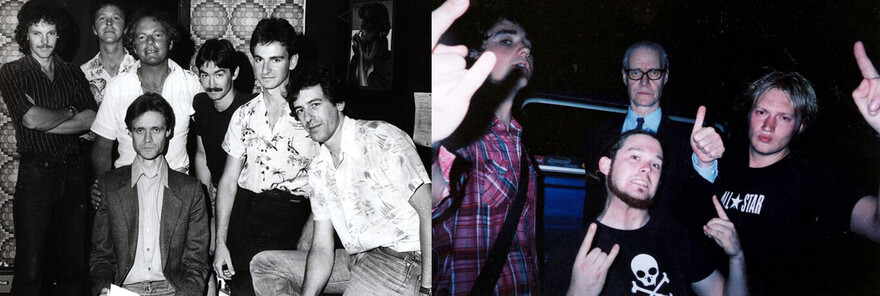
Street Talk at Mandrill Studios, Auckland, with Kim Fowley (front, centre) and WEA Record's Tim Murdoch (back, third from left); photo by Murray Cammick. Kim Fowley with Rubicon at Hollywood's Viper Room, 2003. - Murray Cammick Collection
Fowley also hooked up with The Crocodiles and spent time editing and shaping material for their debut album, though only one of his co-writes made it onto the eventual record – the slightly ill-fitting S&M song ‘Ribbons of Steel’ – and he would hand over the production to Glyn Tucker Jr before recording began.
It was WEA’s Tim Murdoch who match-made Eagles’ guitarist Joe Walsh with Herbs, whose 1989 Walsh-produced Homegrown saw the group’s characteristic Pacific reggae injected with sonic steroids. Today the reverb-laden drums and gnarly guitar solos make it their most dated-sounding disc.
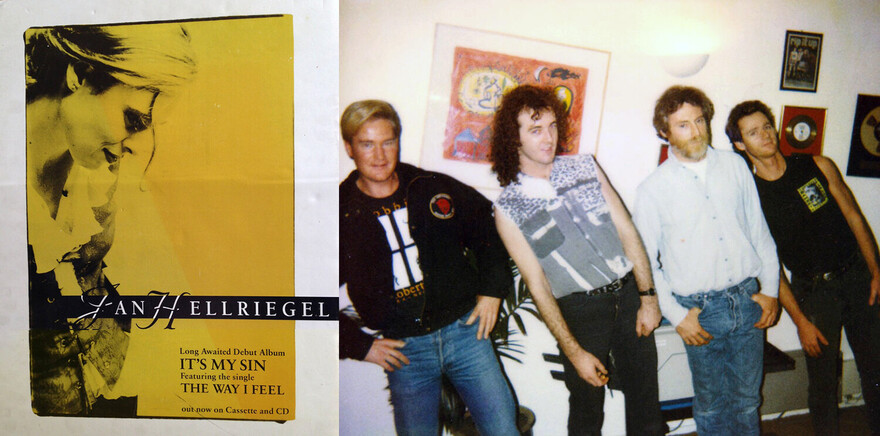
Jan Hellriegel - It's My Sin poster. Members of Jan's band at Airforce Studio, Auckland, 1991: Mark Bell, Tony Lumsden, producer JD Souther, Mark Petersen
Murdoch also paired former Cassandra’s Ears singer Jan Hellriegel with Texan singer-songwriter J D Souther, co-author of Eagles hits ‘New Kid In Town’ and ‘Best Of My Love’, to co-write and produce tracks for her debut album It’s My Sin. Although, as Hellriegel would later reflect, two trips to New Zealand, several weeks in the studio, a dozen-odd reels of recording tape and many bottles of whiskey would yield only a couple of tracks. Major label budgets were like that last century, though the expenditure was usually recouped from the artist’s earnings, sometimes even leaving the artist in debt.
Some visitors stayed longer. Jaz Coleman, who made his name with British post-punks Killing Joke, emigrated here in 1993 and virtually took up residence at Auckland’s York Street Studios where he produced Shihad’s Churn album and Emma Paki’s ‘System Virtue’ single, both of which benefited in different ways from his sonic sensibilities. While Emma Paki ultimately retreated from the music industry, Shihad – in spite of a rough patch during which Coleman sued them – would continue to reflect Coleman’s sonic influence for the rest of their career, and even reunited with him in 2014 for another album, FVEY.
Another who came and stayed for a number of years was Michigan-born DJ and producer Matthew Chicoine, who performs and records as Recloose. Chicoine would play a pivotal role in the Wellington scene that spawned Fat Freddy’s Drop and Trinity Roots, among others.
Originally a jazz saxophonist, he had become interested in the art of deejaying – mixing, cutting and dicing vinyl – during his time at college in Ann Arbor, Michigan, and had got a tape of his work to Detroit-based techno pioneer Carl Craig who was suitably impressed and took him under his wing.
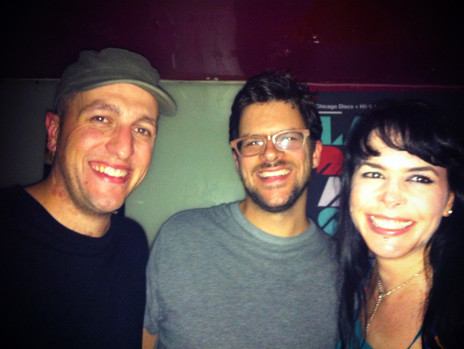
Frank Booker, Recloose and Philippa McIntyre in 2012 promoting Bill Brewster together at Ink Bar, Auckland.
When Chicoine relocated to New Zealand in 2001 he brought his skills directly from the Detroit nightclubs to the Cuba Street café-turned-club The Matterhorn where he performed every Friday night for four years. The Matterhorn became a site for jamming and musical interchange, and Chicoine would collaborate with most of Wellington’s jazz-funk fraternity including Jonathan Crayford, Myele Manzanza, Warren Maxwell, Toby Laing, singers Hollie Smith and Lisa Tomlins and Fat Freddy’s Dallas Tamaira (aka Joe Dukie) with whom he recorded the dance floor hit ‘Dust’.
It was also through his connections that Fat Freddy’s Drop got their first releases in Europe. Chicoine went on to form the Recloose Live Band, which included many of the musicians he had met at the Matterhorn. Though he would return to the States in 2014, there would be a little bit of Detroit on Aotearoa’s dancefloors ever after.
Chicoine wasn’t the only Detroiter to turn up around the start of the third millennium. When Jack and Meg White received a call at their Detroit home from a man named John Baker who claimed to be phoning from New Zealand, they initially thought it was a prank call.
Baker had been working for a number of years as an independent promoter, bringing to New Zealand what he called “low-rent rock’n’roll bands from around the planet”. At a warehouse party in Melbourne in 1999 he had heard a cassette playing on a ghetto blaster that caught his ear. It was raw and basic, just drums, guitar and a quavering yet powerful voice. Eventually he found someone who could tell him what this music was: a little-known indie duo from Detroit called The White Stripes.
He tracked them down and made the call. “Baker explained that he would like to bring us to New Zealand and I had to go check the map again to find out where that was,” Jack White told me. At that stage, the pair had hardly played outside Detroit, and never left the continental US.
But Baker persisted and so in November 2000 Jack and Meg White flew into Auckland, where they were met by Baker and Amber Easby, who had loaned him money to pay for the flights and would be working the door to ensure she was repaid. On that first tour the White Stripes performed at modest venues such as Wellington’s original Willis St Bar Bodega and Pizza Pizza on Auckland’s Lorne Street.
Once they got back to the US the duo's career took off, and on the eve of their first major North American tour it was Baker who received a call. Would he be their tour manager?
Amber Easby explains: “Never having had a tour manager before, John was the closest thing that they had ever experienced in that capacity, so it’s funny, but in their minds the logical thing to do was to call the guy from New Zealand.”
As the White Stripes enterprise grew bigger from month to month, Amber would be called in as well to manage their merchandising. Both Baker and Easby would end up working for the group and travelling the world with them for the next few years. By the time they got to Madison Square Garden, Easby was in charge of two trucks, laden with merch.
Other than providing employment for some New Zealand music industry professionals, how did the White Stripes influence New Zealand music? At the time of that propitious first visit, New Zealand was already germinating its own raw, hardworking rock’n’roll bands such as The D4 and The Datsuns, while bare bones guitar-drums duo The Hasselhoff Experiment – perhaps the closest thing we had to a White Stripes-style garage band – had already been and gone. Yet there’s no doubt that the international phenomenon of The White Stripes with their Kiwi crew helped open doors that within the next few years would see The Datsuns on the cover of NME and The D4 touring the US, Japan, and Europe.
As the 21st century unfolds, access to musical knowledge has transformed dramatically. Recordings by artists that were once almost impossible to obtain are now just a click away. Online tutorials allow viewers to watch musicians – sometimes the original artists – showing in close-up exactly how the parts on those recordings were played. As a consequence, there are more, and younger, skilled musicians than ever before.
But is it possible that the isolation that was long seen as an impediment, that made us so hungry for information and contact with the rest of the musical world, could also be a secret strength? We have an indigenous culture and language here, with instruments and traditions that are unique to us and fascinating to outsiders. Recent decades have seen the rebirth of taonga pūoro and their use in all kinds of music, from metal to electronica. New waiata are being composed in all genres, and none of them could have come from anywhere but here.
Isolation has also helped us develop our DIY ethos. When local musicians don’t know the proper way to do things, or can’t afford to, the creative ones simply make it up. Take the lo-tech recordings of Chris Knox, which were intrinsic to the aesthetic of the Flying Nun label, for which Bruce Russell has coined the term “mis-competence” – “the ability to do something both deliberately wrongly, and well.”
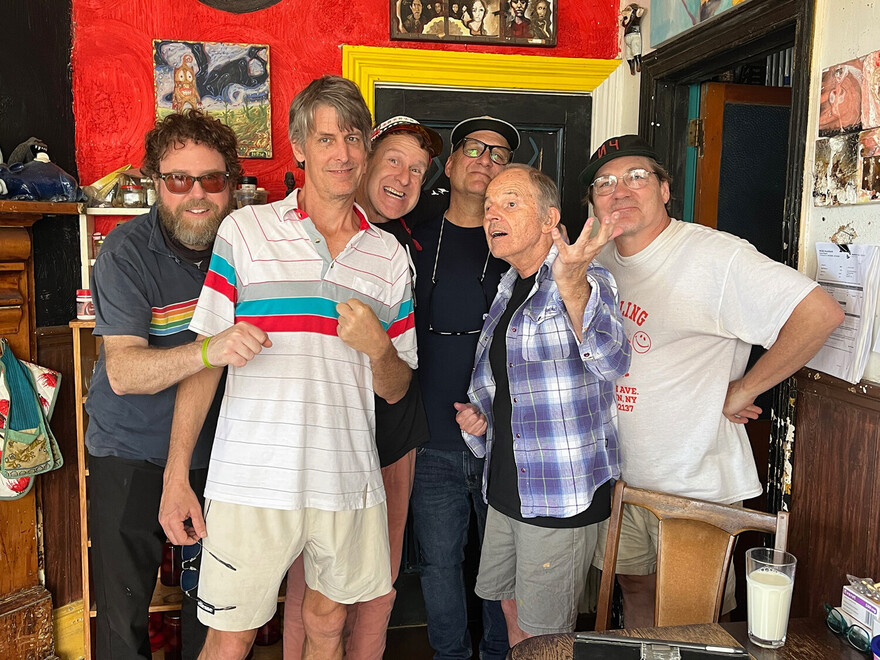
Pavement visit Chris Knox, Grey Lynn, February 2023. - photo by Andrew Moore
Flying Nun founder Roger Shepherd remembers receiving orders for early Flying Nun releases from customers in such far-flung places as Stockton, California, and wondering who these distant fans of obscure New Zealand music might be. Only later would he discover that those Stockton orders were from members of the fledgling Pavement, who would go on to be one of the signature indie bands of the 90s. Last time Pavement toured New Zealand, they made sure to visit Knox whose “mis-competence” had been such an inspiration to them when they were starting out.
In the interests of creativity, perhaps a little isolation is worth maintaining. Then, as time goes on, we might see more visitors paying homage to New Zealand musicians who have influenced them.
--