No culture is an island, not even a culture situated in a group of actual islands 1600 kilometres away from its nearest neighbour. It is human nature to interact, cooperate and mimic, and no more so than in music. Ever since the first gramophones, New Zealanders have been able to hear music from other times and places, enabling local musicians to learn to play in popular and exotic styles that quickly spread through society. Radio, television, and later the internet, sped up the process even further.
But touring acts have remained a special source of inspiration. Ask a musician and they will tell you that there is nothing quite like seeing another musician up close – observing their technique, their body language, their habits, how they move through the world. There are things that can be learned from physical proximity, almost by osmosis, that one could never acquire however much one studies the scores or recordings.
Influence is a difficult if not impossible thing to measure. But though thousands of international artists have toured here over the years, some, through their sheer presence, seem to have left a deeper mark than others.
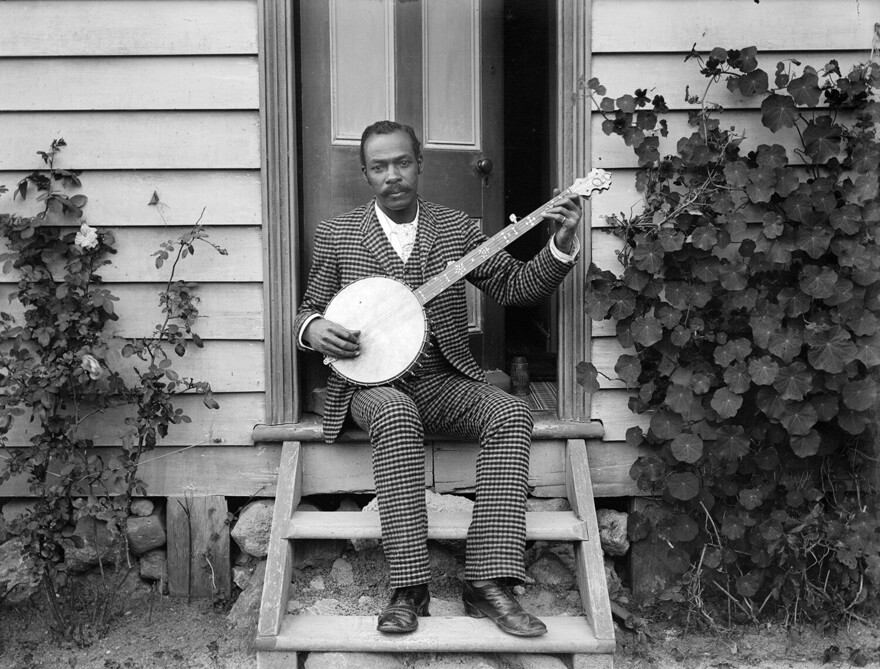
A banjo player, thought to be Hosea Easton of the Hicks-Sawyer minstrels, Napier, 1888. Photograph by William Williams. - Alexander Turnbull Library Wellington. Ref: 1/1-025620-G
A dapper African-American man in a stylish houndstooth suit sits on the doorstep of a Napier weatherboard cottage holding a banjo. Evidence suggests the man is Hosea Easton, musician and comedian, who first visited New Zealand in 1877 as a featured member of The Georgia Minstrels, one of the first successful black minstrel troupes.
Minstrel shows had started in the 1840s: white performers wearing blackface, performing songs, dances and comic skits identified with black “plantation culture”. But by the mid-1860s black minstrel troupes were springing up, shifting the tone from parody to portrayals of black authenticity.
An early review, from the Chicago Tribune, notes the Georgia Minstrels’ show to be “devoid of the forced effect apparent in too many of the burnt cork companies. The troupe is composed entirely of real coloured men, all freed from the bonds of slavery during the recent war. The plantation scenes, songs, and dances are true to the life …”
New Zealand reviews from 1877 indicate that Hosea Easton was clearly one of the Minstrels’ stars, praised for his “manipulation of the banjo, or American harp”.
It seems Easton liked New Zealand too, and there are suggestions he developed some close relationships while here. In June 1882 Dunedin's Evening Star reported that “Hosea Easton was brought up before Mr Carew, RM, charged on warrant with having deserted his wife at Christchurch. Accused said the charge in the information was false – he ‘knew the party’ but was not married to her.”
The charge was apparently dropped after Easton produced a telegram from the “lady complainant” stating that she would withdraw the proceedings if he paid her £10, which he agreed to.
For the next few years he would move back and forth between New Zealand and Australia, with side trips as far as China, performing with various minstrel line-ups. The photograph of Easton was taken in Napier during one of his stays, probably in the 1880s, by Edgar Richard Williams, a New Zealander whose enthusiasms included photography and banjos.
Though there is just the one photo of Hosea Easton among the Williams collection (held in the Turnbull Library), there are others from the same period that show Williams, his wife Lydia and several of their friends, all playing banjos. We see them in their garden and at picnics. An interior shot of the Williams’s house shows a banjo proudly displayed on the wall. There is a portrait of Lydia with her banjo, taken in the same pose on the same doorstep as the one of Easton.
Evidently these folks were banjo crazy. What they played and how much they learned directly from their African-American visitor one can only guess.
Did the Williams family master Easton’s classic three-finger style of banjo playing? No details of their repertoire or technique have ever come to light. But the number of banjos of late 19th century vintage still in circulation in New Zealand are testimony to the banjo boom that took place in this period.
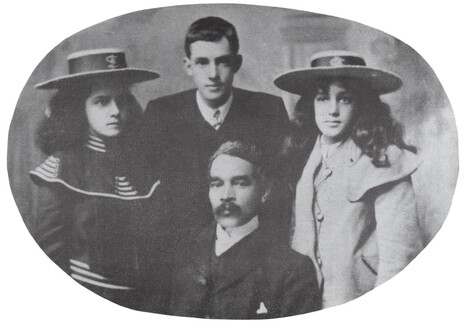
R B Williams, of the Fisk Jubilee Singers from Nashville, settled in Wellington to work as a lawyer, and became the mayor of the Onslow borough. His children are (L-R): Nell, R B Williams, Jnr, and Vera Jane. - Jane Paul Collection
Around the time of Hosea Easton’s visits, New Zealand also hosted a tour by the Fisk Jubilee Singers, who brought “negro spirituals” to this country for the first time. Originally consisting of eight singers and a pianist, they were all students at Fisk University, Nashville, Tennessee, one of the United States’s leading black universities, and had set off in 1871 on a series of international tours to raise money for the university. They arrived in New Zealand for the first time in 1886. The tour lasted seven months.
Looking back in 1942, The Dominion noted that “the Singers were the first to introduce to New Zealand that type of evangelical song known as the negro spiritual, and after they departed it was common to hear such numbers as ‘Steal Away’, ‘On That Great Morning’ and ‘Swing Low, Sweet Chariot’ sung in some of the nonconformist churches.
“Such songs have never been better sung. The modern manner of vocalising them academically has robbed them of their native rhythm and sense. It was a revelation to hear the Singers in their slave hymns, in voice expression, and sometimes in action, they simply lived the lyrics.”
A few of the Fisks evidently liked New Zealand so much they chose to make it their home. During that first tour, Moses Hamilton Hodges and his wife Jean (or Jennie), a fellow singer, decided to leave the troupe, settling first in Auckland and then in Wellington. They set up a singing school and both continued to perform, appearing with choral societies around New Zealand.
Likewise, Fisks member Robertson Bradford Williams, who met and married Katherine Josephine Burke while in Melbourne, and settled with his wife in Wellington where he became the choirmaster of the Wesleyan Church in Taranaki Street and studied law, eventually practising from an office in Lambton Quay.
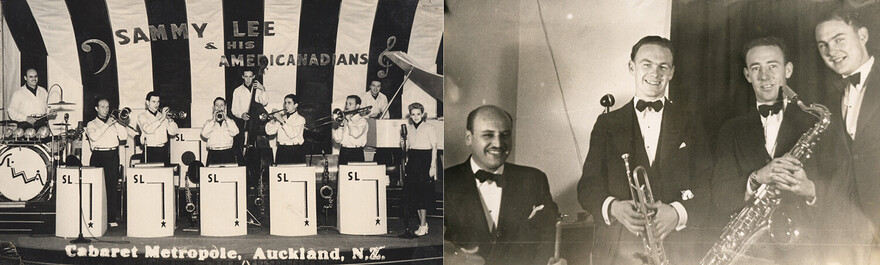
Sammy Lee and His Americanadians during their New Zealand tour in the late 1930s. At right, jamming with Sammy Lee (on drums) are Auckland musicians Jim Warren, Roy Lester and John MacKenzie. - Jim Warren Collection
The swing era was at its peak when World War Two began in 1939. In New Zealand this popular jazz style was discovered largely through records, though even these were scarce, and both fans and musicians depended on radio programmes like Arthur Pearce’s Rhythm On Record to hear the freshest and most innovative sounds.
A visiting band such as Sammy Lee and his Americanadians, a swing band of American, Canadian and British musicians who held residencies at Wellington’s Majestic Cabaret and Auckland’s Metropole between late 1938 and early 1940, showed locals things about volume and timbre that could not have been learned from records.
“They were a big influence,” local trumpeter Jim Warren told Chris Bourke. “We’d never heard anything like it. The brass could blow. They could just play so loud with a marvellous, lovely shimmering sound.”
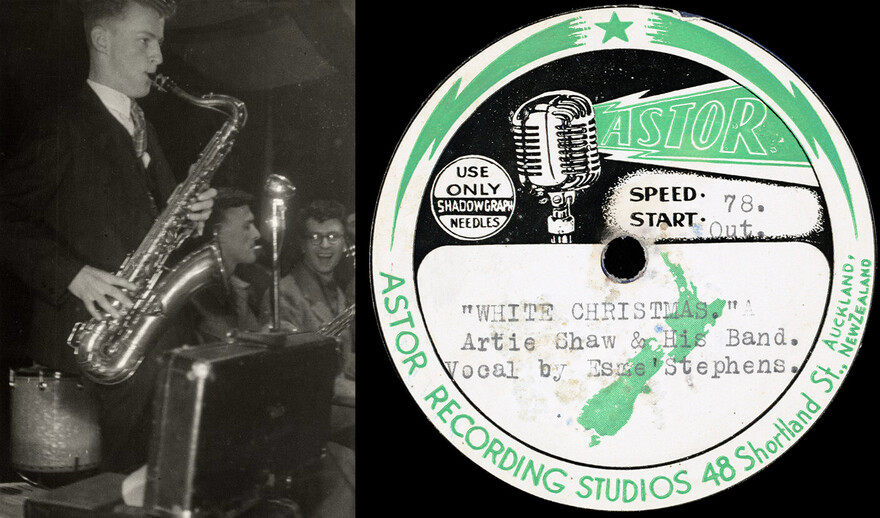
A young Don Richardson on saxophone, early 1940s; Esme Stevens singing ‘White Christmas’ with the Artie Shaw US Navy Band, recorded onto acetate in Auckland. - Don Richardson Collection; Dennis Huggard Collection
Then in 1943 the US Navy sent Artie Shaw, clarinet-playing leader of one of the most popular North American swing bands, on a morale-boosting tour of US troops in the South Pacific. During the days the band would play for US and New Zealand servicemen at military bases and hospitals; in the evenings they would perform concerts and dances at civilian venues, including the Civic Wintergarden and Westhaven Cabaret in Auckland, and the Majestic Cabaret in Wellington. Importantly, these evening concerts and dances involved service people and their guests, which included a number of local musicians.
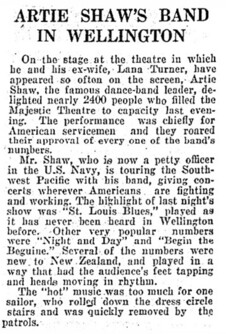
Artie Shaw's US Navy Band reviewed in the Dominion, 16 August 1943
When musicians couldn’t legitimately get into the shows, they would catch what they could through open windows and doorways. Saxophonist Don Richardson told Bourke how he met a GI outside who told him “Give me another 10 minutes – if I can’t find some nice young lady who wants to come back with me, you’re it!”
Reminiscing some 50 years later to New Zealander Bruce Talbot, then working for the Smithsonian Jazz Oral History Programme in Washington, Shaw recalled a “very strange incident” that happened in a New Zealand hospital. “We played a concert, and it was greeted with total silence. We were so used to audiences whistling and cheering and hollering, that we took it for granted. We’d finish a piece and [Shaw claps gently] polite applause. At the end of the concert I went to the commanding general in charge of the hospital and said, ‘Sir, I’m sorry. It was a real flop.’ He looked at me in astonishment. He said, ‘The men were mad about it.’ I said, ‘What do you mean?’ He said, ‘Didn’t you hear how they listened? They didn’t make a sound.’ I said, ‘Oh, I see. I’m used to the American audience.’ He said, ‘That’s right. Exactly.’ He said, ‘You people are much more demonstrative.’”
To which Talbot suggested: “I think also it might have been an element of the fact that it was the first time I think any American band had ever come to either Australia or New Zealand … I think people were probably overwhelmed, you know?”
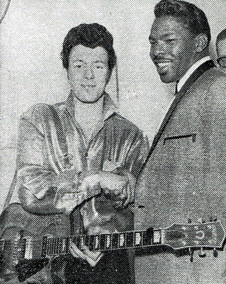
Johnny Devlin with New Orleans R&B singer Lloyd Price who wrote and originally recorded Devlin's big hit 'Lawdy Miss Clawdy', Australia, late 1959. - Cinema, Stage & TV, November 1959
Like jazz and swing, rock’n’roll initially arrived by record. When local country singer and talent show presenter Johnny Cooper made the first local recording of a rock’n’roll song in 1955, a cover of Bill Haley’s ‘Rock Around the Clock’, he had never seen an actual rock’n’roll show. No wonder his interpretation had more of the flavour of a tea dance. When the local success of his recording required him to perform rock’n’roll live, spurred in part by the release of the film Blackboard Jungle with its cameo from Haley and his Comets, it was jazz musicians such as Ken Avery and Jim Carter who accompanied him.
By the time Johnny Devlin emerged in 1958 with a more convincing take on rock’n’roll, Elvis Presley’s Jailhouse Rock was screening in local cinemas and locals had developed an idea of what rock’n’roll was supposed to look and feel like. Dressed in a sparkling jacket with leopard-skin lapels, and a satin shirt, Devlin sweated and shook his hips, and audiences around the country responded with appropriate abandon, mobbing the young rocker and tearing his clothes.
Even so, Devlin’s rock’n’roll act was just one segment of a package he would describe as “a family type show. We had comedians, a female impersonator, a guy who played the banjo. It was a family-type show designed for all ages.”
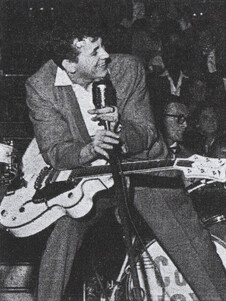
Gene Vincent in Auckland, 1959. - NZ Music & Television, August 1959
New Zealand didn’t get what has been called “New Zealand’s first rock concert” until 1959 with a package headlined by Johnny Cash that also featured Gene Vincent, Bobby Day (‘Rockin’ Robin’) and early Australian rock’n’roll star Col Joye. As with swing, it was the power and force with which the music was played that made an impression.
Auckland Star reviewer Bruce Kaplan was impressed by the “pounding tempo that prevailed throughout most of the show.” But if Vincent – who performed with one leg in plaster, the result of a motorcycle accident – was a convincing picture of a fast-living, risk-taking rocker, Cash, with “no jiggles, no jumps”, was “undoubtedly the star of the show”. His recent Sun label hits ‘I Walk The Line’, ‘Folsom Prison Blues’ and ‘I Guess Things Happen That Way’ spoke directly to the crowd, while his first-hand impersonation of Elvis – with whom he had toured and, until recently, shared a label and producer – had the house in raptures.
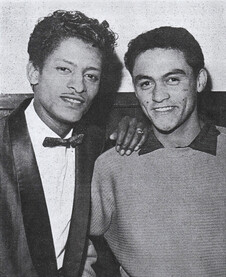
US musician Bobby Day with Whakatāne singer Eddie Howell, Auckland, 1959. - NZ Music & Television, August 1959
Half a century later, Aussie opener Col Joye, in conversation with Marty Duda for RNZ, identified that tour as a watershed. “I think suddenly a lot of Kiwis said, hey we can do that. Being a little isolated as you were in New Zealand … a lot of people [would] come up with their own styles of things. People like Ricky May, who was a great, great talent, Rim D Paul – what a good singer. Johnny Devlin came out of there, Dinah Lee came out of there ...”
The month after the Cash tour, Johnny Devlin would head off to Australia for a tour with The Everly Brothers, and would remain living there for the rest of his career.
The following year, 1960, saw a 10-date tour by Tom Lehrer. The New Zealand entertainment columnist John Berry, in his memoir, Seeing Stars: A Study of Show Folk in New Zealand, recalls hosting the US pianist and singing satirist on his first night in the country. Lehrer showed a keen interest in New Zealand’s political scene and was looking for targets. Berry had one ready-made. The All Blacks were about to embark on a controversial tour of South Africa and, at the insistence of the South African Rugby Union, would not be bringing any Māori players. Lehrer, who according to Berry had never heard of rugby, noted the fact that a nation so proud of its “race relations” was evidently prepared to place an even higher importance on its national sport. Not only did he note this fact at his concerts (“I wish to pay tribute to the New Zealand Rugby Football Union – for not allowing a little thing like human dignity to interfere with the great principles of the game” he told an Auckland audience), but he apparently wrote a series of verses addressed to the Prime Minister Walter Nash, chiding him for not intervening. Berry published the lyrics in the Auckland Star, adding weight to the local protests.
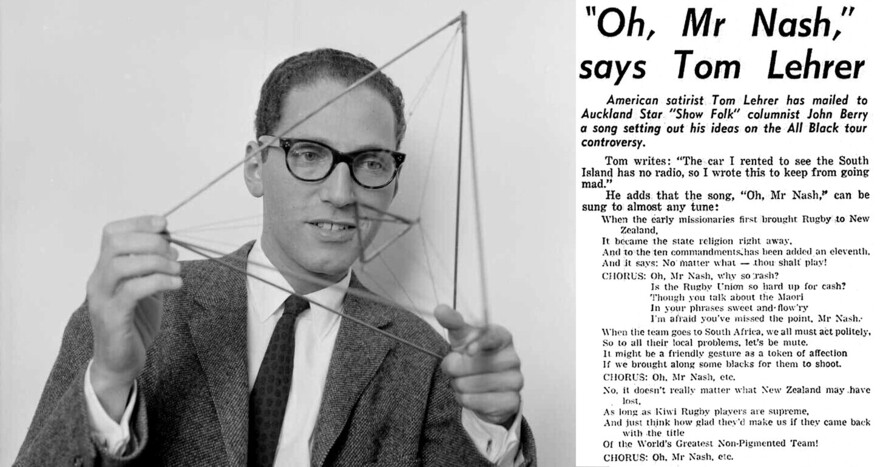
Tom Lehrer in Wellington, 4 April 1960; and the lyrics to his 'Oh, Mr Nash', as printed in the Auckland Star. - Evening Post Collection, Alexander Turnbull Library, Wellington, Ref: EP/1960/1236-F
Lehrer never recorded ‘Oh, Mr Nash’ nor left any notated music for the song, but in 2023 Robbie Ellis, a New Zealand piano comedian living in the United States, set the lyric to music (appropriately based on the old New Zealand rugby song ‘On the Ball’, with additional touches of Alfred Hill’s ‘Waiata Poi’ for a compilation album, The FuMP Desecrates Tom Lehrer.
Another performer whose 1960 visit may have had as much political as musical impact was the singer Paul Robeson. The African-American bass-baritone, actor and activist, had been persecuted during the McCarthy era on account of his vocal support of communism. During his three-week, sold-out concert tour, he criticised the United States for its support of the Spanish dictator Franco and the Taiwanese leader Chiang Kai-shek, spoke openly about what he saw as the mistreatment of Māori, and gave a free performance in Wellington for the waterside workers who made him an honorary member of their union. “He is a man who quite openly wears a chip on his shoulder,” declared the New Zealand Herald.
But the writer from the conservative Herald wasn’t the only person who Robeson offended. In Wellington, playwright Bruce Mason brought him to a party at the Oriental Bay home of the bohemian café owner Harry Seresin, who would later recall the singer demanding from the pioneering composer Douglas Lilburn “of all people” an answer to “why there wasn’t any real music written in New Zealand.” Lilburn was reportedly apoplectic. Margaret Nielsen, the Wellington pianist who premiered many of Lilburn’s pieces, was present, and recalled to Chris Bourke in 2014 that there was a stand-off. The moment was terrifying. “They almost came to blows.” She left quickly.
US harmonica virtuoso Larry Adler was similarly interested in race relations during his 1961 tour, although not as combative. He took time out to visit the East Cape in the company of Māori composer Wiremu (Bill) Kerekere. They performed together, with Kerekere accompanying Adler on the piano. This moment was included on the LP featuring the Waihīrere Māori Club, A Treasury of Māori Music (Kiwi).
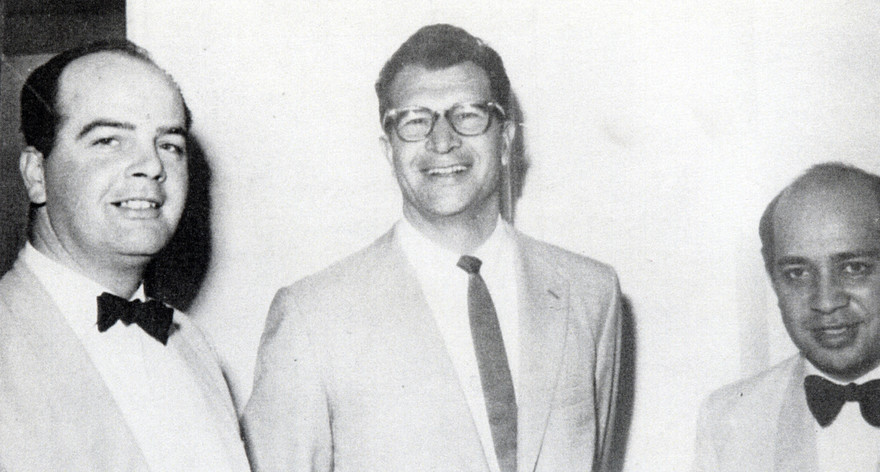
Dave Brubeck, centre, and two members of the Auckland band which played support at the Brubeck Quartet's 1960 Auckland concert, Crombie Murdoch (left), and Lew Campbell. - Bernie Allen Collection
Between 1955, with the visit of Nat King Cole, and 1963, when Louis Armstrong toured, there was a flurry of US jazz musicians who arrived to satisfy a starved audience. In the years since Artie Shaw’s visit in 1943, jazz had moved from the popular mainstream to a more intellectual and cultish audience, but it enjoyed an unexpected return to the limelight in the early 60s with pianist Dave Brubeck.
Brubeck first toured New Zealand with his quartet in March 1960. His album of the previous year Take Five had just become the biggest-selling jazz LP ever (more than six decades later, it remains somewhere in the top five). The Brubeck Quartet was welcomed by polo-neck-wearing hipsters and more sedate music appreciators alike. At Wellington airport he received a welcome from the Te Pātaka Concert Party. In an example of influence running the other way, Brubeck composed ‘Māori Blues’ in response to the welcome, using the haka rhythm as the basis for the piece.
Bruno Lawrence, a talented young jazz drummer and active member of the Victoria University Jazz Club, had a day job at the time, writing for the newspaper Truth (using his birth name David Lawrence). In the paper’s entertainment supplement he devoted a two-page spread to a preview of Brubeck’s local concerts, which he was evidently looking forward to, while noting that his records had not greatly affected him “apart from some of the moving blues Dave has played, when he has approached something of the true feeling of jazz.”
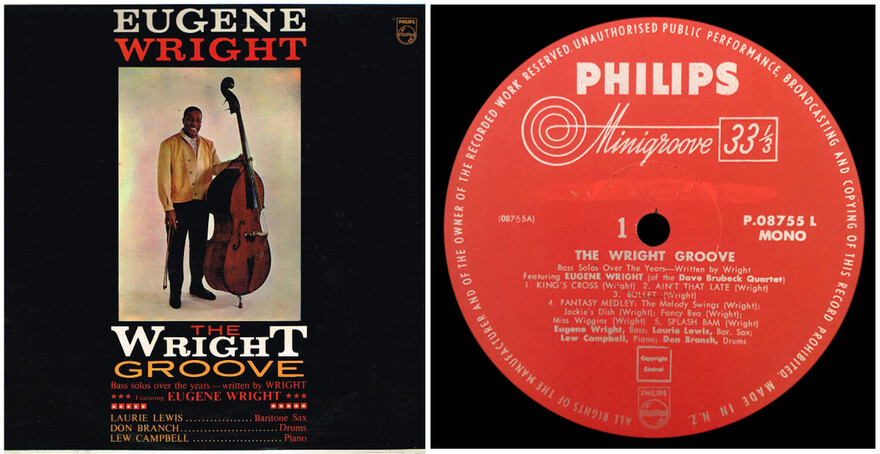
Eugene Wright, bassist in the Dave Brubeck Quartet, recorded The Wright Groove at Broadcasting House in Wellington, in 1962. Backing him were New Zealand musicians Don Branch, Lawrie Lewis, and Lew Campbell.
The Brubeck Quartet would return several times over the next few years and Brubeck’s bass player Eugene Wright recorded an album in Wellington, accompanied by local musicians. Pianist Lew Campbell, drummer Don Branch and baritone saxophonist Laurie Lewis were all Wellington musicians Wright had met during the Quartet’s 1960 visit, and at the end of the Quartet’s 1962 tour he stayed on in Wellington to cut The Wright Groove with them at the NZBC studios.
In his liner notes, Wright praised the New Zealand musicians, singling out Don Branch as a notably “musical drummer” and complimenting all three, among other things, for their “togetherness” and ability to swing in ¾ time.
“The reader might ask, ‘Why New Zealand?’ My reply would be simple – ‘Jazz is jazz wherever you are.’ As long as you can find musicians who can play, want to play and like to play – as I have found here in New Zealand.”
Wright’s affirming words made a pleasant contrast to Lew Campbell’s experience a couple of years earlier when his 14-piece band was hired to accompany bebop pioneer Dizzy Gillespie. Dissatisfied with the rehearsal, Gillespie opted to play his first show with just Campbell and rhythm section. Still unhappy, he eventually sidelined the locals altogether, borrowing co-headliner Sarah Vaughan’s group to back him for the second show.
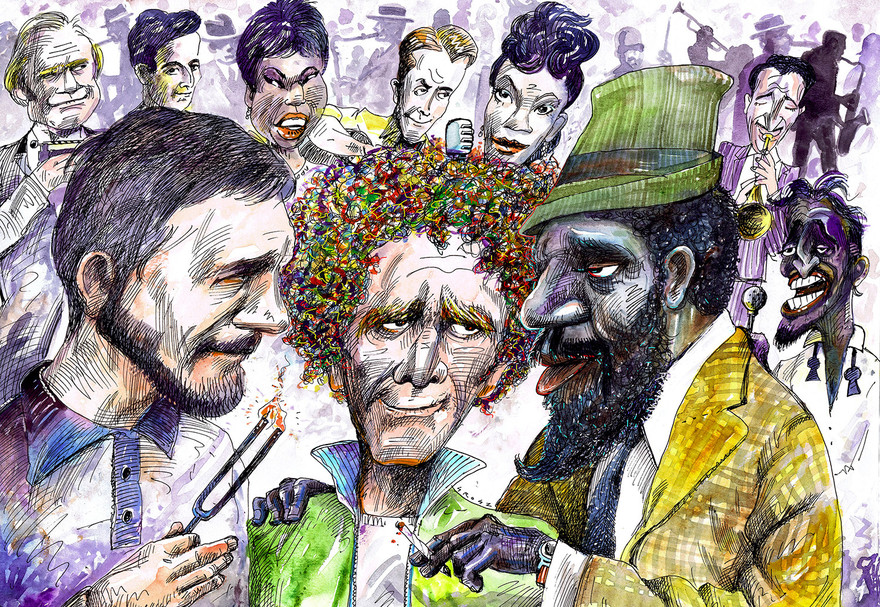
Mike Walker, artist Pat Hanly, Thelonious Monk, and acolytes at a Parnell party, 1965, as portrayed by Chris Grosz for AudioCulture's Rock & Roll Rendezvous series
The visit in early 1965 of another bebop deity, Thelonious Monk, is remembered in part for its extra-musical aspects. Monk requests for “special cigarettes” drew a generally blank response until he was offered some marijuana by a local painter at an Auckland post-show event. On the morning of his departure, his minder arrived to take him to the airport, to find him naked in his hotel room ordering beer and whiskey chasers from room service, with the contents of his and his wife’s 14 unpacked suitcases still strewn about the room.
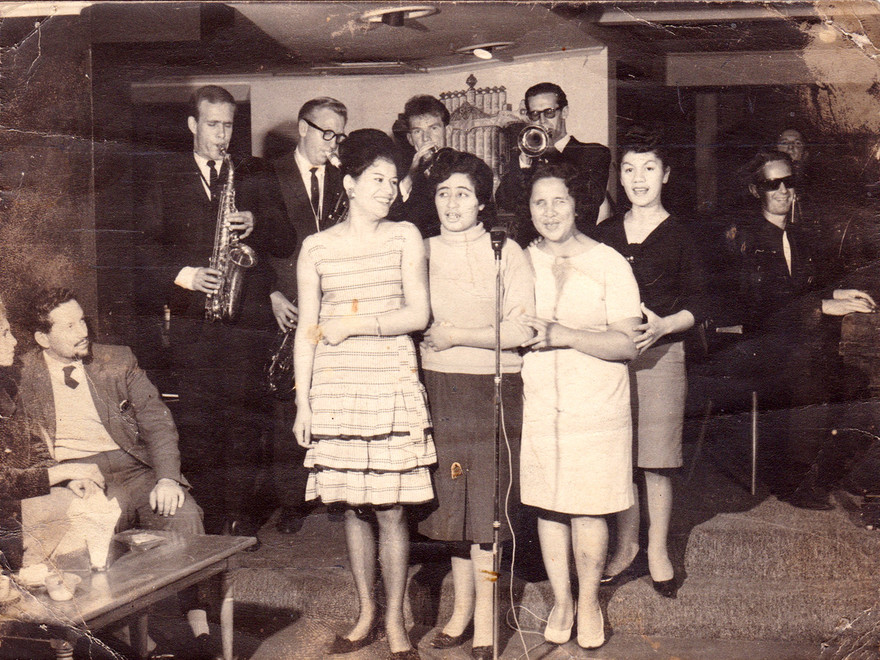
Bebop, Aotearoa: The Claude Papesch soul band, which included Papesch (piano, vocals), Kim Paterson (trumpet), Stu Parsons (baritone saxophone), Bernie McGann (alto saxophone), Tony Hopkins (drums), Andy Brown (bass), with Joy Yates on lead vocals. Kim Paterson: "We covered Ray Charles music plus some originals ... we also did a quintet with rhythm section and Bernie and I out front. We did Charlie Parker, Thelonious Monk, Cannonball Adderley and some originals."
It was neither a pop promoter nor the jazz fraternity who arranged the tour, but rather the admirably open-minded New Zealand Federation of Chamber Music Societies. Monk had been approached in early 1964 by the Federation’s concert manager Joan Kerr, in a letter sent care of Downbeat magazine. By the time the letter reached George Wein, founder of the Newport Jazz Festival and Monk’s acting manager, Monk was enjoying a belated burst of recognition, spearheaded by a Time magazine cover story. He had never been in greater demand. Wein, in his reply to Kerr, noted in her favour that her enquiry had been sent before the Time coverage.
On his arrival in Wellington the Evening Post reporter was waiting with the big question: what is jazz? “He turned his warm, liquid gaze towards me,” wrote the journalist, “started to tug at his frizzle of beard. ‘Well …’ he said, ‘jazz is American music. It’s … well, when you hear it, I guess you know.’ ”
“jazz is American music,” said Monk in Wellington. “It’s … well, when you hear it, I guess you know.’ ”
The Listener’s seasoned jazz critic Ray Harris knew what he was hearing, but wasn’t sure he liked it. “I do not believe that … Monk’s music is easy to understand, nor do I consider it beautiful in terms normally associated with the word. It has none of the beauty of, say, the English countryside, but it does have the type of beauty that goes with New York’s 42nd Street; in other words, I believe it belongs primarily to the cool and calculating world of today in which many strive for existence. Therefore it must be judged by contemporary standards. Much of what Monk plays does not appeal to me at all …”
For classical critic Owen Jensen, Monk’s “famous dissonant harmonies” had “lost some of their edge’, still he hailed the Monk Quartet’s performance overall as a “ripe musical experience.”
But for at least one audience member the experience was profound. Phil Dadson, who would go on to form the experimental music and movement group From Scratch, was a young art student and aspiring jazz musician when he caught Monk’s concert in Auckland. “I have a memory of Monk getting up from playing and, when Charlie Rouse was taking a solo, he wandered round the stage and started turning round in circles with his eyes closed. He got his feet all tangled up in the mic lines which he had to unwind, and then just got back to the piano in time for his solo. It might have been choreographed, it was so beautifully timed.”
It had been a formative lesson in the kinetic art with which Dadson would go on to make his name.
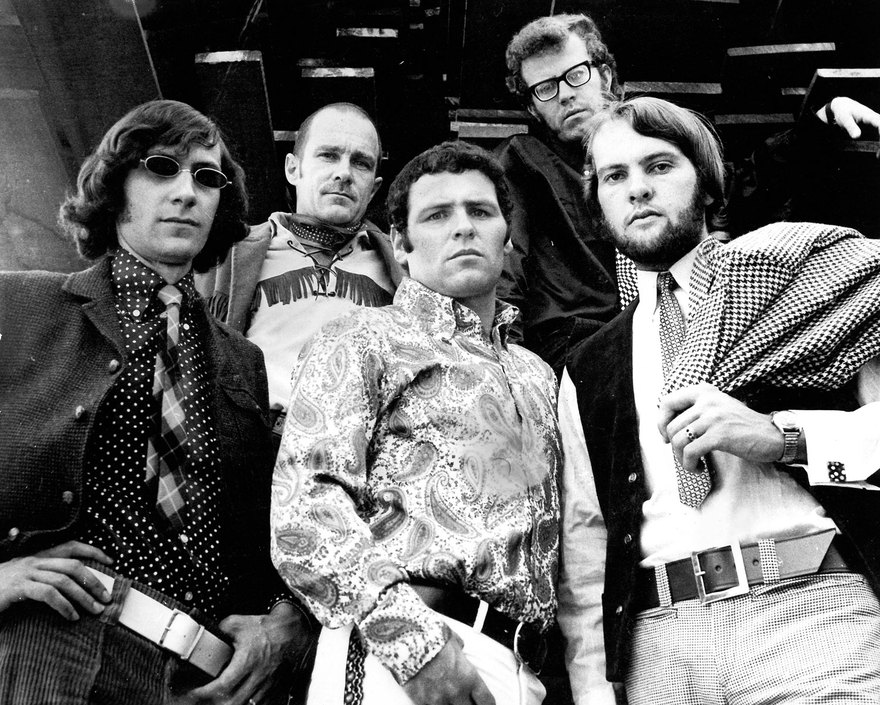
The Brew: Doug Jerebine, Bob Gillett, Tommy Ferguson, Yuk Harrison and Trix Willoughby. - Phil Warren Collection
Perhaps the most sustained influence of any visiting jazz musician came from the lesser-known but much-admired Bob Gillett, a California-born saxophonist who had played with the Stan Kenton Orchestra, Billie Holiday, Ella Fitzgerald and Frank Sinatra, and studied classical composition under Arnold Schoenberg before his arrival in New Zealand in 1960. Between then and 1972, when he returned to the US for 20 years, he played with the cream of the country’s jazz musicians, arranged and led a radio big band, and was musical director for the NZBC programme Jazz For Everyone. As bandleader Bernie Allen put it, Gillett had “the sort of individual talent which we all aspire to.” As the 60s wore on he became increasingly interested in the fusion of jazz and rock, which he explored with The Brew, an experimental band that included local guitar virtuosos Doug Jerebine and Harvey Mann, to whom he was a mentor. As Jerebine would remark to John Dix, “His type of knowledge is restricted to the saints.”
From the late 70s, Wellington trombonist and bandleader Rodger Fox brought a series of top-flight US jazz musicians to New Zealand to guest with his big band. It was like a roll call of current top-shelf players. Horn players included saxophonist Michael Brecker, trumpeters Maynard Ferguson and Arturo Sandoval, and trombonist Bill Reichenbach. Drummers included Steve Gadd, Dave Weckl, Peter Erskine, Dennis Chambers and Greg Bissonette. Lance Philip, who was Fox’s regular drummer for many years and teaches jazz drumming at the New Zealand School of Music, praises his late bandleader’s initiative for an education he couldn’t have got any other way.
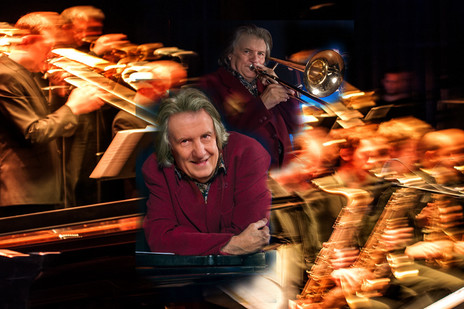
Rodger Fox, who tirelessly brought US jazz musicians to tutor and entertain New Zealanders. - Sal Criscillo
Guitarist David Watson, a member of Wellington’s pioneering free improvisation ensemble the Primitive Art Group, is likewise grateful for an opportunity to interact with musical masters. In his case, he credits the Goethe Institute, who in the late 80s toured European-based improvising musicians such as the German pianist Rainer Bruninghaus and Indian percussionist Trilok Gurtu.
“Seeing visiting artists up on stage under the lights being amazing didn’t really fundamentally influence me,” he says. “But when the Goethe toured an act, it included a workshop or a Q&A session. I think these had a really big influence on me because there was such a small country/glass ceiling feeling, and there you were – playing with or talking to people you’d admired from afar. I still recall someone’s rather mediocre question to Trilok Gurtu in a classroom in the Wellington Polytech: ‘How do you practise improvisation?’ Answer: ‘I’m practising it now.’”
At womad festivals There were further opportunities to get close to visiting maestros
There were further opportunities to get close to visiting maestros when the WOMAD festival became a biennial, then annual, event in the early 2000s. As well as performing hour-long concert sets, many of the international guests would also conduct workshops.
A significant feature was the intimate Artists In Conversation stage, which I hosted for a number of years. Artists would answer questions from the stage and the audience, about their music and their lives, and often brought along their instruments. One memorable session was with the Mongolian-born singer Sa Dingding, who was joined in a duet by a member of the local birdlife – it might have been a North Island robin – which, attracted by her singing, positioned itself on a low branch just above the stage where it warbled in counterpoint throughout her song, flying off on cue as soon as the performance had ended.
Even more than other artists, it is impossible to quantify the influence of The Beatles on New Zealand music. Though they only visited once – an eight-day week in 1964 – their impact would ripple on for decades, whether in The Fourmyula’s Wayne Mason and Ali Richardson in the late 60s consciously modelling themselves on Lennon and McCartney and writing Beatlesque originals like ‘Come With Me’ and ‘Alice Is There’, or Neil Finn, who has called The Beatles’ ‘Across The Universe’ “as close too perfect songwriting as you can get”, borrowing the image of rain in a paper cup for his own ‘Don’t Dream It’s Over’, while the melody was something one could imagine John Lennon humming on his way to Abbey Road.
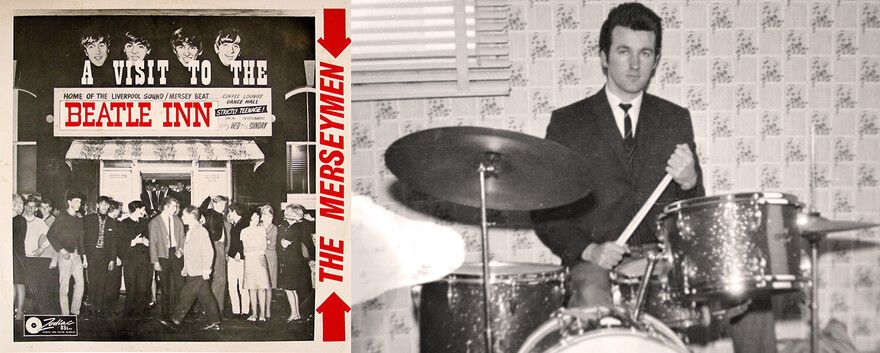
The Merseymen, A Visit to the Beatles Inn (Zodiac LP, 1965); Jett Rink, aka Dylan Taite. - John Taite Collection
At the time, though, Beatlemania’s immediate influence could be found in predictably Beatle-themed venues such as The Beatle Inn in downtown Auckland – a shameless cash-in by promoter Phil Warren, with resident band The Merseymen featuring an authentic Liverpudlian Jett Rink (aka Dylan Taite) on drums –and short-lived covers bands such as The Measels (“it rhymed with Beatles and was catchy”, their guitarist Neil Harrap explained). The Measels included Bruno Lawrence and played Beatles and other Merseybeat covers at Wellington’s Sorrento café for an intense few months in 1964. Neil Harrap recalls: “We played four hours Tuesday to Thursday, five hours Friday and Saturday, and three hours Sunday afternoon – as well as four hours Sunday nigh,t for a total of about 30 hours a week. We usually played 50 minutes of every hour. This was industrial music production, and we sure earned our money.”
Musicians such as Harrap and Lawrence who jumped on the Beatle bandwagon had already been playing in bands before The Beatles came along. Lawrence performed in jazz groups; for The Premiers, Harrap developed his proficiency by emulating slick instrumentalists like The Shadows. Possibly the 1965 visits of The Rolling Stones and The Pretty Things inspired more people to start from scratch. With their raw and bluesy sound, casual streetwear, and no-smiles policy, the Rolling Stones’ influence was one of attitude as much as musical style.
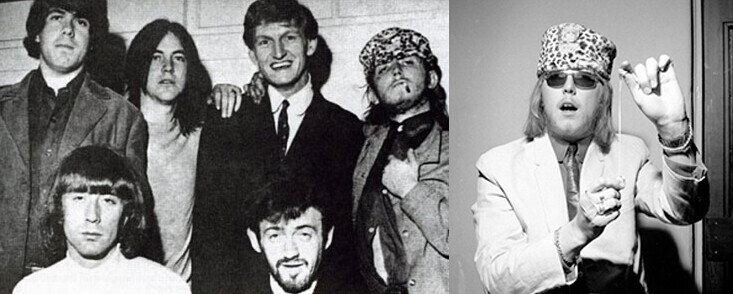
The Pretty Things, Auckland, 1965, with Tommy Adderley beside Viv Prince at the far right; and a formal portrait of Prince taken in Wellington by an Evening Post photographer, 27 August 1965. - Dominion Post Collection, Alexander Turnbull Library, Ref: EP/1965/3179
The Pretty Things were even longer-haired, more raucous, and drew shock-horror headlines as they toured the provinces, thanks particularly to the madcap behaviour of their drummer Viv Prince. When this proto-Keith Moon wasn’t terrorising his drums he was setting fire to theatre curtains, drinking whiskey from a boot, or stalking the streets dressed in a motel bedspread and brandishing a lightbulb. Prince was gregarious and perpetually drunk during his stay. Music fan Susan Pointon recalls attending their Wellington show, then being piggybacked by Prince up Courtenay Place.
Not only did Prince’s antics appeal to rebellious rock fans: political activist organisation the Progressive Youth Movement centred a recruitment drive on the Things’ Auckland show. But the band’s take on R&B had the same sort of DIY appeal that punk would have a decade later, in which roughness could be read as authenticity and finesse took a back seat to raw expression. Almost immediately there were blues-wailing bands bursting out of basements up and down the country: The Dark Ages in Auckland, Chants R&B in Christchurch, Unknown Blues in Invercargill, and many more.
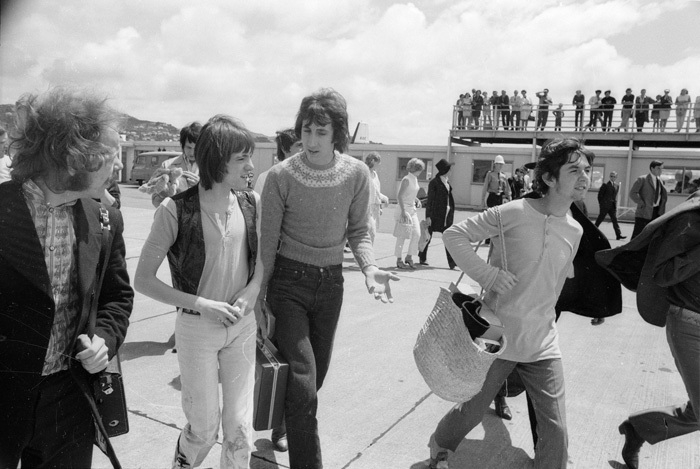
The Who and The Small Faces' Steve Marriott, Pete Townshend and Ronnie Lane arrive in Wellington, 30 January, 1968. - Alexander Turnbull Library, Wellington, Ref: EP/1968/0410/2-F
The visit of The Who and The Small Faces in early 1968 could have been the second coming of Viv Prince. Newspapers primed the public in advance with reports of “animal behaviour” in Australia. Small Faces frontman Steve Marriott celebrated his 21st birthday in sleepy Wellington by hurling a record player – given to him by his record company – from a window of the Waterloo Hotel, with encouragement from Keith Moon. On stage, Pete Townshend thrilled audiences with the auto-destruction of his guitar. As for their impact on local musicians, there was no noted increase in instrument abuse. (Six months after their visit, Moon told Melody Maker that the Australia/New Zealand tour with the Small Faces was “the most enjoyable we have ever done.”)
If the electric blues boom of the 60s was propelled by British bands like The Rolling Stones and Pretty Things, acoustic blues was already being disseminated through the folk scene. The visit of Josh White in 1965 gave local folkies a chance to watch an authentic – if unusually refined – US folk-bluesman up close. In addition to his formal concerts, he gave more spontaneous and intimate performances at local folk clubs such as Wellington’s Monde Marie.
British blues crusader John Mayall made the first of several visits here in 1972, and took opportunities to jam with local musicians after his shows. But his influence had already been established through records, which for many New Zealand bands were the introduction to the blues, the American originals being notoriously hard to come by. The Underdogs even had a national hit with a cover of a Mayall song, ‘Sitting in the Rain’.
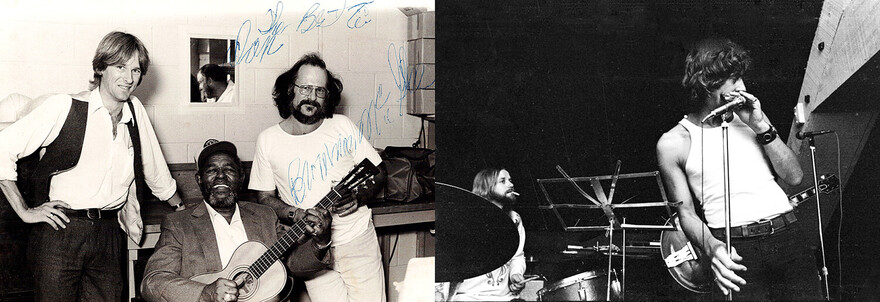
Neil Finlay, Brownie McGhee, and Alan Young, 1987; John Mayall at Granpa's, Auckland, with Headband's Jimmy Hill on drums, 22 March 1972. - Alan Young Collection; Bruce Jarvis, Auckland Libraries Heritage Collections 1704-0825B-07A
In 1973 the New Zealand Student Arts Council toured Sonny Terry and Brownie McGhee, and Barry Coburn brought Muddy Waters to the main centres. The folk and blues fraternity turned out to watch at close range the exceptional guitar and harmonica skills that most had only heard on records. (In 1987, following the death of Sonny Terry, local musician Neil Finlay would accompany Brownie McGhee as his harmonica player on another New Zealand tour.)
For those more inclined towards the arcane sounds of rural white America, there was Mike Seeger, whose contribution to the 1969 National Banjo Pickers Convention included workshops in which he demonstrated guitar, mandolin, autoharp, banjo, fiddle, dulcimer and even spoons. As Dave Calder of The Hamilton County Bluegrass Band recalled: “Mike played all his instruments better than us and we all learned new licks and chops.”
In the 1960s, bands that would become legendary – The Beatles, The Rolling Stones, The Who – played in New Zealand theatres and town halls. The early 70s brought the country’s first stadium rock shows. Creedence Clearwater Revival, Led Zeppelin, Elton John, The Rolling Stones, Deep Purple, and Rick Wakeman all headlined at Western Springs, dazzling with the sheer size of the crowds and power of the sound systems. Local musicians then returned to their far more modest pub gigs, newly aware of what rock’n’roll could be. If nothing else, the experience drove home that rock was as much about spectacle as sound—a lesson embraced by bands as different as Ragnarok and Hello Sailor, who launched themselves, in leather and peroxide, into a scene where moustaches and flared denim had long passed for stage presence.
.jpg)
The Rolling Stones play Western Springs, Auckland, 11 February 1973. From left: Mick Taylor, Charlie Watts (obscured), Mick Jagger, and Keith Richards - Bruce Jarvis, Auckland Libraries Heritage Collections 1704-0923F-27A
But it was the 1972 performance of Jethro Tull and their vaudeville theatrics at the more intimate Auckland Town Hall, that had a formative effect on the young men that would soon form Split Enz. In his memoir-cum-band biography Stranger Than Fiction, Mike Chunn recalls going along with his future bandmates Brian (Tim) Finn, Geoffrey (Noel) Crombie, Rob Gillies and Phil Judd. “Starting with a 45-minute version of ‘Thick As A Brick’ with a power never thought possible … their extraordinary performance drilled into Brian’s head the value of stagecraft and presentation in fulfilling the musical promise. Rob, Noel and Phil were all equally enthused by the show.”
Taking a leaf directly from Tull’s book, Split Enz would make costumes and theatrical interludes an intrinsic part of their act. Eschewing the pub circuit, they would launch their career with concerts in theatres, opera houses and town halls.
--
Read more at part two: the Velvets, Little Feat, reggae, punk, post-punk, and hip hop