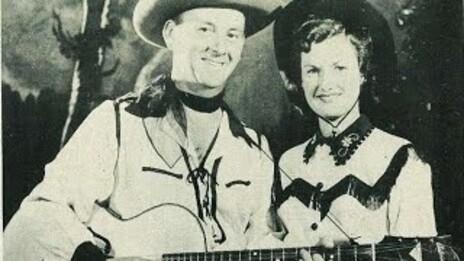
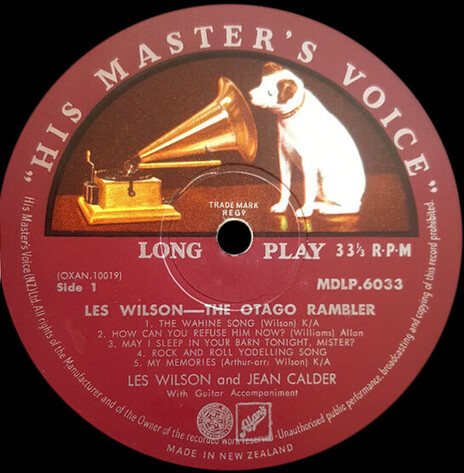
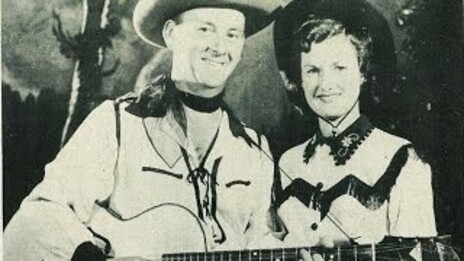
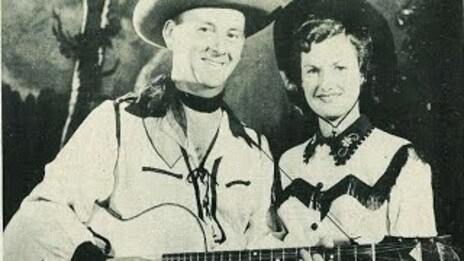
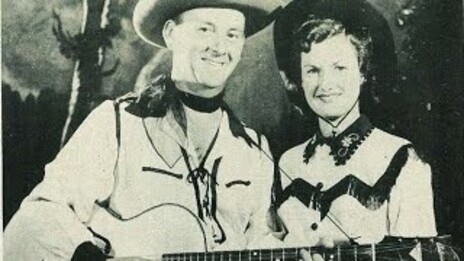
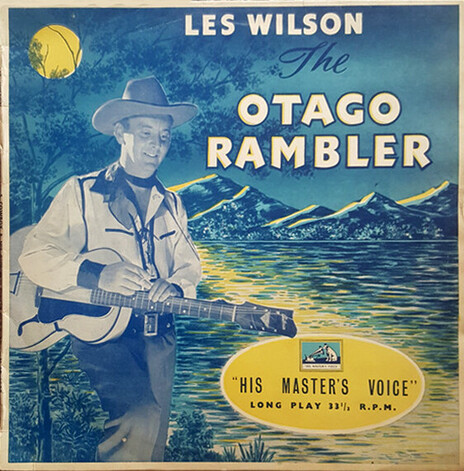
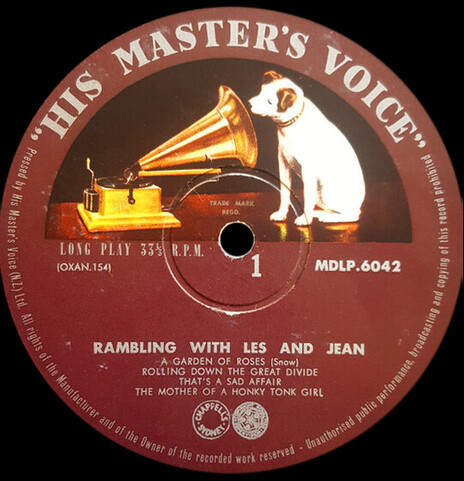
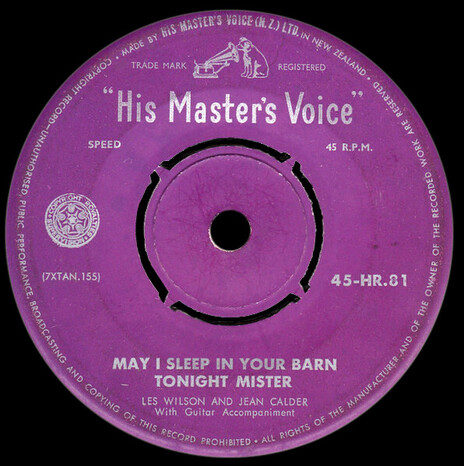
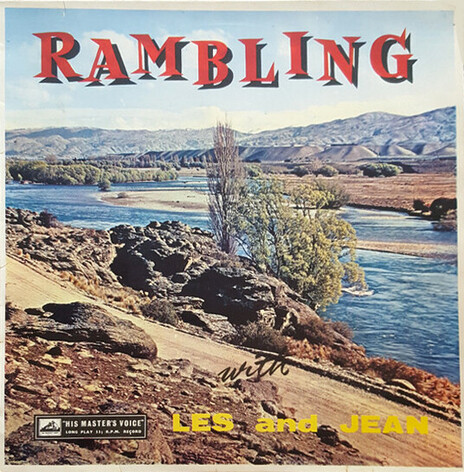
Of his eight 78rpm discs released in 1953, six of them featured duets with Jean Calder. In the second half of the decade the couple released the 10-inch albums The Otago Rambler (also called, in some editions, A Cowboy and His Guitar) and Rambling With Les and Jean before taking their show to Australia.
Although they grew disillusioned with the western music scene and all but retired to Brisbane in 1960, the songs Les Wilson had written until then were recorded by artists on both sides of the Tasman Sea, well into the 2020s.
Titles such as ‘Silver Wings’, ‘Rolling Wagons’, ‘Old Faithful and I’, ‘The Wahine Song’ and ‘Rockonover River’ would be released by the likes of New Zealanders Garner Wayne, Max McCauley, Des Knight, Eddie Low, Patsy Riggir, Noel Parlane, Roger Tibbs, John Grenell, The Topp Twins, and The Harmonic Resonators, and Australians The Hickey Sisters, Rex Dallas, Owen Blundell, Reg Poole, and Dianna Corcoran. These recordings put Les Wilson among the most covered New Zealand songwriters of all time.
Les Wilson is among the most-covered New Zealand songwriters of all time
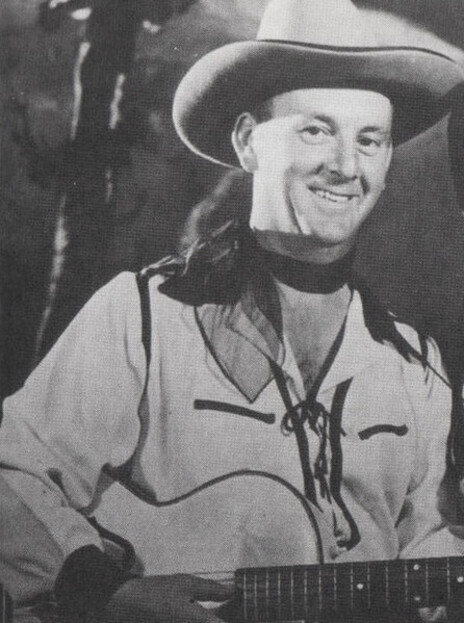
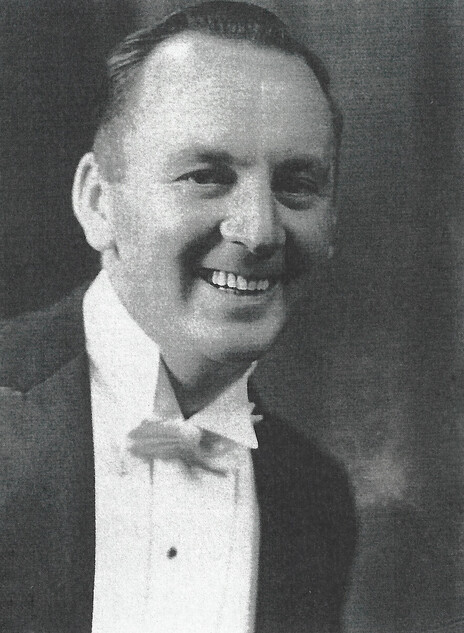
The fourth of Bob and Louisa Wilson’s four children, Arthur Leslie Wilson was born in Dunedin on 2 August 1924. By the time he was seven, he was handy enough on the harmonica to accompany his tap-dancer sister, May, at various events around the city. For three years he was part of the acclaimed St Paul’s Anglican Cathedral Choir, although his tenure was not fondly recalled.
In the early 1980s, Wilson told Australian author and record label owner Eric Watson that some sunny Sundays his bus-driver dad would transport the neighbourhood families away for picnics, but not before dropping Les at church for choir practice. On one occasion when he did make it to a picnic, he heard a man with a ukulele singing ‘They Cut Down the Old Pine Tree’ and he was enthralled.
On his 12th birthday, Les bought himself a banjo, and he and older brother Cole would sing and yodel as they struggled to recreate the sounds they heard on their Tex Morton, Wilf Carter and Buddy Williams records. It dawned on Cole that their heroes weren’t playing banjos; they were playing guitars. Soon, the boys had one each.
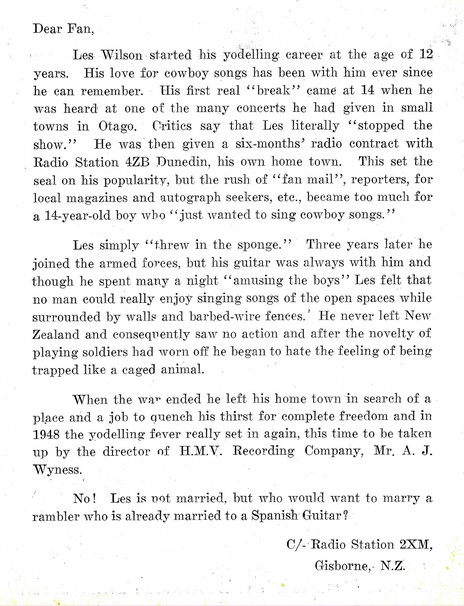
In May 1939, 14-year-old Les was invited to join the Dunedin Community Sing Committee’s concert party as a mouth organist for a show at Waikouaiti. He took his guitar along instead, performed the new cowboy numbers he’d been learning, and brought the house down.
The reaction was the same when committee head Jim Himburg formed other country concert parties around Les, and he was soon a regular attraction on 4ZB, sometimes backed by Dick Colvin’s Dance Band. Dunedin Town Hall Dance promoter Joe Brown heard Les Wilson at one of the community sings and signed him to a contract. Fan mail poured in, and he was regularly mobbed for his autograph.
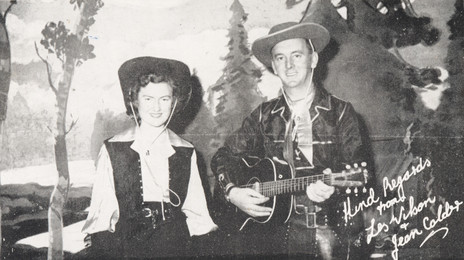
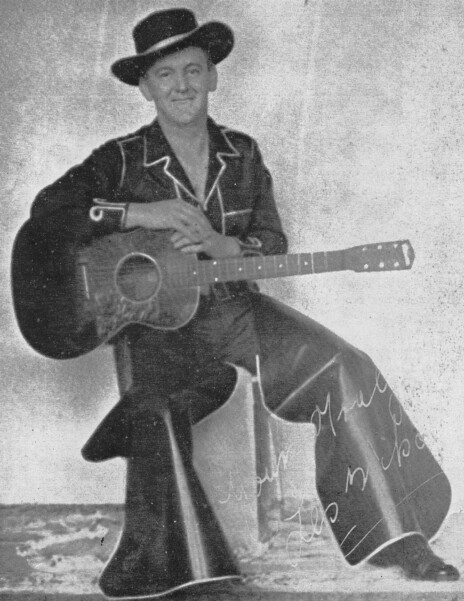
The New Zealand Record of 31 July 1939 reported: “One night during a broadcast from the hall, Mr Brown offered to send a photograph [of Wilson in his cowboy attire, with guitar] to anyone interested. One hundred and sixty photographs were requested, letters coming from all over New Zealand.”
A six-month residency at the Dunedin Town Hall made Les feel “like a monkey in a cage”
But Wilson later confessed he grew to resent his six months at the Town Hall Dance. “He felt, he says, like a monkey in a cage,” Eric Watson wrote in his 1983 tome Country Music in Australia: Volume 2. “A cab used to call to take him to the hall, usually when he wanted nothing more than to get something going with a couple of mates from across the street.”
When the legendary Tex Morton came to Dunedin, Wilson spent an hour or so backstage with him where Morton taught him how to conventionally tune his guitar, how to correctly finger chords with the tuning, and how to pick runs from one chord to another.
Contracted to tour the commercial radio stations of New Zealand, Wilson’s bags were packed when the Second World War broke out, and the trip was cancelled. When he came of age, he joined the Royal New Zealand Air Force but never saw active service. At the war’s conclusion, he took to studying engineering but soon drifted north to Gisborne in search of freedom.
There he met Percy Stevens who, in 1923, had received one of the first broadcasting licences issued in New Zealand and established private radio station 2YM from his home. By 1939 only the renamed 2ZM and one other station remained in private ownership. Nine years later, the call signal was changed to 2XM. One of the station’s most popular singers was Jean Calder.
Born in 1929, Jean Ellen Calder was 11 when she began singing on Stevens’s radio station. On her first appearance, she sang Gracie Fields’s ‘Wish Me Luck As You Wave Me Goodbye’. Shortly after, Jean and her sister Dorothy were performing concerts for servicemen and leaning towards the western repertoires of Australian yodellers Shirley Thoms and June Holm.
After Les Wilson arrived in town, he and Jean Calder were corralled into concert parties to entertain the services and for patriotic appeals. They swiftly became a popular combination onstage and were falling for each other offstage.
Around this time, Percy Stevens came into possession of a disc-cutting machine and had Wilson cut some acetates. Wilson took the discs to HMV, who were impressed enough to sign him but wanted original material. So, write he did, falteringly at first but it became easier.
Although the acetates were popular on 2XM, they weren’t the sound that Wilson had in his head. There was no instruction manual on how to achieve the echo-laden yodelling of Canadian Wilf Carter. Stevens hit upon the idea of driving his recording gear the 70-odd kilometres to the reverberant Nūhaka Hall to see what results could be achieved there.
When recording, Wilson yodelled into the wall to get the sound he wanted
He had Wilson sing directly into the microphone until it was time for the yodelling choruses. Then Wilson would turn his back to the microphone and yodel to the wall. When they played the recording back, the echo on the yodel was exactly the sound they were after. The only problem was the drop in volume of Wilson’s guitar while his back was to the microphone. But that was a small price to pay.
HMV were happy with the results too, and the fact that both sides were written by Wilson, and released ‘Old Faithful and I’ b/w ‘Shadows On the Trail’ in 1950. The tracks were released in Australia on Regal Zonophone, the label that had launched Tex Morton in 1936. The 78 became popular on radio in both countries and HMV suggested Wilson and Calder get better known by touring.
At first, they went out with a small group, but it proved too expensive and was cut back to just Les and Jean. Taking a leaf out of Tex Morton’s book, Wilson sent away to Australia for a £2 hypnotism instruction book. Their advertising promptly stated: “You will be amazed and amused during Mr Wilson’s hypnotic demonstration.”
Meanwhile, Wilson’s brother Cole, with whom he’d painstakingly tried to figure out banjo chords with 14 years earlier, had also found success with his band, The Tumbleweeds, whose ‘Maple On the Hill’ was a hit on HMV’s fierce rival Tanza.
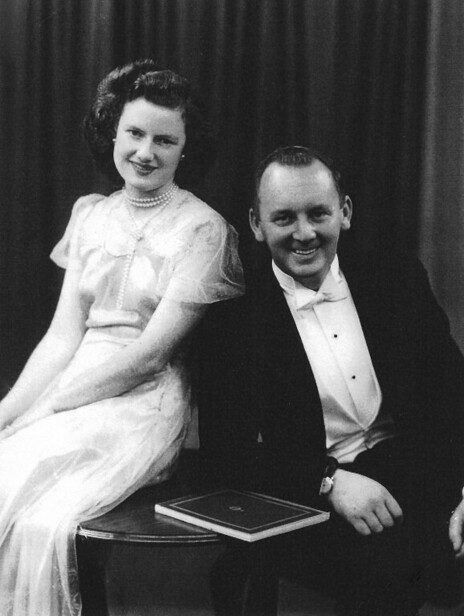
Les Wilson and Jean Calder were married in 1952, and Calder was prominent on one side of Wilson’s next 78 release, ‘Yodelling Cowboy’ b/w ‘Prairie Rose’. By accident or design, the record was released first in Australia in 1952, again on Regal Zonophone, before starting a flood of Wilson 78s in New Zealand in 1953.
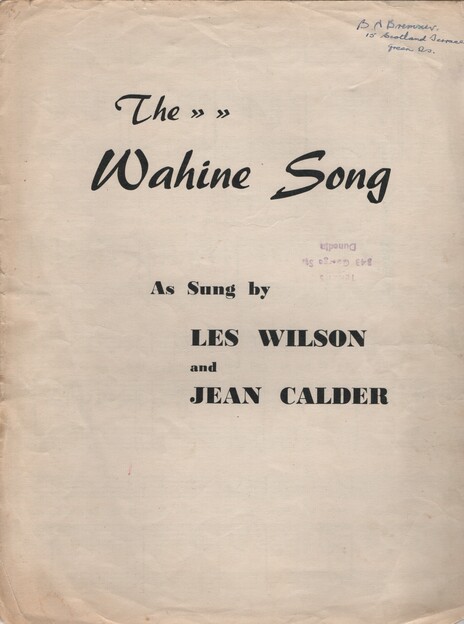
All but two of the duo’s 16 sides released that year were written by Wilson. Some were recorded back at Nūhaka Hall and some at home with tape delay equipment made by Dunedin radio technician Leao Padman. Among their most popular were ‘Rolling Wagons’ and ‘The Wahine Song’, also known as ‘The Wahine’s Farewell’. The latter was later released on 45 by EMI (Australia) on their Columbia imprint.
In 1953 the couple took part in a nationwide closed-circuit Television demonstration
Also in a busy 1953, the couple took part in the Wellington leg of nationwide closed-circuit TV demonstrations. Wilson and Calder performed before the camera at radio design company Collier & Beale and the presentation was transmitted to a waiting throng at Kirkcaldie’s department store on Lambton Quay. The newspaper advert announced five screenings: “20 minutes of the world’s newest entertainment. No charge.”
Their 78rpm release of 1956, ‘How Can You Refuse Him Now’ b/w ‘The First Sad Year’, showed the challenges of recording at home. Written by Wilson on the death of Calder’s mother, ‘The First Sad Year’ concludes with the line, “It dawns the first sad year.” As the last chord rang out, a rooster crowed outside. Thinking the take might be destroyed, when they played it back it seemed almost appropriate and was kept.
Wilson and Calder continued touring to full houses, including a Dunedin homecoming for Wilson in 1955, and HMV released the 10-inch album The Otago Rambler (aka A Cowboy and His Guitar) in 1957. Inevitably, thoughts turned to taking the show to Australia. The couple had received encouraging words from Neville Pellitt, whose Harmony Trail programme was heard around Australia from 3SR in Shepparton, and Bob “Two Guns” Fricker from 5AD in Adelaide.
After getting a letter from Australian star Slim Dusty and his songwriter wife Joy McKean, telling them how often fans asked about Les Wilson, Wilson signed hundreds of photos and sent them over. Wilson and Calder crossed the Tasman themselves in 1958.
When they pulled up for one of their first package show performances, a stranger approached them. “Oh, you’re Les Wilson,” he said. “How would you know that? I’ve only just arrived in Australia,” Wilson replied. “I’ve just bought your signed photo over at the Slim Dusty tent!”
While they were away, HMV released the 10-inch LP Rambling With Les and Jean. The notes on the reverse said Wilson and Calder were on “a lengthy tour of Australia where they are appearing regularly on TV as well as in radio and stage shows.”
In 1960 tragedy hit Les Wilson’s tour of Queensland; it continued under a dark cloud
Although they returned to New Zealand for more touring, the intention was always to get back to Australia and capitalise on the progress they had made. In about 1960, the Les Wilson Show hit the road again in Australia, but the wind was soon taken out of its sail in the most dreadful way in the Illawarra region of New South Wales.
Efforts to confirm the details with the Wollongong City Libraries, Illawarra Mercury newspaper, Shellharbour Museum, and various online community sites brought no joy, but the following is from Eric Watson’s 1983 book Country Music in Australia: Volume 2.
“At Shellharbour, New South Wales, the advance agent was back with the show to discuss strategy with Les and Jean. The agent’s wife was doing caravan chores, and their three-year-old daughter was playing nearby. There came one of those brief periods, no longer than five minutes, when each of the parents thought the child was with the other, before they missed her. Then a quick search proved fruitless. The caravan park proprietor reported seeing her get into a black car, but an extensive police search brought a complete blank, and nothing more has been heard of her to this day.”
The show spent many days off the road while Wilson and Calder helped with the search. When it finally got rolling again it did so under a dark cloud. They worked up the New South Wales coast and into Queensland, but when they got to Brisbane, Wilson had had a gutful and ended the tour. They sold their caravan and made Brisbane their home, rarely to perform again.
In the second half of the 1960s, sons Davey and Geoff were born, and the Wilsons built a home on Narellan Street, in the northern suburb of Arana Hills. In the backyard, Les began a business as a mechanic and auto electrician.
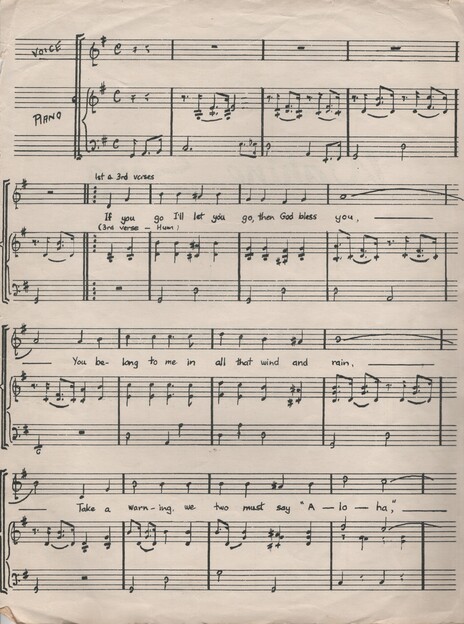
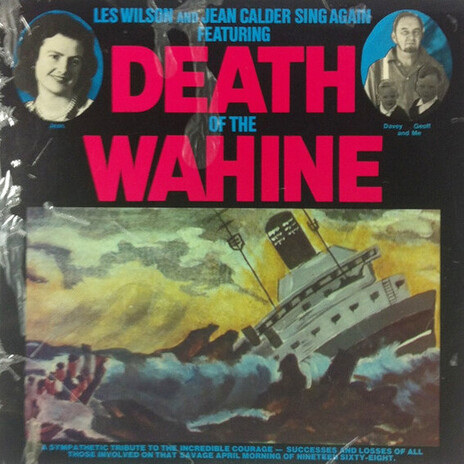
Following persistent encouragement from his mother to write a song about the 1968 sinking of the Wellington-to-Lyttelton passenger ferry Wahine, Les finally relented and in 1977 he and Jean recorded the album Death Of the Wahine on a Grundig tape recorder in their lounge. Their sons kept the family dogs quiet in a bedroom.
On the back cover of the LP, Les comments: “To write about a national tragedy such as the sinking of the Wahine, I found most difficult – almost forbidding – but Mum pressed for it as mothers sometimes do when they think that their offsprings are capable of doing something. Some of my closest friends set out to persuade me to make the accompaniment more elaborate. This I firmly refused.”
Instead, he overdubbed a one-stringed bass guitar he’d fashioned out of a bedpost and a borrowed set of drums. “All mistakes therefore must be attributed to myself and no one else,” he wrote. Death Of the Wahine was released independently with the tagline: “Les Wilson and Jean Calder sing again.”
In January of 1978, Wilson was among the second intake of inductees to the Australian Country Music Hands of Fame at the Tamworth Country Music Festival; the third New Zealander, behind Tex Morton and Suzanne Prentice the previous year.
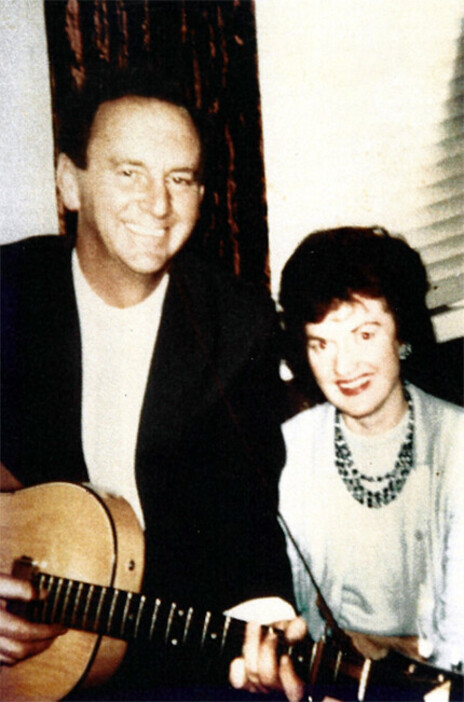
The Wilsons’ home often hosted guitar-toting visitors seeking Les’s advice
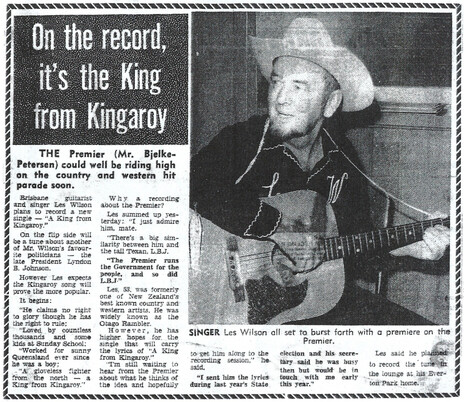
Also in 1978, he released the independent single ‘A King From Kingaroy’, a salute to the divisive Dannevirke-born Queensland premier Joh Bjelke-Petersen. The flip side, ‘Theme Of West Arana’, was a tribute to son Geoff’s under-11 grand-final-winning rugby league team and featured the club’s cheerleaders.
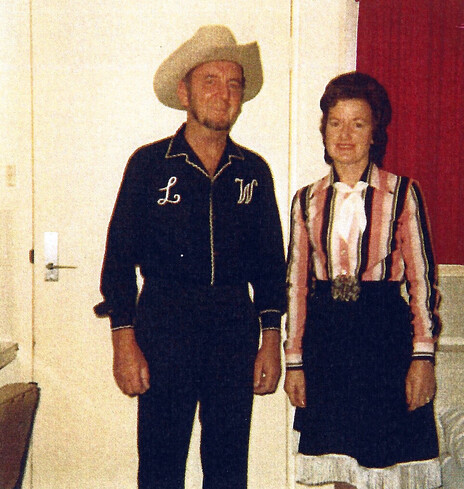
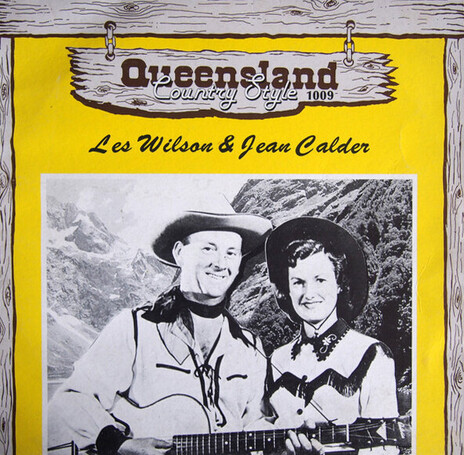
The Wilsons’ home often hosted guitar-toting visitors seeking Les’s advice or opinion on new songs or sometimes even to pitch him material. One night in the early 1980s, after listening to a radio broadcast from the Tamworth festival, Jean insisted she would push Les back into the business because every second award winner was someone who had visited and taken on Les’s guidance. Les wasn’t interested, but in the mid 1980s, the Queensland Country Style label released a compilation of 16 of his and Jean’s HMV tracks from the 1950s.
Les Wilson passed away of a suspected heart attack at the age of 72, on or about 28 February 1997. By that time, he and Jean had separated, and Les was living in a caravan on the site of a disused mill in Dayboro, around 50 kilometres north-west of Brisbane. Jean Wilson passed away on 10 March 2019, aged 89.
Almost a year to the day after Jean’s death, UK specialist label Jasmine Records released the definitive Les Wilson and Jean Calder CD compilation The Otago Rambler, with a slightly rejigged take on HMV’s album cover of 1957. The collection included 27 songs from Les’s heyday, including 15 duets with Jean.