Continued from Bruce Lynch, 1: bass and beyond
It wasn’t for lack of work that Bruce Lynch returned to New Zealand in late 1979, but an opportunity to do something different. He was lured back, along with engineer friend Graham Myhre, to help set up the Mandrill recording studio in Auckland, and spent the best part of a decade playing on and producing some of the most enduring songs and albums of the period.
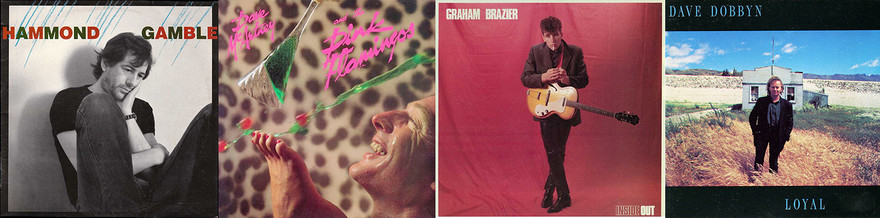
Bruce Lynch productions and contributions: Hammond Gamble (1980); Dave McArtney and the Pink Flamingos (1980); Graham Brazier, Inside Out (keyboards, 1981); Dave Dobbyn, Loyal (1988).
These were incredibly productive years and a small sampling includes producing the self-titled Dave McArtney & The Pink Flamingos’ self-titled 1980 album, playing bass on Pacific Eardrum’s self-titled 1980 album with old pals Frank Gibson Jr and Brian Smith, producing and performing on Street Talk’s 1980 album Battleground Of Fun, playing keyboards on Graham Brazier’s classic 1981 solo album Inside Out, producing and engineering Hammond Gamble’s 1981 solo album, not to mention production credits for the likes of Deane Waretini, Tina Cross, and the Murray Grindlay-conceived Monte Video and the Cassettes novelty hit ‘Shoop Shoop Diddy Wop Cumma Cumma Wang Dang’.
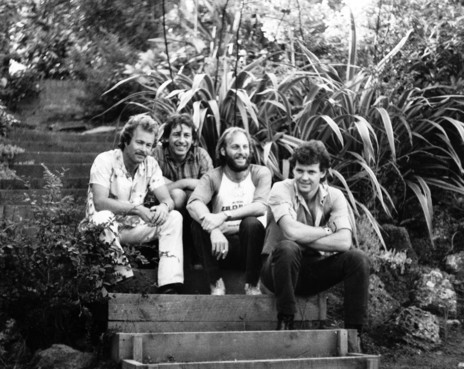
The Hammond Gamble Band, 1980s (L-R): Bruce Lynch, Hammond Gamble, Frank Gibson Jr, Stuart Pearce. - Bruce Lynch Collection
Then, a few years later, there was Dave Dobbyn’s first solo release after DD Smash, a single for the animated film, Footrot Flats – The Dog’s Tale. Lynch co-produced ‘Slice Of Heaven’, which had to be done in two days at Marmalade Studios in Wellington, with the help of a fancy new computer sampling synthesiser called the Emulator. With this, they created the Japanese flute sounds that give the song its specific character, along with the Polynesian male chorus provided by Herbs, which was overdubbed later. Hilariously, radio programmers wouldn’t touch the song, but their hands were forced when it did the unthinkable, and went to No.1 on the New Zealand charts for an unprecedented eight weeks. Lynch would continue to work with Dobbyn during his charmed run of singles in the mid-to-late 1980s, including the evergreen ‘Loyal’.
Lynch was also instrumental in the phenomenal comeback of 1970s singer-songwriter Shona Laing with a new, electronic sound, producing her 1985 single ‘America’ and the subsequent Genre album, as well as producing and arranging her big 1987 hit, ‘(Glad I’m) Not A Kennedy’.
For some, 1980s sampling technology represents a litany of sonic and aesthetic transgressions. Others remember the era with affection. Regardless of personal taste, one of the most recognisable hits from the era is Shona Laing’s ‘(Glad I’m) Not A Kennedy’ with its unforgettable ear-worm string simulation.
“I had come into possession of a Roland JPX3 with a built-in sequencer that I was using a lot,” says Shona. “I went along to Bruce with some ideas, and he took them apart and put them back together in a far more sophisticated way, with an Emulator keyboard sampler, which was a big deal. He used the original audio sample of violin and cello to do the string section of ‘Kennedy’, which happened very fast when we were in the middle of doing the Genre album. He just immediately set to work undoing the sequences and putting them back together again as a string quartet and the various pieces. Bruce was great like that, never short of an idea.
“Bruce was integral to part two of my career – and a wonderful human being, measured, mild and very funny” – Shona Laing
“There was a trumpet solo that George Chisholm played, and I remember being so impressed, the way he went over to the manuscript and wrote out a part, handed it over to George, who played it. That was pretty remarkable. Bruce is an arranger, but he also has all that production perspective, so he knows where he’s going to put things in an aural way.
“It was the beginning of part two of my career, and Bruce was integral. And a wonderful human being, measured, mild and very funny.” Genre was released over 40 years ago, in 1985.
Lynch: “The 80s was just busy-busy-busy. We built Mandrill Studios, and there was a whole rash of them: Dave McArtney & The Pink Flamingos, Shona, we did all the Hammond Gamble, Peking Man … a whole bunch of stuff in between the commercials and doing jazz gigs at night. Those were the days when you could have a residency somewhere four or five nights a week.”
Between working busily with local acts during something of a renaissance for New Zealand music in the 80s, he was still taking off for international sessions with the likes of Chris Rea and Richard Thompson. Having worked on an earlier album with Thompson and his then-wife Linda, Sunnyvista (1979), he was invited to participate on his 1985 album, Across A Crowded Room.
“That actually required two trips,” says Lynch. “I remember on the first day of recording [drummer] David Mattacks’s arm went into total spasm. He was just writhing on the floor in pain. So we’re in the studio there, and all his English mates, they go, ‘Oh, I hope you’re better tomorrow, Dave. Look, I’ve got to go and catch the train.’ They all buggered off and I had to take him down to the hospital. He was out of action, so I had to come back again.”
Lynch’s golden run of 1980s hits stopped dead at the end of the decade when he was bought out of Mandrill and, feeling disillusioned with the business side of production – and specifically the lack of financial accountability – he spent the 90s setting up his Boatshed studio and immersing himself in commercial work.
“It’s just the business model,” he says all these years later. “A producer goes in and works with an artist and you have an album contract which states that you get an advance on royalties. Then you have a small percentage of the sales. But you know, of all the stuff I did … I have not had one statement ever on earnings. I’m not joking!”
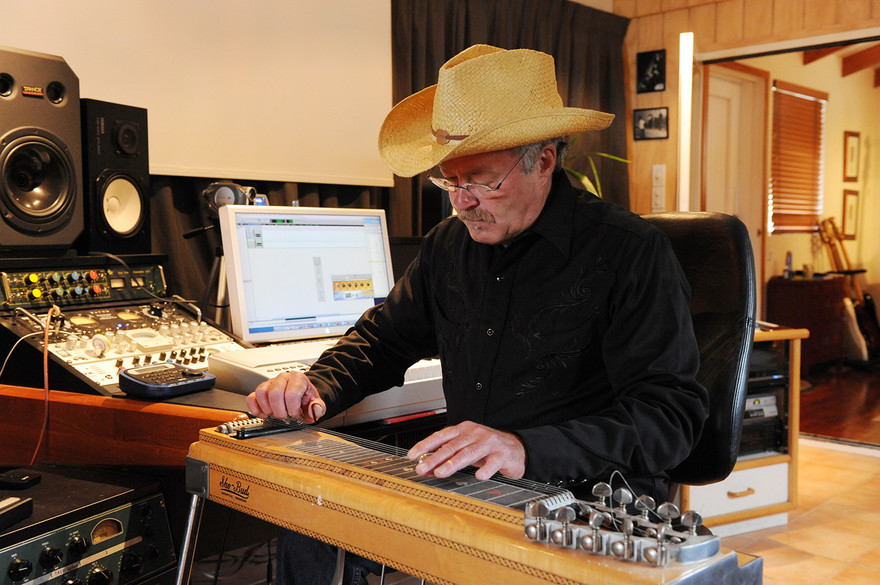
Bruce Lynch, dressed appropriately to play a Sho-Bud pedal steel guitar. The brand was founded by Shot Jackson and Buddy Emmons in 1955 in Madison, Tennessee - Bruce Lynch Collection
When I met up with Lynch for the first time in his Bayswater-based Boatshed Studio in 2018, he proudly played me some audio from the World Of Wearable Arts: super-slick big band arrangements with a high level of razzmatazz. He introduced me to his son, Andy Lynch, who has played guitar in bands Zed and The Feelers. His enthusiastic and super-friendly dog slobbered all over me and I got an allergic reaction.
This is the gorgeous setting in which he’s worked from the 90s on, mostly in the commercial domain. “The 90s were busy with commercials and, later on, film projects. Of note, in 1990 I produced a NZ Police TV recruitment commercial featuring Hammond Gamble with our version of ‘He Ain’t Heavy’ which I recently licensed back to them some 34 years later. All participants were rewarded, which has set hopefully a precedent for contributions by New Zealand musicians to soundtracks!”
Then in 1996, Lynch did the music for a full song-length Air New Zealand TV ad featuring Kiri Te Kanawa, which led to doing the arrangements on Kiri’s Maori Songs album in 1999.
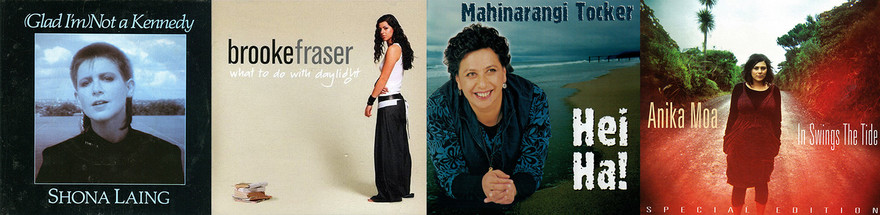
More Bruce Lynch productions and contributions: Shona Laing, (Glad I'm) Not a Kennedy (1987); Brooke Fraser, What To Do With Daylight (2003); Mahinaarangi Tocker, Hei Ha! (2002); Anika Moa, In Swings the Tide (arranger, conductor, 2007).
The 21st century has seen Lynch make a partial return to working with artists in various roles: performance, production and arranging. On Anika Moa’s 2007 album In Swings the Tide he arranged and conducted the strings and plays lapsteel guitar, and on her 2010 album Love In Motion he plays pedal steel guitar. On Brooke Fraser’s What To Do With Daylight (2003) he plays acoustic bass on one song, and on Paul McLaney’s Play On (2017) he’s credited for pedal steel guitar and producer/mixing/engineer. He’s a producer-arranger on John Hanlon’s 2021 comeback album Naked Truths, and was all over Mahinaarangi Tocker’s Hei Ha! (2002), playing piano, bass, guitar, programming, arranging strings, ukulele and double bass. Oh, he engineered, mastered and produced it as well.
Lynch has fond memories of Tocker: “She was an absolute darling. We did an album at the Boatshed, and my role was varied: arranger, engineer, tea-maker, etcetera. Miss that girl.”
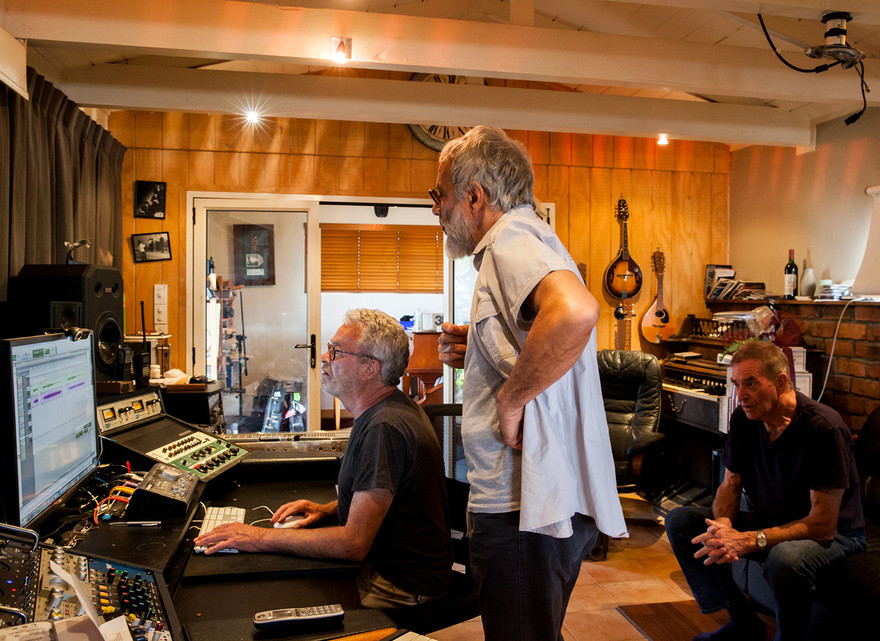
Bruce Lynch in the studio with Yusuf Islam/Cat Stevens. - Bruce Lynch Collection
When I met up with Lynch for a second time in 2024, he had moved home and studio to the gorgeous countryside location of Matakana, and he showed me around. Most of the hard work is done at his digital recording station and mixing desk, though there’s a room with a grand piano and his upright bass positioned and ready for easy action.
He played some of the dramatic music he composed for the Power Rangers series: four seasons, four years and 138 episodes. Divorced from the childish visuals, the pieces take on a life of their own, and it’s easy to understand the pride Lynch takes in these digital orchestrations. “Just to give you an example of the scale of that one,” he says, “here we have Mystic Force, the duration is nearly 13 hours of music. One series. That’s all in the box, the choir and everything. Shostakovich was a great reference. Mystic Force was all about magic.”
And how does he achieve the performance? “I use a sequencer called Cubase, and in my library there’s all the Native Instrument [tools]. It’s virtual.”
Ultimately, however, Lynch’s early big-band jazz influences – together with the arranging skills he learned as a student, decades before the advent of the internet and digital workstations – give him the musical know-how to do what he does.
“There are basic rules. The whole thing about music and performance, composing and orchestration is vocabulary, having the tools.”
He brings out and fondly thumbs through some precious mementos: Berklee School of Music books on basic music theory. Remembering legends like Duke Ellington, Billy Strayhorn and Quincy Jones, Lynch offers some advice: “There was one particular arrangement of a Quincy Jones composition for Count Basie called ‘Jessica’s Day’. It’s just a beautiful, beautiful recording. You transcribe stuff, and when you go and listen to stuff and work it out you actually learn a hell of a lot more than somebody just giving you, ‘this is the score for whatever’ or ‘this is Charlie Parker’s solo for whatever’, transcribed. Unless you’ve figured it out for yourself, which takes a lot longer, obviously. Some of the courses are good, but the ones that say ‘forget your theory, you don’t need to …’ just walk away.”
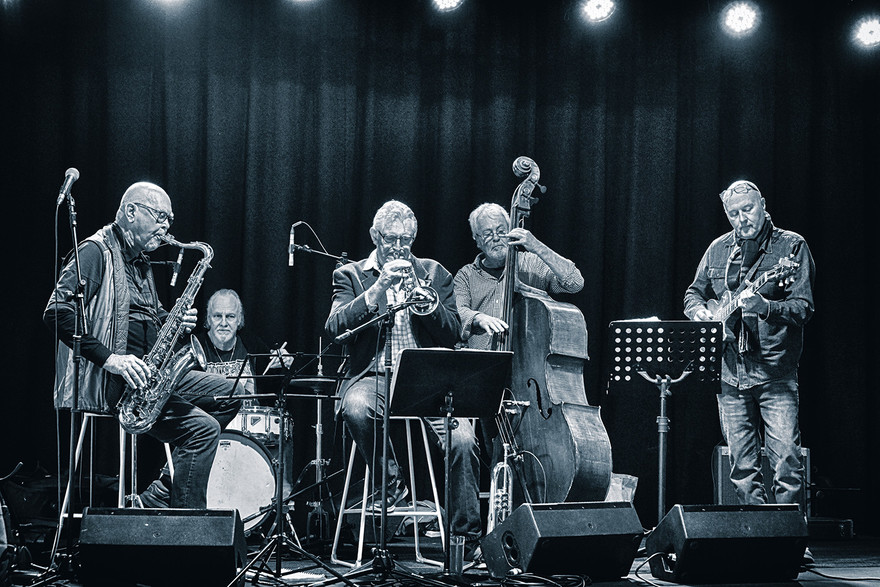
The Brian Smith band, with Smith on saxophone, Frank Gibson Jr on drums, and Bruce Lynch on double bass. - Bruce Lynch Collection
Like so many great New Zealanders, however, Lynch is humble about his abilities and achievements, while noting that he’s most often described as simply a bass player and a former husband of Suzanne, née Donaldson. Describing himself as “polyuntalented”, he’s happy to have taken on crucial roles that were, for the most part, less visible.
It seems inconceivable that he’d have time for anything else, but Lynch’s second passion is flying vintage aircraft – a recently finished restoration of a 1947 Tiger Moth.
--