Deirdre Lusby had never run, or even worked on, a music festival before. Her day job was raising three young children at Double D Appaloosa Ranch, the farm she owned with her husband, John Hore Grenell, on Whitecliffs Road, Coalgate, in Canterbury.
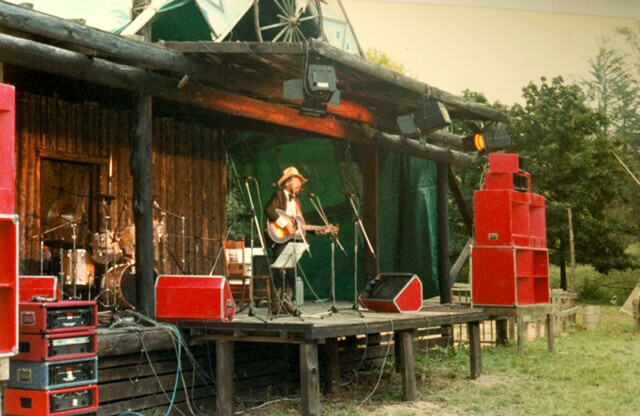
John Grenell opening the Whitecliffs festival in 1982.
But in 1982, she and John launched an event that would, under various names – most notably, the Whitecliffs Family Festival – become one of New Zealand’s longest-running festivals.
The story begins in 1981, when the producers of the Christchurch-based That’s Country caught a performance by the American-born duo the Gypsy Mountain Pickers and invited them onto the show – where John (then as John Hore) was a regular. They soon became friends – and John suggested that Deirdre expand from booking his shows and manage the Gypsy Mountain Pickers too.
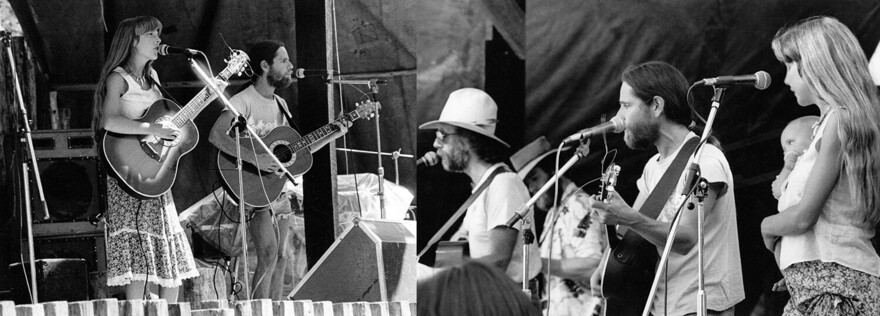
The Gypsy Pickers' Lindy and Ron Valente with John Hore Grenell at the Whitecliffs festival in the late 1980s. At right, Lindy is holding the Valentes’ daughter Crystal.
“So we took them on a concert tour, with John and Patsy Riggir,” Dierdre recalls. “And while we were in Timaru, I was sitting in the audience and everybody’s toes were tapping – they had very toe-tapping music those two – and I could just feel everybody wanting to get up and dance. So I said to John afterwards ‘we should have a barn dance, no we should run a festival’. Because John and I had been to Nambassa when he played there a couple of times, and we loved the atmosphere and music outdoors.”
Armed with the skills she had picked up years before on a secretarial course, Deirdre began organising a festival. While John prepared the farm, she and her sister ran off 100 or so posters with a Gestetner machine (“I turned the handle many times”) and hand-coloured each one.
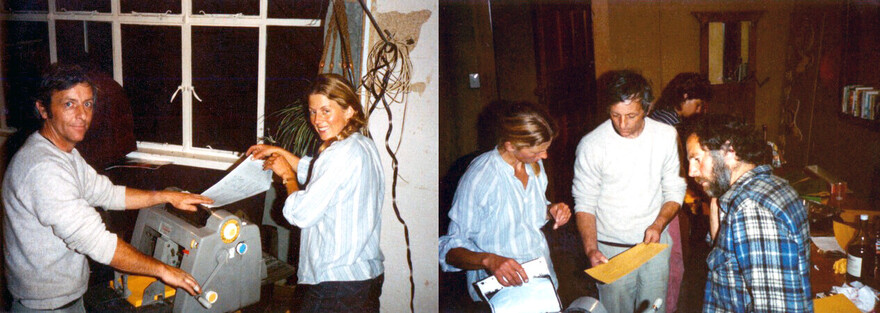
Deidre and John Grenell with friend at the Gestetner (mimeograph) duplicating machine.
The festival’s main stage was built onto the front of an old church they’d had trucked from Glentunnel with the intention of converting it to a barn. As would be the case for the rest of its history, there was a team of volunteers to help. Even the local council came to the party.
“I remember the health inspector coming out and helping dig one of the long drops. He was out there in a suit and shirtsleeves and took his jacket off and helped. They were just great.”
On Saturday February 20, 1982, the Malvern Country Folk Music Festival debuted with a lineup that included the Gypsy Mountain Pickers, Slim Pickins, Phil Garland and the Canterbury Bush Orchestra – and, of course, John Hore Grenell. About 500 people turned up. And it rained.
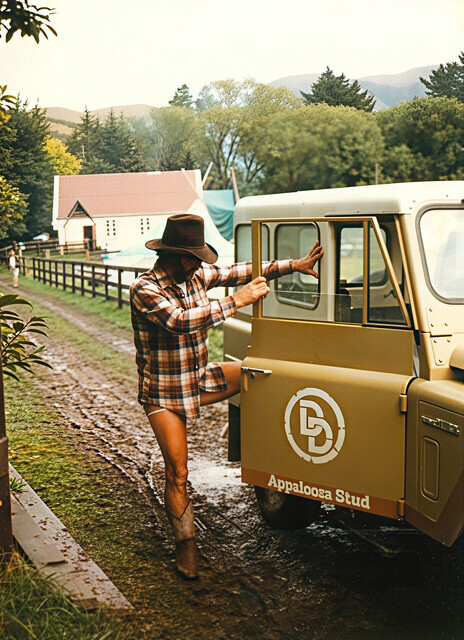
Whitecliffs festival, 1982: John Grenell after shedding his saturated trousers.
“Everybody danced in the mud on the first night, but I felt so sorry for the people in their tents in the rain. I drove around the camp in the morning with an urn in the back and said, would anyone like a hot drink? And then after the last act I said, come backstage and we’ll all have a drink.”
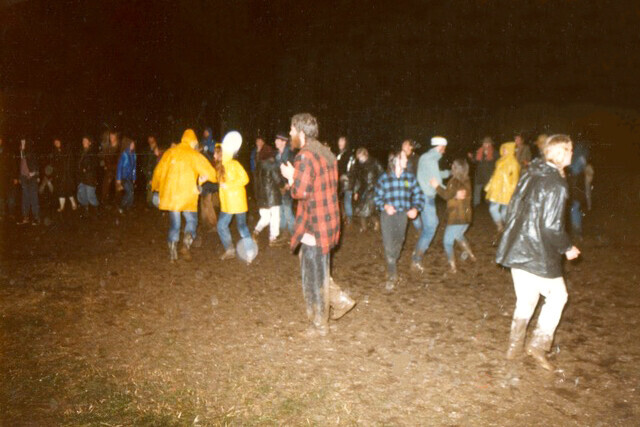
Whitecliffs festival, Friday night mud dancing, 1982
The inaugural event was deemed a success by The Press, which noted that “spirits were high” in spite of the weather. The following year, the printing of 2500 tickets was organised by accordion and harmonica player John Lloyd (formerly of The Cowboys and later the Ranchsliders and Coalrangers), who also took over duties on design and printing of posters, T-shirts and posters. Ashley Smith (the father of Wellington musician Tyson Smith) provided the programme illustrations.
Phil Spence, a friend of friends, joined the crew and later became site manager, after buying a paddock from the Grenells and moving from Christchurch. Andrew and Jane Dixon from the Mussel Inn in Tākaka built the festival’s second stage, The Little Forest Theatre.
Lloyd’s friend Bill Marks became a regular, bringing his family over from the West Coast and fixing vehicles and killing sheep to feed a growing crew of volunteers. Deirdre prepared the meals from the farmhouse, with help from a versatile crew. She continued to cook for up to 40 people for two weeks, until 1987, when Amiria, the youngest of the couple’s four children was born a few weeks before the event “and they said, right, you’re not cooking. They invited an Austrian chef to come out. And my oven was so dirty, it caught on fire. I was so embarrassed.”
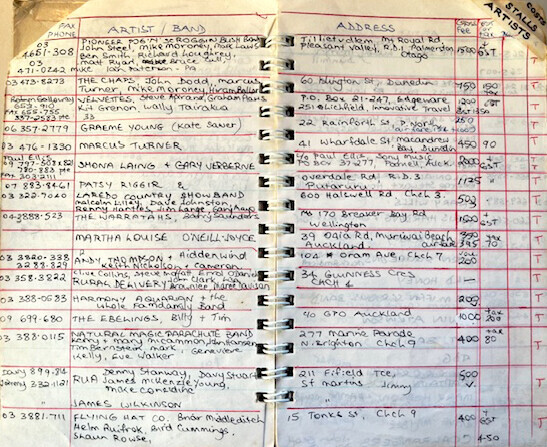
Deirdre Lusby's handwritten spreadsheet for the 1992 Whitecliffs festival.
Meanwhile, she was still running everything off an electric typewriter and her “handwritten spreadsheet” – the notebook she kept strung around her neck for easy access.
“Oh, a cellphone would have been so much easier! I lost a lot of weight in those early years, running from the house to the Main Stage to the Little Forest Theatre with messages. What joy when someone located three lovely old wooden turn-the-handle phones that were installed in those three places!”
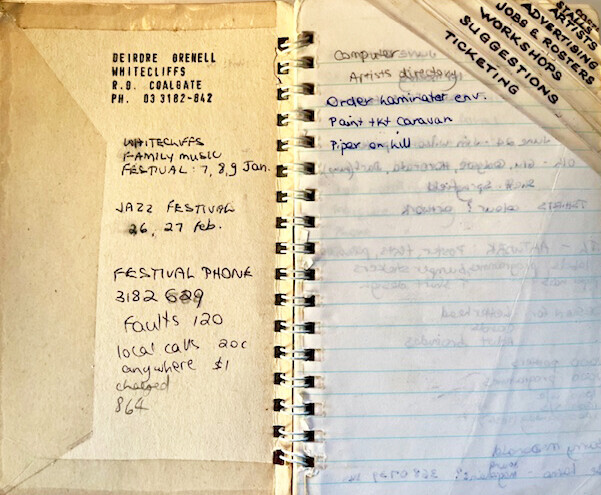
Whitecliffs festival, Deirdre's "bible" which she wore around her neck
In 1985, the festival hosted for the first time an act who would become good friends of the event: the Topp Twins. And they made an impression.
“They were they were so funny. They arrived and I said, look there’s a tent out there on the lawn, do you need pillows? And they said, oh you got a hay barn? I said yes it’s down the back paddock. Got some sacks? So they went off and made their own pillows.
“And then the neighbour came down and said we need some help in the shearing shed, we’re a bit short, and the girls just said yeah, we will – and so off they went and the neighbours didn’t really realise who they were.
“Apparently they grabbed the huge rams and they shore and shed-handed and really pitched in – and then the next day when they were on stage the neighbours came down and realised who they were.”
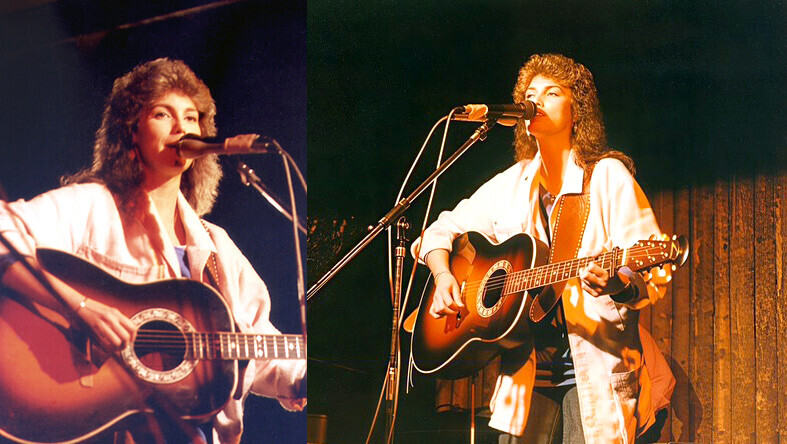
Emmylou Harris at Whitecliffs festival
The festival’s most famous guest was a surprise – even after she started playing. In 1984, That’s Country brought country legend Emmylou Harris out to Whitecliffs as part of a documentary it was making about the country legend.
“She did a set. She’d had her hair cut and it was very curly, which wasn’t the very long straight hair most people remembered at the time. So when she came on stage, I think a lot of people didn’t realise it was her – and probably weren’t expecting it, because we didn’t do any build-up, we just thought, this is a nice surprise. Then people realised who she was, and went wow!”
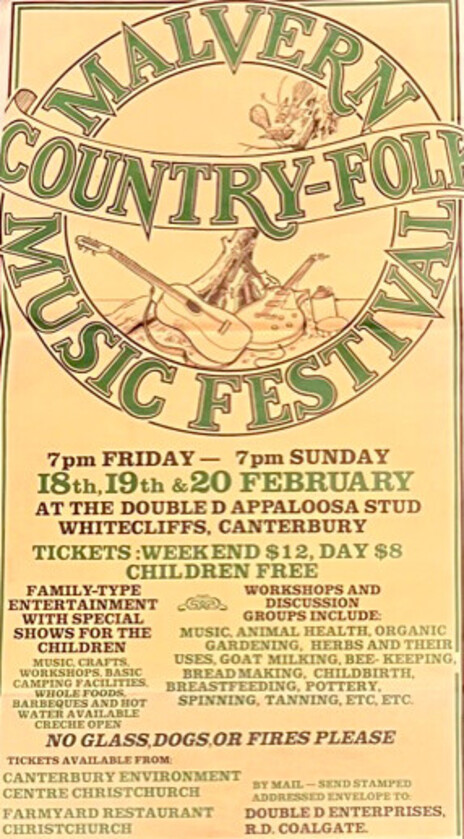
Whitecliffs festival 1983 poster
As the festival continued, and cycled through names – it was Malvern Country Folk Music Festival in 1982, 1983 and 1988, Whitecliffs Music Festival from 1984 to 1987 and Whitecliffs Family Festival from 1990 to 1994 – the annual crowd grew to around 5000.
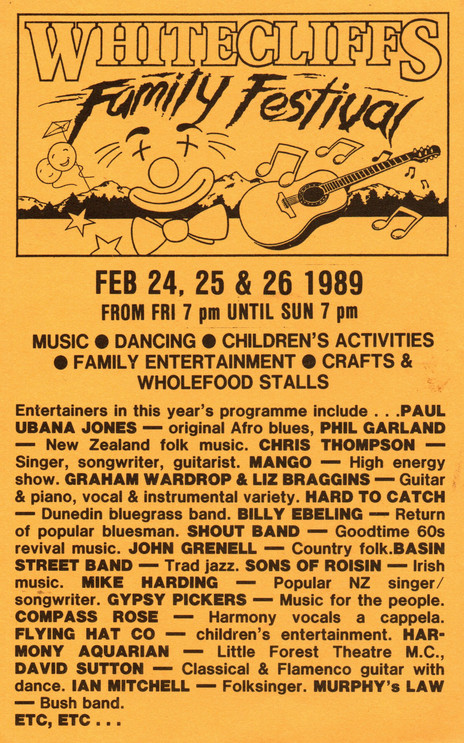
The lineup for the 1989 Whitecliffs Family Festival.
The core team of four was completed when publicist Barb Cuttance joined Deirdre, Spence and Lloyd. (It was through the festival that Cuttance met Mike Waldegrave, whose company The Soundpeople ran its PA systems. The pair would later go on to run a local talent quest that went nationwide as Smokefreerockquest.)
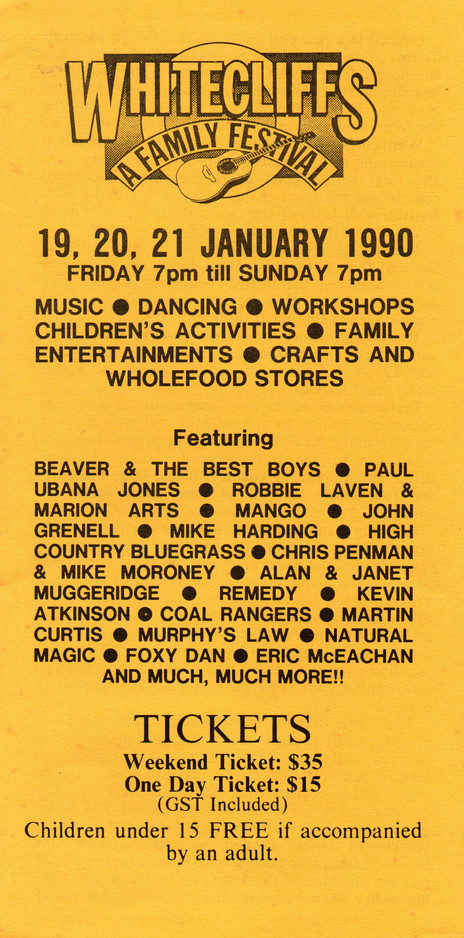
The 1990 Whitecliffs family festival lineup included Mike Harding, John Grenell, Beaver and the Coal Rangers
Deirdre, meanwhile, finally got a computer and upskilled. She completed a diploma of Sport and Recreation with modules in event management, programme planning and working with volunteers – all things she had already been doing. She still didn’t get to catch a lot of the music she presented.
“I had to be in the house, near the phone and the children. I learned to invite artists into the house to tune up and practise if they needed to, so I could enjoy the music as I missed most of it on stage. I had always enjoyed classical music, so a highlight for me was putting together a classical concert in the house. Many of the musicians had had classical training and were able to switch genres for the concert.
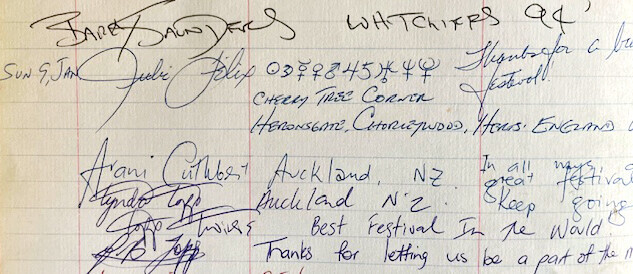
Whitecliffs festival signatures from 1995, including Barry Saunders, American-British folk singer Julie Felix, Lynda and Jools Topp, and their long-time manager Arani Cuthbert.
“But I made a point of hearing the Topp Twins, as they were such a wonderful duo, on and off stage, bless their gingham skirts. Phil Garland and the Canterbury Bush Orchestra were always popular and I loved watching people of all ages, getting up onto the sawdust, which we spread after the first year of a very muddy dance floor, to learn a barn dance and having so much fun. And the Gypsy Mountain Pickers played irresistible rhythms to get everyone up. Stilt walkers fascinated me and how they strutted and danced on soft earth always amazed me.”
Mostly, though, Deirdre was “never able to party along until the final night, when a friend offered to put down a hangi – which became a welcome tradition.”
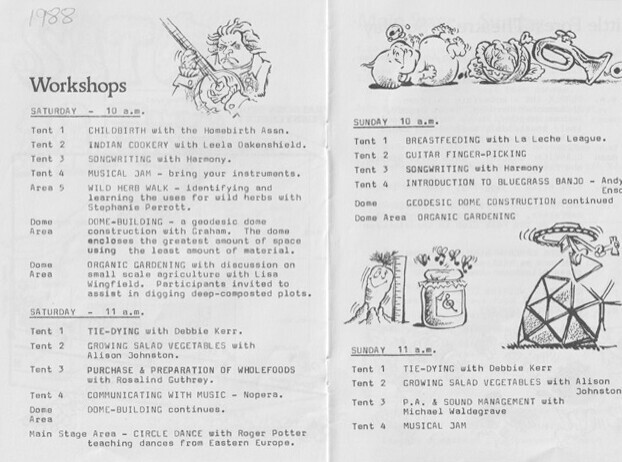
Whitecliffs festival 1988 workshops
One idea she and John had picked up from Nambassa was the workshops which ran in the mornings at the Little Forest Theatre, covering topics like bread-making, animal health and songwriting. Unlike Nambassa, nudity was not encouraged.
“We only had one guy, who we told it was inappropriate, because it was a family festival, thank you very much.”
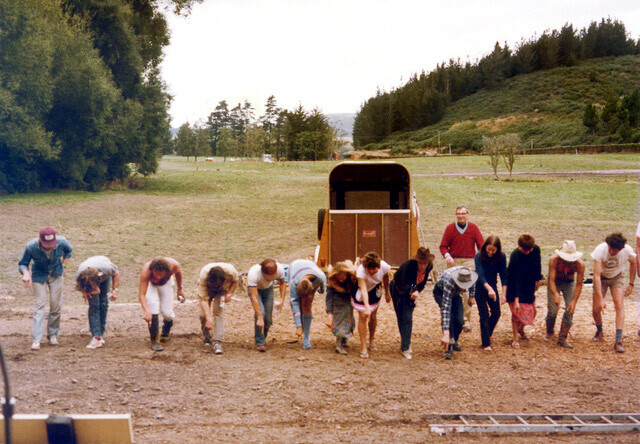
Whitecliffs festival, the cleanup drill was nicknamed "Whitecliffs Shuffle".
Deirdre and John’s own family was immersed in music. In 2015, singer-songwriter Amiria Grenell, their youngest, recalled in a Sunday Star-Times interview being “a young’un and dancing in the sawdust to all the different styles of music that were being performed, being inspired by the musicians I met in our lounge, the workshops, the river swimming, the amazing crew that would come and help and work so hard every summer to get the festival up and running. It was so exciting as a kid to be a part of it all.”
Amiria and her brothers all played music. Denver, the eldest, played bass and drums, Oakley sang and played guitar and Redford played drums – and later became the founding drummer for Shapeshifter.
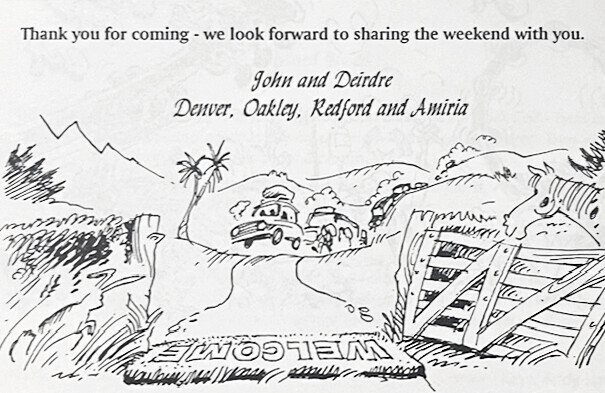
Whitecliffs festival welcome.
“I think the festival had more influence on them than having a musical father,” says Deirdre. “Because he didn’t actually practise much at home, or he got up really early in the morning and learned a new song. It was more the exposure from the festivals. I can remember Redford coming in at about eight years old, saying, I really like jazz and blues, Mum. And I thought, well, he hadn’t been hearing that in the house at home.”
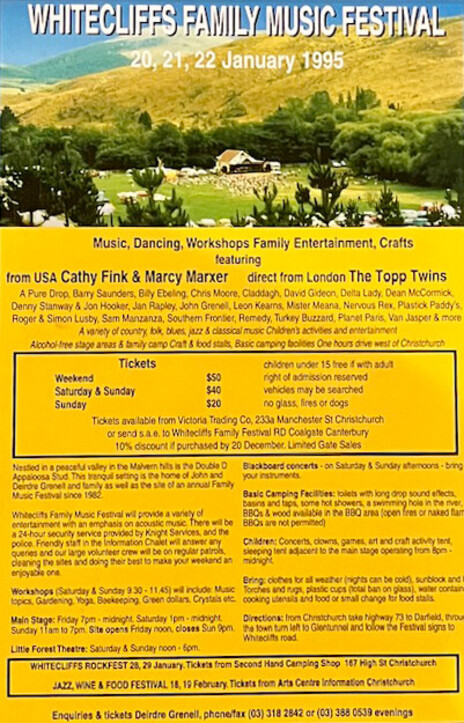
Whitecliffs festival 1995 poster.
The year 1990 would turn out to be a big one for the family and the festival. That year, the name Whitecliffs Family Festival debuted, formalising a decision to steer it towards family groups and away from rock music, which had brought a “small but undesirable element,” Deirdre told a reporter from The Press.
“Our vision for the festivals was to support homegrown talent with an equal billing of Kiwi musicians,” she says, “as well as attracting an audience that enjoyed the whole festival atmosphere, rather than bringing in overseas acts and having people coming just to see headliners. The compliment we treasured was when someone said, ‘It’s the one event of the year that our whole family enjoys’.”
Beaver headed the 1990 bill and Spence and his crew put together a big new shower block with 40-gallon drums and a large wood burner to serve a crowd of 5000 (“That was as many as we wanted the site to handle”).
The Press reported baking temperatures and “a diverse range of people (law clerks from Riccarton, bone carvers from Golden Bay, tourists from Germany)”, along with “surebeat South American rhythms” from Christchurch group Pacha Mama, theatre, barbecues and “ethnic everything”.
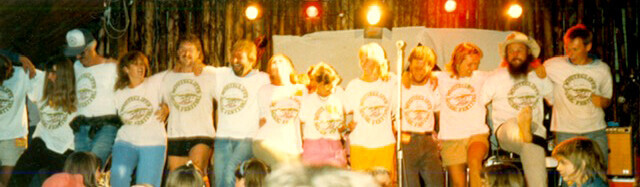
Whitecliffs festival stage dancing.
The festival also received a community initiatives grant from the 1990 Commission.
“The four of us formalised our roles that year and hoped to earn some remuneration for all our hours of work. But we never earned more than pocket money – it was a labour of love, and all for the music and the people. John would often have head off to do more gigs to cover the expenses.”
That same year, John’s career got a major boost after Toyota picked up his version of ‘Welcome to Our World’ for a long-running ad campaign. They decided to lease out the farm and move to Waikato, to be nearer all the work that was coming his way, and to Deirdre’s own family.
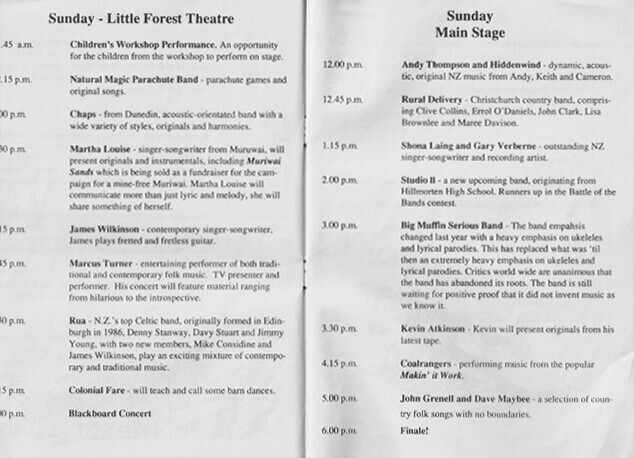
The Sunday lineup at Whitecliffs festival, 1992.
It would prove to be the festival’s peak. Although the team sought to diversify – debuting a jazz festival in 1994, then running the Family Festival, a Jazz, Wine and Food Festival and Rockfest on the site in 1995 – the tide was ebbing.
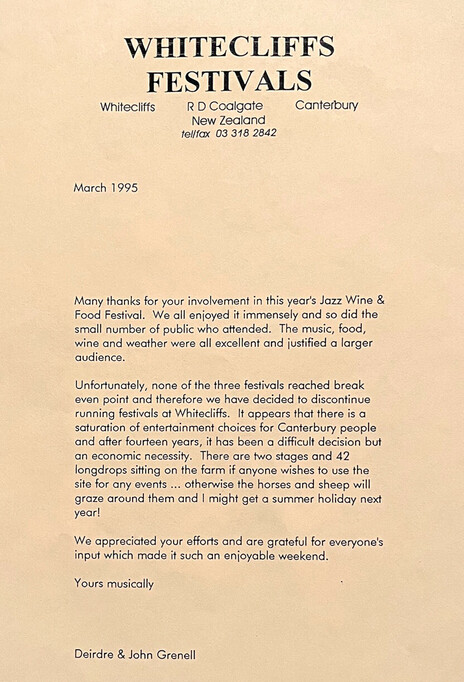
Farewell to Whitecliffs: a letter from Deirdre and John Grenell, March 1995.
In March 1995, Deirdre wrote a letter to stakeholders in her and John’s name, explaining that none of the three festivals that year had broken even. The “difficult decision” to bring it all to close after 14 years did, however mean that “I might get a summer holiday next year!”
It would not be the entirely the end. In 1986, the workshops had become so popular that Robert Hunt, who organised them with Deirdre, spun them off into the week-long Towards 2000 festival at the Whitecliffs site, which focused on “personal renewal, sustainability, and community connection”.
Deirdre: “And all I had to do was enrol in workshops and carry a plate to be fed – bliss!”
That later became Convergence 2000 and operated at the Whitecliffs site until 1994, when, after a very wet year at Whitecliffs, it relocated to the Journeys End campground. It continues to this day at the drug and alcohol-free Convergence Gathering.
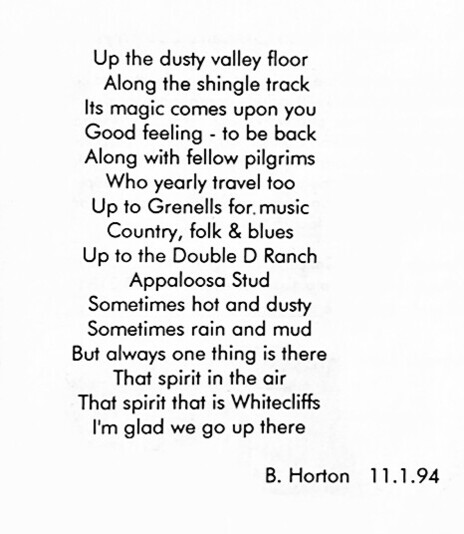
Whitecliffs festival, poem from a fan of the festival, B. Horton 11.1.94
In 1995, the pioneering outdoor dance party Entrain moved from Tākaka to Whitecliffs for a year. In October 1997, the site hosted The Gathering Christchurch, a warm-up for the main Gathering event near Nelson.
Simon Blackburn ran the New Beginnings dance party there in 1998 and 1999. Blackburn later teamed up with Oakley Grenell to stage I-Nation, which ran from 2007 to 2009 and featured Ladi6, Shapeshifter, Tiki Taane, King Kapisi Sunshine Soundsystem, Bunyip and many others.
“Until they realised that it’s a lot of work for very little income,” Deirdre observes. “But they had a lot of fun.”
For all the work, Deirdre’s memories are fond.
“I’m 77 now and still meeting people, my children’s friends, saying, oh yeah, my parents used to go to that, we went as kids and we really loved it. And so I’m thinking, oh gosh, it’s that long ago, isn’t it? And looking at the old programmes, I would still love to attend those festivals!”
--