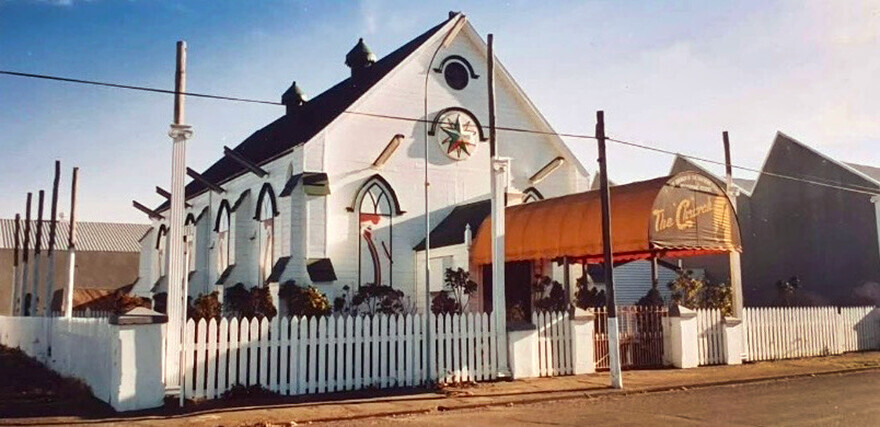
The Church, Coronation Street, Ahuriri, Napier.
Since the mid-1990s when the doors were locked shut on this Napier landmark, it has caught the eye of anyone passing, curiously admiring its dilapidated beauty, leaving them wondering how a beautiful church could possibly be left to ruin.
Originally built on Convent Road, Napier Hill. in 1873, St Mary’s Catholic Church was one of Napier’s first churches. It’s a beautiful kauri building with two stained-glass windows adorning its frontage, and the smaller of the two windows is still intact. The church was partially dismantled in 1910 then reassembled on its current site on the corner of Coronation Street and Te Atu Street, Ahuriri. Considering bullock trains, horse and carts and a steam traction engine were the transport of that day, it was a phenomenal feat.
The inner harbour waterline across the road from the church is clear to see in an original photo of Coronation Street. This image was abruptly altered during Napier’s devastating 1931 earthquake when the land was thrust up and reclaimed. Today, houses occupy this land.
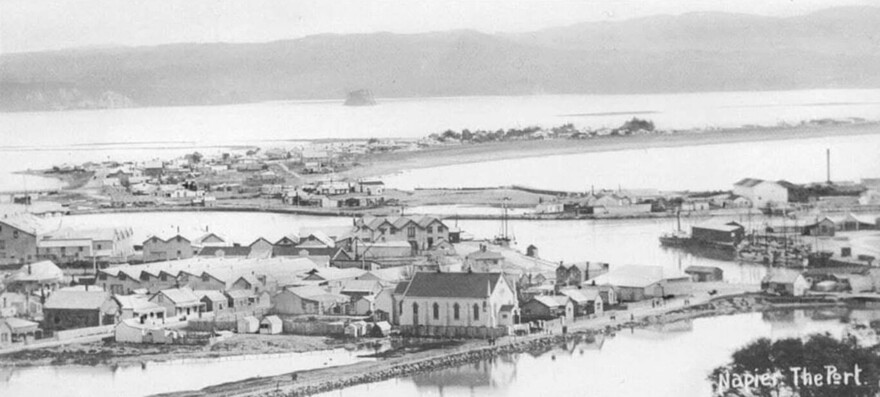
St Mary’s in its Ahuriri location, showing its location after 1910 and the inner harbour waterline. - Michael Fowler Collection
After nearly 70 years of church gatherings the building was put on the market and sold in 1983. Facebook memories and comments tell of many weddings from 1914 through to the 1970s. Another Facebook comment relating to the church in the 1960s mentions that visitors had a clear vision – still there – of the bright green marble Jesus and the cross above the altar.
Absolutely steeped in history and, sadly, partially derelict, the next chapter of St Mary’s was its resurrection after its sale in 1983 to a local businessman, Brian Finch (1939-2024).
This time it was for the love of music as it became The Church of the Southern Cross Recording Studio.
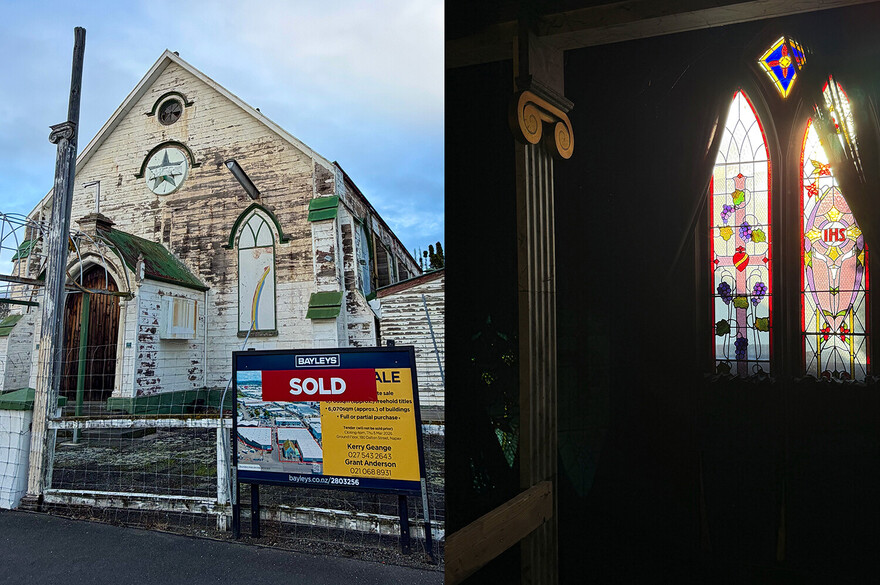
Going, going: The Church, outside and in, 2026. - Photos by Lee Pritchard
Finch was a former three-quarter, drag racing and motorbike speedway driver. Along with his father Alec Finch, he owned and managed the family run businesses Hawkes Bay Agencies and Alron International. Hawkes Bay Agencies was a musical instrument import company, and Alron International was next door in the Onekawa Industrial area, making guitar amps and PAs.
They purchased a huge PA system for The Church, and a state-of-the-art Allen and Heath System 8 Model 2416 recording and mixing console for $6500. The stage was set for the next chapter for the former St Mary’s to begin.
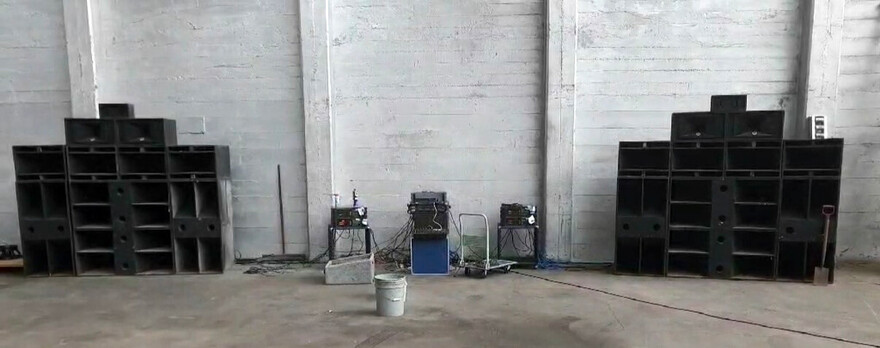
Speaker stacks at The Church, before the sale, 2026. - Photo by Lee Pritchard
With the owners being in the music equipment import business, the sound at The Church was always going to be top notch. There were eight speaker stacks and a total power of approximately 7000 Watts. There was also a complete hire rig available to all bands that needed one for gigs; they were the “go to” company for bands wanting gear in the 1980s.
A late 1980s article in the Hawke’s Bay Herald-Tribune states the intentions of the new owners: “It would appear that the name ‘The Church’ has been somewhat misleading. Although the building was formerly St Mary’s Catholic Church, any resemblance to a church, other than structurally, was no longer seen or heard.” This is very apparent inside where the ornate original floor-to-ceiling kauri pillars and altar had been painted white to resemble more of a marble Roman amphitheatre look.
A few months after Brian Finch purchased the building, a group of priests were organised to deconsecrate the Church. Shortly after, when the roof was painted, the ornate crosses that adorned the ridgeline were removed.
In 1984, Phil Drinkrow (formally working in design at Jands, an Australian, audio, video and lighting company) became manager of The Church. As a musician also for local band Homegrown (bass and guitar) he became a great friend of “Finchy” and stayed with The Church right until the very end.
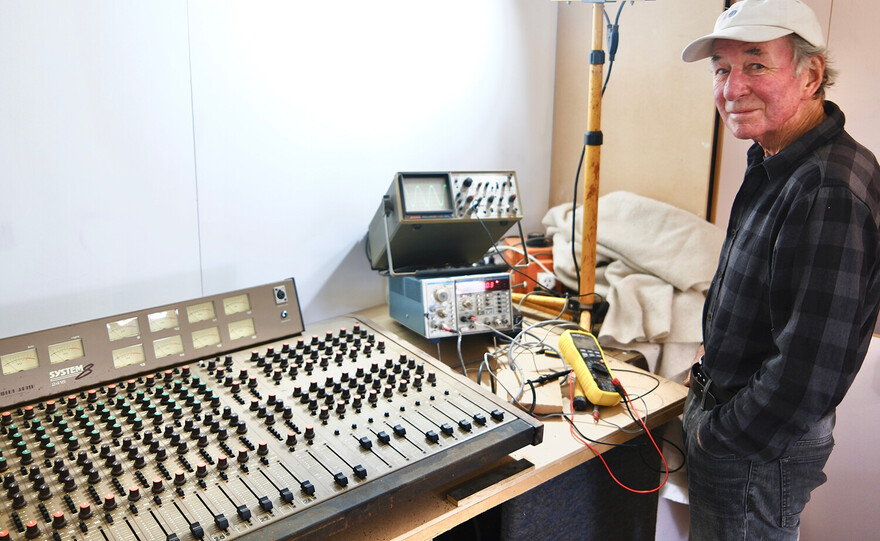
Phil Drinkrow and The Church's Allen and Heath System 8 Model 2416 recording and mixing console. - Photo by Lee Pritchard
Recalling those great days Drinkrow said, “The Church had the best gear, Brian didn’t do anything by halves, [it was] all locally built by Alron. These were the days of the last New Zealand made stuff before the government of the day removed the import tax.”
Phil says, “As the sound engineer for the Church Recording Studio I recorded many great bands over the years from all genres [including] The Colonials, Brenda Coley Anderson, John Martin, Emulsifier, Bluebeard Blues Band, Wicked Sensation, M.A.D, Third Party, the Housetruckers Blues Band from Palmerston North ... to name a few!”.
Brian had the agency for Ibanez, which meant he knew a few people in the industry, including AC/DC drummer Phil Rudd; he was also friends with Santana’s manager. It was through the Ibanez connection that he met Billy Kristian (Billy Karaitiana, legendary bass player of the Invaders and the Meteors), who visited the Studio in 1984, along with Mike Farrell and a drummer from Auckland. They came down to play the opening gig at The Church for Brian.
“Finchy loved ‘out there’ ideas,” recalls stalwart Hawke’s Bay musician Joe Atkin. “I painted up the decorative window bays on the exterior and I remember saying to him it would be cool to hang real guitars outside. They would have to be munted first obviously, and Finchy was in the best place to find some.”
Lots of local musos helped at the start, all providing their individual trades and skills, particularly on the interior. Finchy had the best musical gear available at the time in there, just as he wanted. He was always wanting good bands to come and record there. A couple of outfits abused the facility at some stage, however, making him more selective. (You don’t piss Finchy off!)
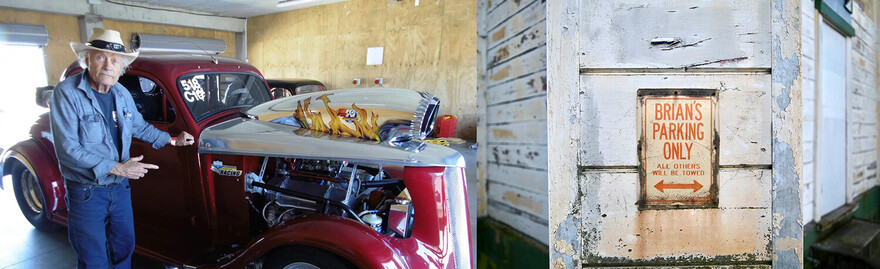
Brian Finch with another restoration project; a personal Brian parking spot at The Church.
“He was a real character, a little crazy, but fun,” says Atkin. “He would come into a pub like a chief, sitting down to talk – and he would gradually flip into an American accent within minutes. He travelled a lot, wore cowboy gear at times. He was very successful. With him and his father Alec owning the original Hawkes Bay Agencies, they had the Fender franchise for New Zealand and Tama drums. No one else at the time could import them.”
The addition of old street lights from Napier’s Marine Parade was another interesting move. They were modified to LED lights and the entire building glowed at night, looking quite spectacular.
With the demise of Napier’s only youth venue Michael’s Place – “The pub with no beer” – it showed great foresight to open The Church up as a place for 15-20 year olds to enjoy live music in a safe, drink- and drug-free environment.
Napier had many venues at the time with the likes of the Hotel Cabana, Mossy’s, The Criterion and The Iron Pot Cafe. But The Church was Napier’s missing link for youth entertainment. They promoted themselves to all the local schools, giving young bands and high school bands the chance to audition for a spot at the weekly gigs. Free buses were offered for hostel students to and from the shows, food stalls, and deals such as five kids getting entry for the price of four, only $20.
On the last day of winter term, Friday 18 August 1989, The Church was back in session. It is uncertain how many attended but in its day as a “proper” church it would seat 350.
Not only did The Church provide gigs and bands a stage to perform on, they contacted every high school in the region, offering to pass on their knowledge of the music industry to students who were interested in the technical side of things – recording, stage set up, lighting and sound.
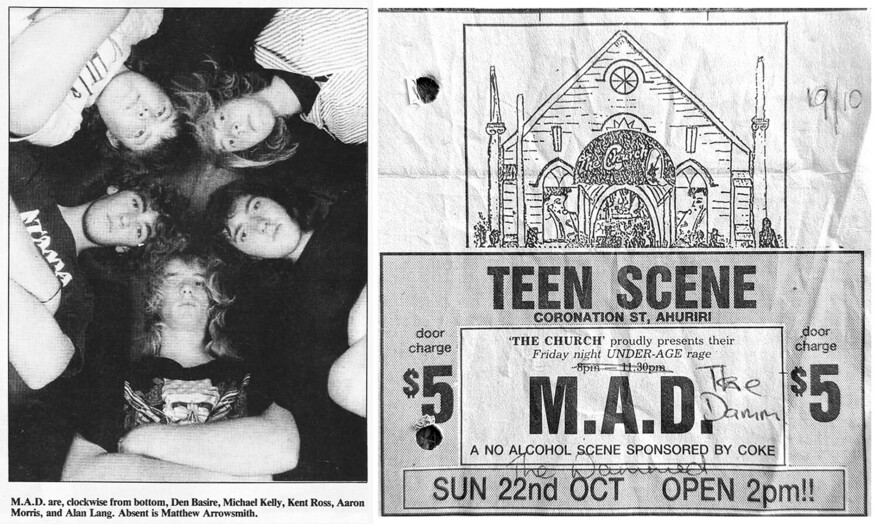
Battle-of-the-Band winners M.A.D. present an alcohol-free gig at the Church, Napier, 1994.
One local band in particular, M.A.D (Mutually Assured Destruction), from Tamatea High School, held a resident band spot for a period.
In 1990, 23 bands entered a Battle of the Bands: two nights in which about 1000 punters paid $4 each to watch the competing acts. Peter Thwaites, co-organiser of this event, remembers that it started out fine, but Brian got upset about some imagined sleight and threatened to stop the whole show. “Fortunately the kids were none the wiser. Once the event was over, he was all sweetness again and talking up the event for the following year at his place.” (Unfortunately it didn’t take place the following year.)
This competition was sponsored by Warwick Mather from Mathers Music World and the first prize included recording time at The Church.
When M.A.D won the debut competition they had 22 original songs to their name. After its members left high school the band continued playing gigs at different venues but The Church was their prime motivation for music, due to the support and encouragement from Brian Finch and Phil Drinkrow.
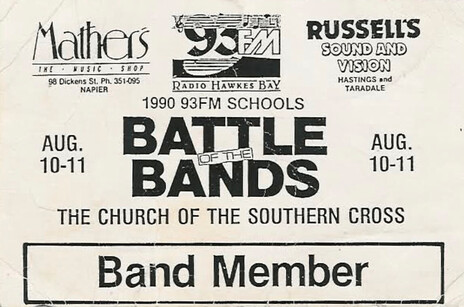
Access all areas: a pass for the 1990 Battle of the Bands at The Church, Napier
Reaching out to local musicians for this story triggered memories of fantastic times. Ivan Sawyer played drums on a few of Drinkrow’s recordings, and always felt welcome hanging out there on the odd Friday night sessions.
Neil Matcheson, who played there a few times in his high school band, DAMM, says “Brian was constantly supporting young musicians which was very cool, by putting on all age gigs on weekend afternoons.” Matcheson also recalls he played at another battle of the bands event, the precursor of Smokefreerockquest. “It was always a huge buzz for us young guys to play on a big stage with a huge sound and I used to love plugging into the Mesa Mark II stack that was on my side of the stage. I remember a really nice bloke called Phil Drinkrow who ran the shows and got us all organised and tuned up.”
The 1980s saw many Hawke’s Bay bands playing original music and covers at local venues, always to enthusiastic crowds. Steve Blair (bass player, Bedside Manner, and singer/bassist in Exocet) fondly recalled The Church, and its support to Hawke’s Bay musos. “All I can say is I’m happy I was around when Brian had The Church operating because it gave me/us somewhere to hang out and enjoy what we loved doing – being in a band, and having a common space where we could be together. We felt welcome and part of the scene we loved. It wasn’t restricted to Saturday nights, it became somewhere to go at any time as it was set up and ready to go whenever we wanted.”
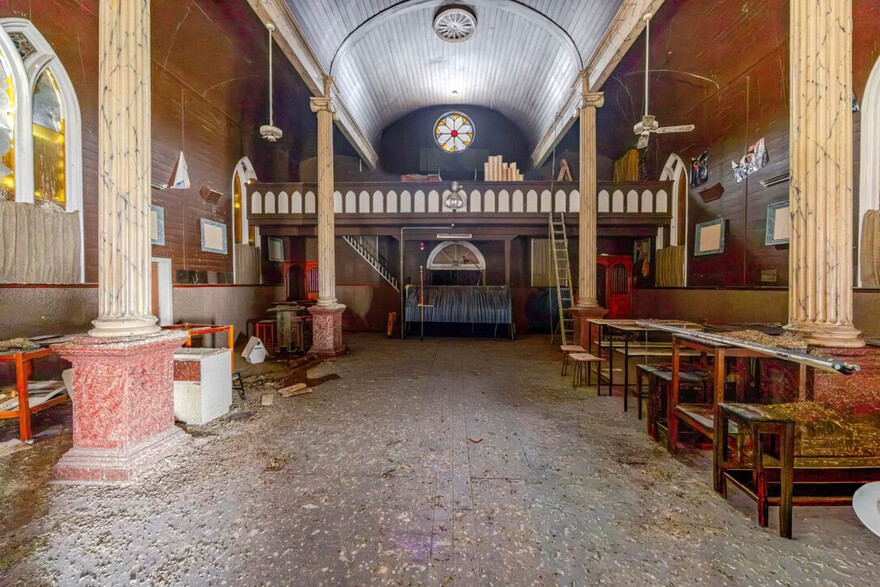
The Church, Napier: the view from the stage, 2026. - Photo by Lee Pritchard
In July 1991 Glen Moffatt and his band The Colonials recorded at The Church. Glen recalls that Phil Drinkrow engineered, with assistance from Brian Finch, “although I don’t remember exactly what Brian did. I don’t think it was being used as a live venue at that time, but it had a stage and equipment. We set up on the stage as if playing a gig, and Phil was in the control room backstage.”
The Colonials – Glen Moffatt, Ian Turbitt, Simon Beattie, and Tamihana Johnston – gigged regularly at a nearby venue, The Iron Pot Cafe. They sought to play entirely all country music. Tamihana’s 13-year-old son, Jason Johnston, would occasionally fill in and jam on drums with the band at The Church, while his dad played bass.
Jason Johnston, now drummer in the internationally acclaimed band Jakob, recalls those days as being a leading inspiration to pursue his music career. “To watch and play with professional musicians at an early age was such an amazing opportunity.”
Simon Nixon, also from the Bay, recalls the good old days at The Church with Finchy and co. “It was a great place to hang out and jam. I practised a lot down there. It was brilliant way to try it all out the gear – the amps and speakers. I was working next door at the time in the woolstore, so it was very easy for me. I married my wife Glenda at The Church in November 1995. I believe it was the very last function held there before Finchy locked the doors forever due to various compliance and noise issues.”
So, in a very serendipitous way The Church ended with a wedding, a musician’s wedding. The Church became a Church again, just for one day.
Brian Finch, the owner of the building, died in 2024. I thought it was time to capture this gem’s history. As a Napier teenager, The Church was an exciting and inspiring place to watch live music. I was there in 1990 watching the Battle of the Bands. I can also recall seeing Wicked Sensation and Hanging Tree there.
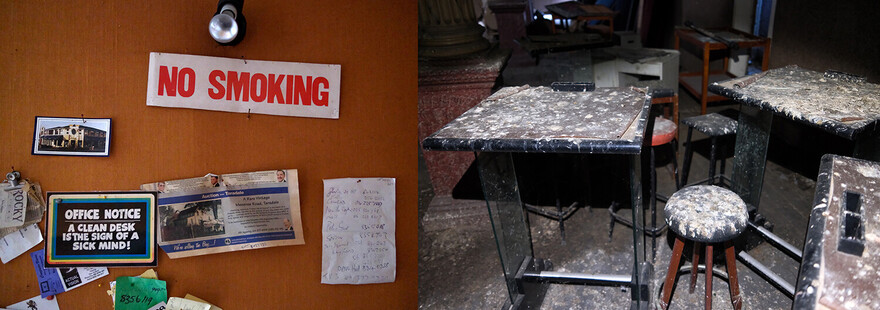
Abandoned ephemera at The Church, Napier, where some recent inhabitants left their mark. - Photo by Lee Pritchard, 2026
To go back into the building after all these years was surreal, a flashback in time. I found an empty room where thousands of people had enjoyed either church services or Church rock bands. Still on the walls were the posters (Steve Vai!), and No Smoking signs; there were pigeon droppings everywhere. Tidily gathered behind the front door was the red carpet and stanchion poles and ropes. Thirty years after The Church doors had been closed and padlocked, all chattels were paused in time and locked in the building after too many noise complaints and compliancy issues.
In 2026, The Church was put on the market; getting it into saleable condition after 30 years was an enormous task. All musical equipment had been left in place. The recording desk, the PA, amps, speakers – everything. Unfortunately it was covered in pigeon droppings and a few items were also damaged by the odd roof leak.
It was Brian’s mates and former work colleagues who undertook the task of dismantling the place. The same electrician that ran all the wires – nearly 40 years ago – was back, undoing all his hard work. There were guitars, some very collectable; along with other items these were taken to the local auction house or listed on TradeMe.
The Church was sold in 2026. Who knows what its next purpose will be; speculation is that it will be dismantled again. But the echoes remain, and the rumours that Sting, Elton John and Santana once recorded there ...
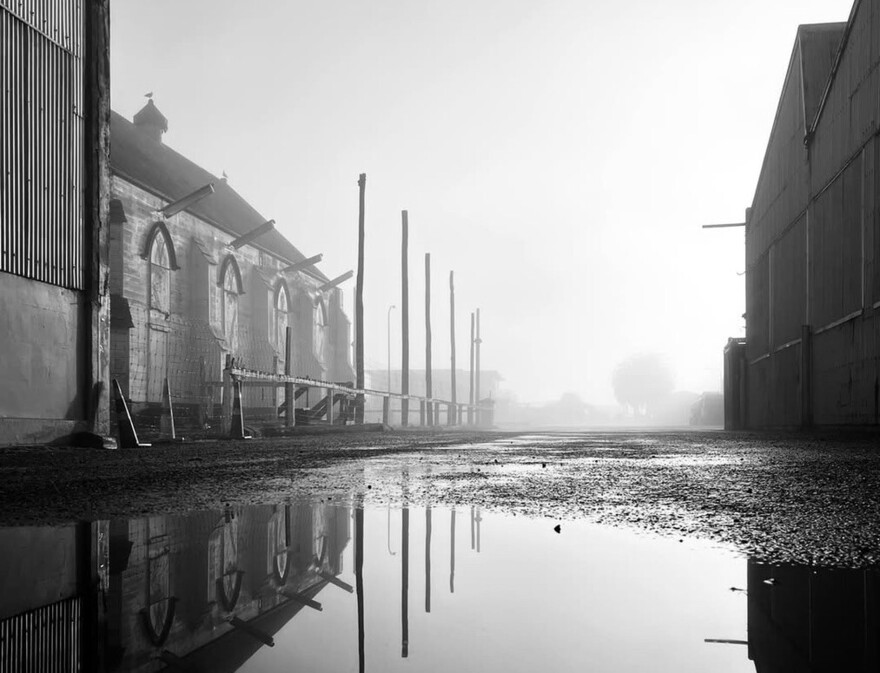
A final moment of reflection at The Church, Napier. - Photo by Lee Pritchard, 2026
--