Continued from Poetry as Music, 1
Selina Tusitala Marsh
There are powerful rhythms and repetitions running through the poetry of Selina Tusitala Marsh that already feel like music.
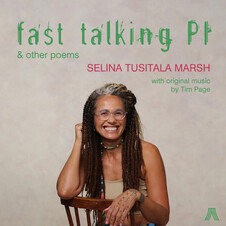
Selina Tusitala Marsh - Fast Talking PI and other Poems, with original music by Tim Page (Auckland University Press audiobook, 2025)
Marsh has been an irrepressible presence in New Zealand and Pasifika poetry since her first poetry collection Fast-Talking PI was published in 2009, with two further collections of poems and three instalments of the ongoing Mophead series (recommended for readers from 8 to 80). She’s been this country’s Poet Laureate, and is currently the inaugural Commonwealth Poet Laureate, a position she will hold until 2027.
Fast-Talking PI came with a CD containing seven of her poems accompanied by music composed and performed by multi-instrumentalist Tim Page. In 2025 a bigger collection of Marsh’s recitations, with Page’s accompaniments, was released as an audiobook (also under the title Fast-Talking PI.)
What Page adds doesn’t turn these poems into songs so much as amplifies the music that’s already there. The handclaps and ukulele on ‘Airport Road To Apia’ propel the poet’s journey as she drives towards the Samoan capital itemising the sights along the way. By contrast, the resolute minor chords of ‘Calabash Breakers’ underscore her defiant ode to the rebellious heroes of Pacific mythology.
Arthur Baysting
The late Arthur Baysting is a beloved New Zealand songwriter. He co-wrote The Crocodiles’ classic ‘Tears’, which is still performed widely. ‘Waltz of the Wind’, another popular Baysting collaboration, was recently covered by Australian-based duo Dog Trumpet. Children’s entertainers Suzy Cato and Justine Clarke regular perform his songs.
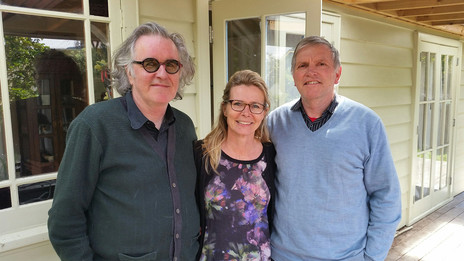
Arthur Baysting (right) with children's songwriting collaborators Peter Dasent and Suzy Cato, Auckland. - Suzy Cato collection
But before Arthur found his musical tribe he moved with a bunch of young Auckland-based poets, which included Alan Brunton, Ian Wedde, Russell Haley and Murray Edmond. In the early 70s he could be heard at readings and found in publications such as the Brunton-edited journal, Freed. In 1972 he published his own volume of poetry, Over The Horizon, and the following year edited the landmark anthology The Young New Zealand Poets.
A lifelong love of songs eventually led him to collaborating as a lyricist with musicians like Tony Backhouse, Bill Lake and Fane Flaws, but he would still sometimes write verse for its own sake.
‘Knights’ started out as a children’s rhyme – never intended to be sung – but when he showed it to Flaws, his songwriting partner had an idea. “I thought it was hilarious,” Fane remembered, “so Peter Dasent and I set it to music. Later I painted a picture of knights. At some point I realised it could be a book with songs, so I started writing rhymes myself, and every so often Arthur would give me another one. We ended up with 50 of them.”
This became The Underwatermelon Man and Other Unreasonable Rhymes, a Baysting-Flaws-Dasent collaboration that would spawn an illustrated book, a CD and a stage show.
Chris Price
Chris Price is a poet and percussionist. A teacher for more than 20 years at the International Institute of Modern Letters, she has published several books of poetry as well as performing as part of Waiting For Donald, an acoustic-based quartet, using folk instruments – guitars, mandolin, djembe – to weave intricate original instrumentals.
With Chris’s first poetry collection Husk (2002) came a companion CD, interspersing her readings of some of her poems with instrumentals by Waiting For Donald, which could be heard as either interpretations of the poems or simply musical interludes.
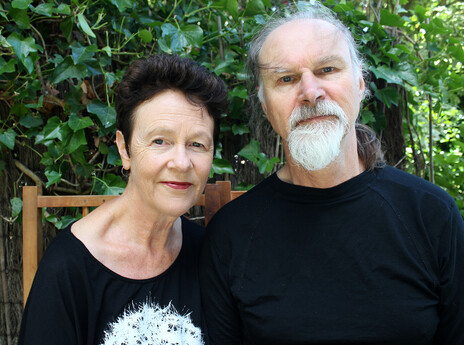
Chris Price and Robbie Duncan
Poetry and music were more tightly integrated on Trapezing, a singular project undertaken by Waiting For Donald guitarist Robbie Duncan to mark his 60th birthday in 2010. With an eclectic bunch of handpicked players and a small choir with a very particular task, Duncan created – and recorded in a single take – a 36-minute semi-improvised yet beautifully poised piece of music, representing the course of a human life, from birth to death. The piece is anchored at either end by Chris’s poetry: ‘Trapezing’ (originally part of Husk) and ‘Wrecker’s song’, and her voice and words bring to the piece the precise weight and pulse it needs.
Michael O’Leary
Michael O’Leary is a poet and publisher, based in Paekākāriki where he runs a secondhand bookshop on the railway platform. He has Māori on his maternal side, Irish Catholic on his father’s as well as mother’s, and explorations of this dual heritage run through his writing, alongside such abiding concerns as love, war, and the Beatles.
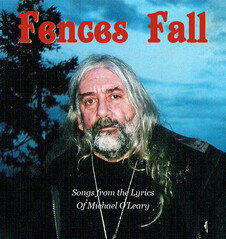
Fences Fall - Songs from the Lyrics of Michael O'Leary
Fences Fall is a 2011 CD presenting a selection of poems from three of O’Leary’s books – Toku Tinihanga (2003), Make Love and War (2005) and Paneta Street (2008), set to music and performed by seven mostly Kāpiti-based musicians. The dominant modes are folk and blues, ranging from Al Witham’s bluesy, guttural take on the elegiac ‘Fifteen Years’ (“Fifteen years since the earth yawned/ And you fell in the gaping mouth”) to Francis Mills’s folk-soul setting of ‘A Memento of You’ (“That morning I woke up/And I put around my neck the black and white scarf/That several years ago I stole from your house”).
O’Leary himself can be heard in recital mode, with Gilbert Haisman’s piano accompaniment, on ‘T.A.B. Ula Rasa’. In the clip below, Paekākāriki musician Kayte Edwards and band perform their adaptation of O’Leary’s poem ‘Fences Fall’ in 2010.
Apirana Taylor
Apirana Taylor has been interweaving his skills as a poet, performer, storyteller and musician since the 1970s. His performances have taken him all over Aotearoa and as far afield as India and South America. His writing draws on Aotearoa’s history, myths and culture, as well as his own imagination.
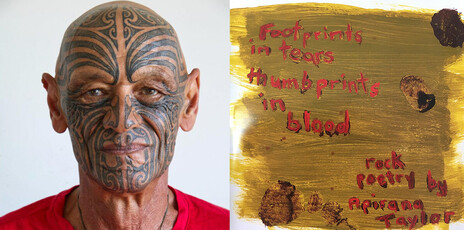
Apirana Taylor - Photo by Himiona Grace; at right his 2004 CD Footprints In Tears, Thumbprints In Blood
His 2004 CD Footprints In Tears, Thumbprints In Blood is subtitled rock poetry by Apirana Taylor. The “rock” seems to refer more to the poems – which feel as though they have been carved out of rock or moulded from the earth – more than the music, which isn’t rock so much as a medley of taonga pūoro, country and blues.
Moving between te reo and English, Apirana accompanies his readings with combinations of guitar, nguru (nose flute), tumutumu (struck stones or wood) and other taonga pūoro, played by himself and Hone Makatea. The mournful descending tones of the flute and sparse rattling of percussion lay a suitably sombre soundbed for ‘Kāpiti’, an elegy for Te Rauparaha and meditation on the price of war. For ‘Zig Zag Roads’ two gently chiming guitars – one acoustic, the other electric – evoke a road movie soundtrack as Apirana takes us on a winding trip through the rural Taranaki and observes that “stolen roads are never straight”.
In this clip, Taylor accompanies himself performing ‘Te He Māori Ora’.
David Eggleton
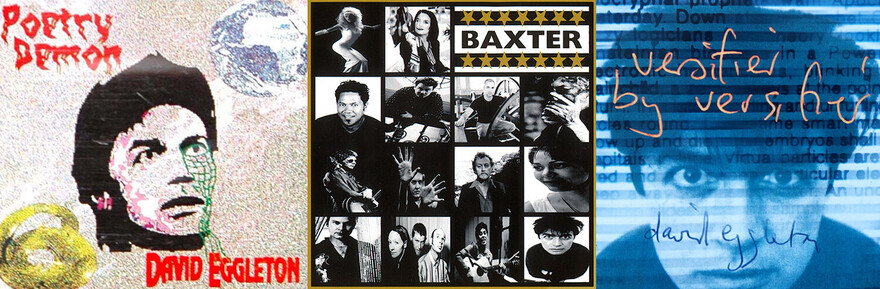
David Eggleton: Poetry Demon (Jayrem CD, 1993), bottom right on the Baxter compilation (Universal Music NZ CD, 2000), and Versifier (Yellow Eye CD, 2002).
Emergency sirens, a firestorm of guitars, a fusillade of drums, and now a voice, barking out a breathless lyric in the meter of ‘Subterranean Homesick Blues’. This is ‘We Are Driven’, the opening track on Poetry Demon, the 1993 CD that in its first few bars efficiently erases the line between spoken word and punk rock. It was the first long-playing collection by David Eggleton, who was known at the time as The Mad Kiwi Ranter, a title that has fallen away over time to be replaced simply with “poet”.
Eggleton’s collaborators on Poetry Demon included some familiar figures in the indie rock scene at the time: singer-songwriter Otis Mace, guitarist Richard Wallis (who came to the project direct from a Sex Pistols tribute act, the Ex Pistols), drummer Robbie Yeats (The Verlaines, The Dead C). Whether the result is poetry or music is still up for debate. There’s as much melody in some of Eggleton’s two and even three-note recitations as you’ll find in a lot of punk rock songs. On the other hand, Eggleton would perform a lot of the pieces unaccompanied at readings.
Though his reading of Baxter’s ‘The Māori Jesus’ was one of the highlights of the Baxter album, it would not be until 2002 that Eggleton offered another full-length album of collaborations with musicians. With collaborators including Martin Phillipps, Jay Clarkson, Jordan Reyne and David Downes providing musical settings ranging from electronica to country-rock, Versifier was a more varied and refined piece of work.
Though he has released no recordings since then, music remains an important and original foundation for his work. As he told his friend Vaughan Rapatahana, after being appointed Poet Laureate in 2019: “My life as a poet began in South Auckland at school out of a miscellany of ‘happenings’ in the late 60s, from the mantras of the beatniks and the hippies, to the slogans of political liberation movements, to the jingles of consumerism, and, above all, in response to rock and roll music.”
The 2021 documentary below, The Singing Word by Richard C Wallis, shows Eggleton recording in a studio during his stint as Aotearoa poet laureate.
Cilla McQueen
Southland-based former poet laureate Cilla McQueen has been combining her terse, playful poetry with music at least since the 1980s. In a televised Kaleidoscope feature on McQueen in 1984 you can see her performing poems with a guitar and drum machine accompaniment.
Dunedin guitarists Jim Taylor, Ali MacDougall and Johnny Fleury worked with her on Bad Bananas, settings of four songs, released on cassette in 1986. In 1989, another cassette was issued, Otherwise, featuring McQueen reading with solo guitar accompaniment by MacDougall.
Classical composers also had a go: Antony Ritchie, Gillian Whitehead, David Farquhar and Kathryn Lauder have all set McQueen poems to music. Farquhar first heard McQueen reading her poem Synaesthesia at the opening of the new National Library building in 1987 and was entranced “with its sustained lyricism”. To Farquhar it “seemed to be crying out for music”.
But the most expansive collaboration has been with The Blue Neutrinos, a group assembled for her 2006 CD A Wind Harp, which showcased 21 of her poems in varied and expressive arrangements. In ‘Wild Sweets’ a guitar stutters like gunfire on the line “terrorist incident”, and in ‘Crikey’ the whole band responds to the poem’s humorous take on teen romance imagery (“a kiss on a ferris wheel in the tunnel of love”) with an appropriate doo-wop chorus.
James Brown

James Brown in an author photo by Russell Kleyn for Te Herenga Waka University Press.
In local literary circles they joke about James Brown being the hardest working man in poetry, but that’s not the where the musical connections end for the Wellington-based poet.
He has also provided verses for former Mutton Birds bass player Alan Gregg, who has turned what might have remained dark parodies of children’s rhymes into delightful pop songs.
With their wistful melodies and quietly cunning chord changes ‘Peculiar Julia’ and ‘Shrinking Violet’ are very much at home among the other songs on Please Go Wild, the album Gregg released in 2024 under the nom-de-disc Polite Company.
Richard von Sturmer
Richard von Sturmer is a poet and performer who has had a long association with New Zealand bands. In the late 70s he was a member of punk-theatre-and-music group The Plague. Fellow Plague members Mark Bell and Tim Mahon would go on to form Blam Blam Blam with Don McGlashan. Though never a member of the Blams, Richard provided lyrics for songs like ‘There Is No Depression In New Zealand’, ‘Maids To Order’, ‘The Bystanders’ and ‘Businessmen’, and McGlashan would credit him with inspiring him to go on to write his own lyrics.
Lately, Von Sturmer has been engaged in a prolific collaboration with Auckland musician Gabriel White. Recording as The Floral Clocks, they have produced three albums of songs built with Von Sturmer’s words. Some started out as poems, which multi-instrumentalist White has put to music. Others were presented by Von Sturmer as lyrics. Curiously, some of these songs written as lyrics come out sounding more like poems, and vice versa. Further blurring the boundaries between poetry and song, the CDs come tucked into the back of elegant paperback-sized books displaying the lyrics – or poems – illustrated with Von Sturmer’s lyrical, poetic photographs.
The clip below is of the Floral Clocks performing Von Sturmer’s poem ‘Guiding Star’ in 2025.
Lindsay Rabbitt
Kāpiti Coast poet Lindsay Rabbitt collaborated with jazz and ambient musicians to create the varied aural settings for his words on Look!

Two portraits of Lindsay Rabbitt: “rueful, wistful and comically sardonic”
“Poems which affirm the dignity of the ordinary” is how fellow poet David Eggleton has described Lindsay’s work. “By turns rueful, wistful and comically sardonic. Like a priest attentive to the goings-on in his parish, [he] wanders, observes, and acknowledges his neighbourhood and its inhabitants.”
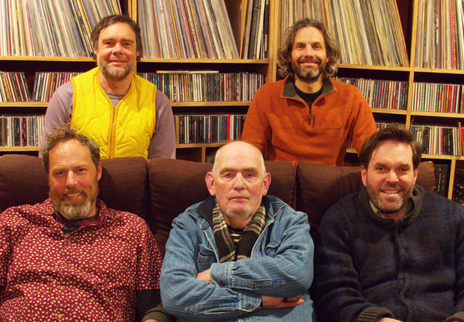
Lindsay Rabbitt, front centre, with musicians at The Surgery. Clockwise from Rabbitt are Tim Jaray, Lee Prebble, Andy Hummel, and Lucien Johnson. - Lindsay Rabbitt Collection
On Look! Rabbitt delivers his affirmations in a voice that is both weathered and measured, usually accompanied by a single musician. Soundscape artist Andy Hummell supplies a very literal “waterscape” for ‘Hockney Pool’ and a more abstract treated guitar arrangement for ‘Like An Old Man Falling’. Tim Jaray’s synthesiser flaps and chatters almost onomatopoeically on ‘Squawk Squawk’, while the piano piece he offers for ‘Apocalyptic’ (played by Lucien Johnson) is suitably spiky and ominous. Switching to saxophone, Johnson engages in improvised dialogue with Lindsay’s text, recalling the poetry-and-jazz trade-offs of the bebop era on ‘Pastiche’.
But on the track that gives the album its title, all three musicians come together for a shimmering blues. Johnson plays piano, Jarray switches to double bass, and Lindsay delivers the text as if holding each image up to the light so the listener can see it more clearly.
Released in March 2026 under the banner of The Wing and a Prayer Collective, Look! is the most recent inclusion in this list.
--
One more makes 11:
Janet Frame
Celebrated writer Janet Frame also caught the attention of composers. Jenny McLeod wrote three song cycles to poems by Frame, one of which (The Poet, for chamber choir and string quartet) represented New Zealand at the 2009 International Rostrum of Composers in Paris.
The same year, Norman Meehan, Thomas Voyce and Hannah Griffin set Frame’s short poem ‘Before I get into sleep with you’ as part of Wahine, an album dedicated to Aotearoa women poets, which also features settings of Hinemoana Baker and Cilla McQueen. Frame’s poem – which her niece Pamela Gordon has called a “punchy and wise little piece” – gives the album a perfect coda.