Early on, Paul Dyne discovered his enjoyment of music through instruments that make sound with the breath: harmonica, recorder, cornet, clarinet and saxophone. Since university days, his focus has been on four strings, primarily the double bass. The architecture alone of this patriarch of the violin family demands a high level of hand and whole-body fitness and requires constant practice and dedication. His first bass, a flat-back Czechoslovakian bass, he left behind in New Zealand when he moved to Canada in 1970, so on arrival he searched immediately for another and bought an Ampeg Baby Bass he found on a local trading site.
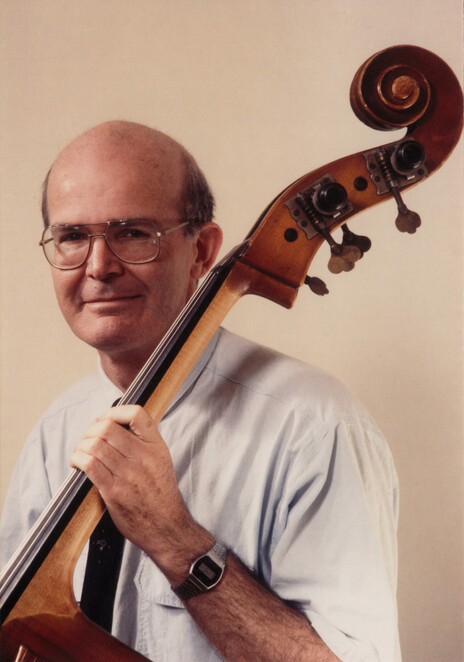
Paul Dyne
Tell me about your basses, please …
The Ampeg electric has an almost a cello-shaped fibreglass body. Those basses were very popular with Latin bands, like the Buena Vista Social Club, and they transport well. Mine’s had an amazing life. It’s been up into the Arctic Circle. When I was in Canada a guy borrowed it and took it up there rather than take his real bass. I’ve made a fibreglass case for it for when I travel, and played it for a number of gigs, but it’s not as much fun as playing a real bass. I’ve also got a fretless Fender Jazz Bass, a regular Fender Jazz Bass, and I bought a cheap Hagstrom Swedish electric and played a few gigs on that. Bass nuts know about them; they are considered quite a good bass. I gave it away [in Montreal]. It wasn’t till later on in the mid-70s that I ended up buying the bass that I have now, my main bass, the Pöllmann.
Do you need to be physically fit to play double-bass?
There’s no doubt that it’s a physical instrument and most people stand to play it, because that enables them to get their whole shoulder and upper arm into the plucking motion, so you’re not just pulling the string with a finger, you’re actually using your arm. And the same with the left hand; you normally hang your elbow up for a certain amount, but you’re also using the weight of your arm to pull the hand towards the strings and down on the fingerboard, so you try not put too much pressure on your hands and find a way to stand or sit so that you can utilise more than just your hands.
What do you do to maintain your hand strength?
Hands for a bass player are always a problem. If you haven’t played for a long time and go out and play very hard you’ll get blisters or damage underneath your skin, and if you do have a callous and you play hard, often the callous is not enough and you’ll get pain underneath it, which is just dreadful. People wrap their fingers with Elastoplast and all sorts of stuff to try and get through it, but it is a physical instrument, hard on your hands, hard on the skin and the tips of your fingers. You need to build up callouses the same as for a guitar and other string instruments. I can’t go and do a two-hour gig now where there’s like six musicians on stage and it’s an electric guitar, an electric piano, a trumpet and a couple of saxophones or something. Even though I’m amplified, I can’t quite hear myself, because there’s a lot of noise, so I automatically play hard and it takes probably two days for my hands to recover. I’ve got a whole regimen of exercises I do every day, of stretching them and different sorts of movements.
I’ve had Dupuytrens Contracture, aka Vikings’ disease, like my father – curling up my little fingers – so I’m doing lots of movement exercises. Obviously, the right hand didn’t matter so much, but the left little finger was curling right over onto the string. After the Dupuytrens operation there was a complication and the nerve was damaged on the left hand. I was starting to worry and looked at techniques that didn’t use the little finger. There’s the technique by the famous classical player, François Rabbath, with YouTube clips of how he gets around it. He does use his little finger, but tends to mostly use the other three, which, of course, is not what you recommend when you’re teaching somebody to play electric bass; you try and use all your fingers, because that’s what Jaco [Pastorius] did.
You stand almost equal in height to a double-bass. Is your hand-span wide?
Ten notes on the piano is about it. I don’t have particularly big hands and a story that I tell is about a famous American bass player called Rufus Reid, who worked a lot with Stan Getz. I went to hear him with Getz and … at the end of the concert I got the nerve to go up and talk to him. Eventually he said to me, with all these people milling about the stage), “So you’re a bass player are you? Let’s hear you play my bass. ” I could hardly get the strings down onto the fingerboard, the action was so high. I said, “Oh, man, I can’t get the sound out. Just out of interest can we do a high five?” and I put my hand to his. He had almost more than an inch [2.5cm] of extra length in his fingers, which were like the size of my thumbs. There’s a whole bunch of bass players out there with big strong hands and that’s how they get that huge sound – often not using an amplifier, because they can crank the action up and make the bass do all the work.
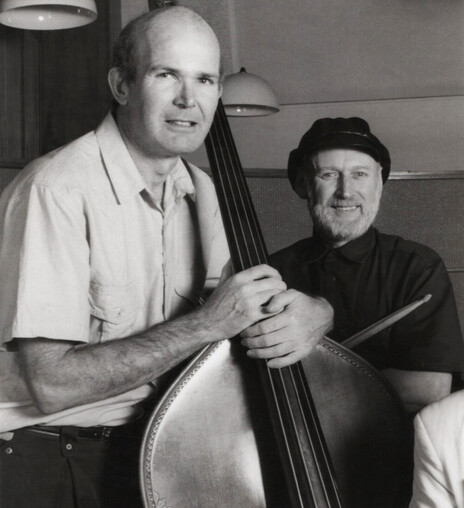
Paul Dyne and drummer Roger Sellers: “We were like the engine room for a whole lot of groups”
What about air travel and double-bass doctors?
I’ve had the most success with Malcolm Collins [1939–2025], a local guy who just died. He was a wonderful man. He built sea-going boats among other things. He did a lot of craft work and built violas and cellos, which sold all over the world. He was something very special.
When I flew back from Montreal [in 1970] I looked at getting a seat for the bass. They said no problem and booked it through to Auckland for “Mr Bass”. That was for it to be strapped into a seat with the bass neck pointing downwards. I asked them what would happen from Auckland to Wellington and they said it’d be thrown in the hold. I thought that was a waste of time, to get it all the way to New Zealand and then it’d be smashed, so I built a huge pinewood box and we filled it with a lot of our bedding. I strapped the bass in it so it was suspended in mid-air, but there was a strike somewhere on the way in northern Australia or Japan and the container sat on the wharf for two or three months in summer. When I went to get it, it had exploded – the neck and fingerboard had come apart. I asked around and was told the best people to see were in Auckland, so I sent them the bass. They sent it back saying they’d had a go at fixing it, but couldn’t, because the neck was too thin. I thought, that’s ridiculous, it’s a well-known German bass, a Pöllmann and they’re used in symphony orchestras all over the world.
Malcolm Collins, 1990 - Upper Hutt Leader CC.04
Somebody suggested I go and see Malcolm. He had a look and said it is quite a thin neck, but the fingerboard is a nice ebony and that’s where all the strength comes from, but the neck needs straightening out a little, because it’s now got a bend in it. He got the correct glue, fixed it, got it going and that was a godsend. I took all my basses to Malcolm at some stage and sent my students to him, so it was a real loss when he died.
After the repairs I made a fibreglass case for it. It was in two parts, so it would fit into the car. I’d put the bit over the neck when I got out at the airport. One time, heading off to a jazz festival in Auckland to play with Mike Nock, I decided to send just the bottom half of the case and left the neck sticking out. They put it on a trolley, rushed it into the terminal, went too close to one of the concrete uprights and smashed the neck. Air New Zealand took responsibility for that. After that I found Neville Whitehead, an Auckland luthier and bass player. (Roger Sellers had worked with him.) Neville had been in England and had done some good bass-repair work for well-known American musicians. He actually changed the neck to a thicker one, rather than the thin Pöllmann, and put a flash piece of ebony fingerboard on it, basically making it into a Pöllmann-Whitehead bass. Unfortunately, he moved to Australia, but he used to come to Wellington once in a while and fiddle with the bass.
Who will you turn to now for repairs?
I’m not sure. There’s a couple of guys in [Wellington] who are getting good reputations. I don’t think I’d try to get it down to Peter [Peter Stephen in Lyttelton], although I know he’s very good. I don’t really like flying with it anymore. Even in Auckland, if I’ve got a gig I’d rather drive, even though it’s a hellish drive. I still have that original fibreglass case, but since then I’ve bought a polystyrene case from Pete McGregor in Auckland, which I’ve used on occasions. These cases offer some protection, but wouldn’t withstand a drop, for example, from an airplane hold onto the tarmac; the bass inside would be damaged.
Where do you source your strings and parts?
Pete McGregor stocks the Thomastik strings that a lot of us use, and there’s Lemur, a Californian company, that sells double-basses, educational material and every type of string you could ever want. Bass strings are expensive, with a set costing $300 or $400. Mostly over the years I’ve got a set from Lemur and the shipping has been minimal. At the moment I use Thomastik Spirocore Weich. Neville Whitehead suggested I should be using TSW and I’ve followed his suggestions ever since.
What is your approach to bowing?
I’ve neglected my bow-playing entirely. In fact, just a few days ago I had a Kiwi friend visit from Melbourne. He’d come over for a memorial for Wellington piano player John Key, whom he’d played with quite a bit. He told me he’d had some lessons from the best arco players in the world and thought I might be interested. He spent half-an-hour showing me what I was doing wrong and what I should be working on. I’ve got a bit of interest in getting the bow happening. I’ve done stuff with it – long notes at the end of tunes and I can kind of solo on it – but really the bow is close to totally neglected. It’s on my list of things I need to do.
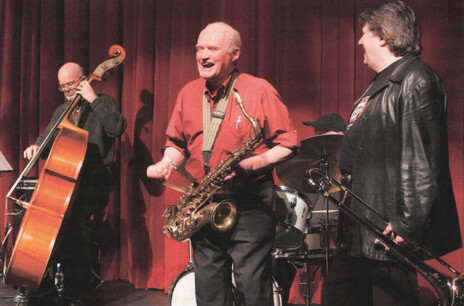
Paul Dyne with Stu Buchanan, Roger Sellers (obscured), and Rodger Fox, Blenheim, 2000. - Scott Hammond
You’ve talked about how US bass player John Patitucci borrowed your bass to play at a Wellington Jazz Festival with Wayne Shorter; that he pulled the strings so hard you were worried, but that the bass became more responsive. Did that change your way of playing at all?
Yeah, I would say so. I’ve always taken the attitude that when you play an instrument, what’s most important is the music, so why would you have a instrument so hard to play that you’re fumbling all the time? The answer to me is to get the fingerboard planed so it’s perfectly flat and you don’t get buzzing up and down the board, then to lower the action to where you’re comfortable and you don’t have to work hard.
A lot of people have pooh-poohed that and said you’ve got to raise the action to get the bass to work properly. I watched a Ron Carter thing yesterday where he was talking about that very thing – that if you don’t raise the action enough the air inside the double-bass chamber won’t be doing its proper job and you won’t get the tone etc. Normally, when people have picked up my bass, they’ve said, Oh, that’s lovely, it’s so smooth, it’s like cutting through butter or something, and they can get on with making their music. Other people want to hear a big sound and some want to play without an amplifier, in which case you can’t do that with lowered action.
When John (who plays a Pöllmann) called me up, he asked me bring the bass to the hotel before the sound check. I headed down to his room and he said, “Thanks, this is lovely; I’m so pleased that you’ve been able to supply me with this bass. Do you mind if I raise the action?” I told him not at all, because it’s got adjustable action with little wheels in the bridge to raise or lower it. He cranked it up a bit and said, “Can you hear that? It’s sounding better than it was.” I said, “Yes, of course I can.” I have raised the action on occasions when I knew what they wanted for a particular recording was a nice, fat bass sound. I’m having to work, but it doesn’t matter if it’s mostly long notes.
This went on during the afternoon: Do you mind if I raise it a little bit more? Eventually he said, “See how it’s starting to ring now?” and told me that Ron Carter said you should be able to fit a regular HB pencil between the string and the fingerboard. Mine was never much lower than that anyway, so when he gave it back I thought it’s been set up by Ron Carter basically. I left it the way it was for a couple of weeks, but my hands were speaking to me quite loudly, telling me I was being an idiot, that they’d let me down if I carried on, so I lowered the action again, but not as far as I used to.
I also asked to have a close look at his hands. He said, “A lot of people say they’re plumbers’ hands. I’ve got stubby, fat fingers.” His were not quite the same as Rufus Reid, whose whole hand was much bigger than mine, but all his fingers were the thickness of my thumb. Very, very strong hands.
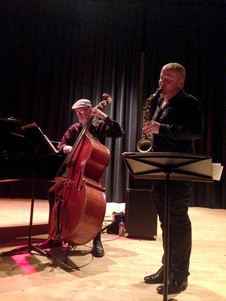
Paul Dyne and expat saxophonist Hayden Chisholm
Are you travelling much to play now?
This year [2025] we – the band Unwind – toured to promote a CD we’d recorded last year. Norman Meehan is on piano and they’re mostly his compositions. (He became head of jazz at the Conservatorium after I resigned from that position.) Hayden Chisholm is on alto sax. He’s from New Plymouth, but has spent most of his life in Europe. He's been keen to come out every year, so we help with airfares and do a tour. We toured in February for the second time, just North Island, but prior to that we’ve done tours to Christchurch and right down to Wanaka, Nelson and Nelson area and all around the North Island. Now we’re doing just the North – Auckland, Tauranga, sometimes Rotorua, Hamilton, New Plymouth, often Whanganui and several concerts in Wellington. Norm’s already booking the tour for 2026.
Unwind’s actually a quartet with Julien, my son, on drums. We’ve done two tours, but this year we had the chance to do a particular set of tunes on a fantastic piano in Wellington, belonging to Emma Sayers, a well-known classical musician with a beautiful studio and a couple of pianos. It’s a really good room to record in. For the pieces that Norman had written this time, drums would’ve been nice, but they weren’t required, like many of the tunes in the past, so we didn’t invite Julien down to record.
--