Zines NZ: Punk to Present, by Bryce Galloway (Massey University Press, 2026)
Who would have thought that from the plethora of (mainly) punk zines in the 1980s, that the world of zines would explode and still be going strong nearly five decades later?! Bryce Galloway – from long-time upstarts Wendyhouse (and other bands), and creator of zine/book Incredibly Hot Sex With Hideous People (still going!) – has done the serious legwork required to pull it all together, as much as humanly possible, and has done a great job. Many interviews were done, original zines sourced to be documented – there’s a lot involved.

Zines NZ book cover, and author Bryce Galloway on stage with Wendyhouse in 2025.
The book looks the part (that size, just short of A4 – can’t remember my printer’s measurements!) and it’s lime green and hot pink cover. Perfectly punk! Which is where it all starts on the New Zealand scene in the 1980s, when it seemed like everyone was doing a zine, for themselves, for their band. It was a networking tool for “the scene”, with an almost total lack of representation in normal music media, and with only negative reports of punk rockers and skinheads (punks and skins from this point) in conventional newspapers. This just fuelled the fire.
The book is arranged in chapters by decade – cool purple-blue ink throughout – with an introduction for each in terms what was happening in New Zealand at the time, musically, politically, etc. The 80s were particularly grim.
This is where I come in. I left home at the end of 1985, two weeks before Bursary, as me and my dad just couldn’t see eye-to-eye on anything. I found a flat about a month later, in Brooklyn, Wellington with three other (“straight”) people.
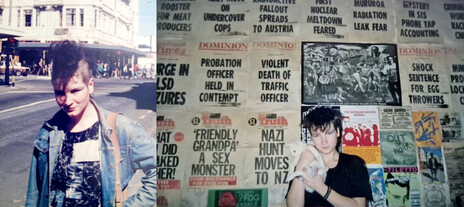
Ania Glowacz in Wellington, 1980s: you had to run fast when required.
That summer, a bunch of Auckland punks came down, and quickly made themselves at home, squatting in Wellington punk’s flats, wreaking havoc around town! At the time Wellington was rough out on the streets, including daytime. It was “punks vs skins”, but beyond that punks and skins often did get along, but not always. There was also street kids vs punks and skins. Because they would be in “packs” and just wanted to beat you up, you had to be careful of your surroundings, as well as run fast when required.
There was also this terrible trend of being “stepped out” for your boots or leather jacket, just in the street. This could be skins on punks, or punks on other punks, but it happened. (Along with stealing records from people’s flats, etc.) I actually carried a knife as I didn’t want my Docs or leather jacket taken. It was second-hand, but it cost $300 in the 80s! A bit of a violent backdrop …
Wellington had lots of bands, but not that many venues, especially ones that would let punk bands play. I started Submission in 1986 – a fanzine. Issues #1 and #2 came out that year. All self-publishing qualifies as a “zine”, a fanzine involves an inspiration/focus and for me it was Flesh D-Vice. They played as often as they could and I went to every gig. Not strictly “punk”, maybe “hard” punk or horror punk … Regardless they were irresistible, the energy, the originality (rules to live by!).
I wasn’t in a band because I couldn’t find anyone to join up with, so I put my creativity elsewhere. So I was a “fangirl” if you like, but more than that, I worked at Jayrem in 1987 and 88 and that was the Flesh D-Vice label! Gerald Dwyer used to come in all the time, and it wasn’t long before we became friends. FDV were inspirational to me (we don’t need overseas bands kind of thing) and I wanted to do whatever I could to help promote them etc. It became more than that, when Gerald got involved in postering around town to survive as an artist, he got too busy to host the Wild, Wild Rock Show on Radio Active. At first we alternated weekly, then I just took on the whole thing. With CDs not being a “thing”, and punk tracks often being incredibly short, you needed to be organised as well as have a huge pile of records to carry up the hill.
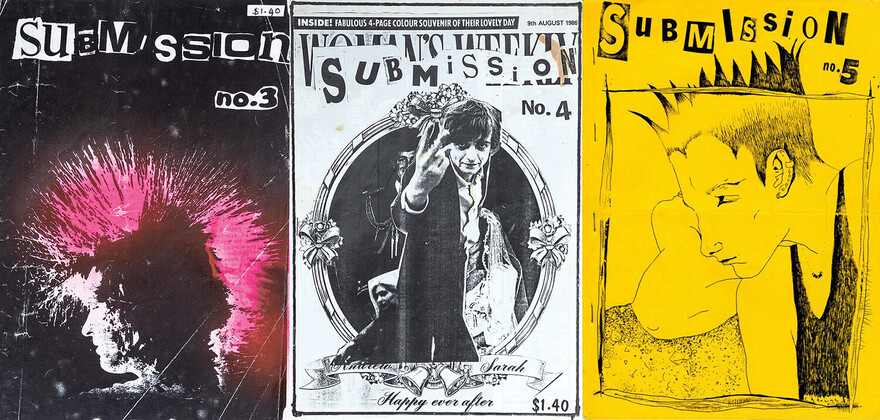
Submission, issues 3, 4, 5; edited by Ania Glowacz, mid-1980s.
The (fan)zine wasn’t all Flesh D-Vice – there were plenty of other things going on – more an interview, a review, an update. I’m not really sure how I started physically, can’t remember what I typed on for that amazing font I used for most pages, but having a penchant for “clippings”, it just came naturally. Comics, newspaper clippings, a cut-up interview arranged on a page … Bits and pieces of art and poetry that I liked and wanted to share …
One of my “things” was cutting stuff out from newspapers and asking myself “Is this really news”?! It’s ridiculous! I had a “Bullshit Page” for that, but the clippings turn up randomly all over! Looking back, I’m quite surprised at how anti-royal I was/am. I think it was the poverty in England, Thatcher’s Britain, the nuclear threat (that was very real, kids) … A lot of interviews happened by post/snail mail (local as well as international), which no one would probably bother with now. Proud of my Abaddon from Poland interview! Polish punks, yeah! (And how much harder it was for them to even exist.)
Comics? Yes! Oink comic was golden. The whole comic was about animal rights and not eating them, it fit right into the NZAVS (New Zealand Anti-Vivisection Society) and animal rights scene happening in Nu Zild. Plus, some originals from Adam Decay – legend! And now a well-known tattoo artist.
I even printed some negative correspondence (would now be known as “haters”) and replied to it. Both letters published were from females, which is disappointing, especially as I’m from the anarcho-punk/feminist tribe, and the negativity wasn’t helpful. In 1987 came issues #3 (my famous spraypainted-by-hand cover, in dayglo orange, pink or lime), #4 (Mark E Smith doing the fingers with a Royal Wedding background), and #5, an original artwork by Caroline.
I’m not sure why I stopped except I got tied up in a desktop publishing job, and doing rock reviews for the NZ Listener, then was programme director at Radio Active, so I guess things got busy. I was also carrying on RAD magazine, a free city arts-related magazine that Mark Cubey and Michael Lockhart from Cadre Communications started, and where I worked. My OE was on the (shifting!) list and the “scene” was changing as well, younger punks coming through etc.
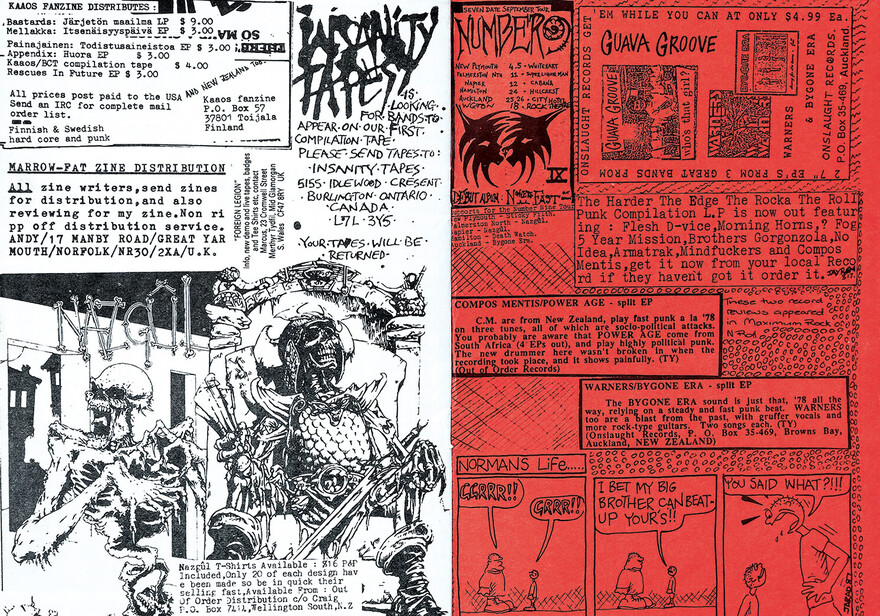
Double-page spread from DWF [Divided We Fall] #6, c. 1987, edted by Michelle and Craig from punk band Nazgûl.
The most important thing about the zines was the sharing of information, swapping zines, tapes etc. Promoting small stuff, someone’s shop, gig whatever ...
What we had access to was overseas “super” zines like Maximum Rocknroll, Flipside, and Forced Exposure (which made your hands black). But essentially it started somewhat of a revolution – just like the photocopier was!
Punk was about bands and audience existing on an equal footing – and that’s where it is with zines and everyone being able to create one – about anything! No barriers to access or creativity (always subjective).
Things really change in the following decades, in the world and in the world of zines. The 1990s seem to be dominated by comics, not surprising considering creativity often remains unpaid and unrewarded, and is definitely a way to get yourself out there. A lot of people love comics, talking about them, collecting them and obviously drawing them! There’s a few niggles throughout the book about female artists not being properly acknowledged (in general), therefore revenge through art is sweet! So there’s comics as zines and comics in zines. The 90s also had early computers and desktop publishing, things like Photoshop for the first time, so changes were afoot in print world ... not to mention the rise of the internet …
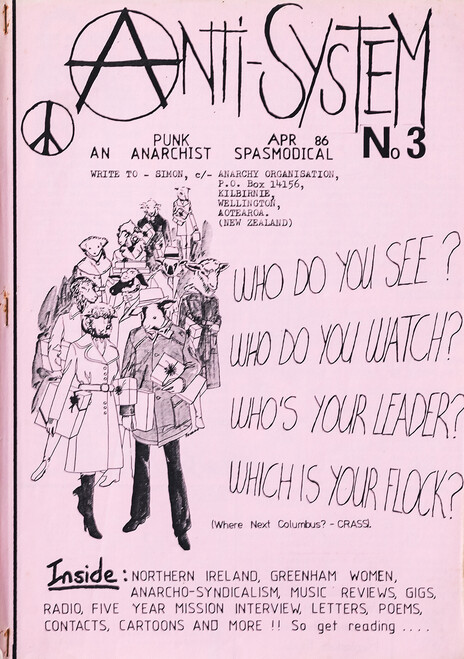
Anti-System #3, April 1986, edited by Simon Cottle
The 2000s chapter sees the rise of Riot Grrl-influenced culture, and it’s about time! (Despite the sad example of a male asking a female stallholder if she had any “political” zines, ignoring what was there, saying “No, I mean like anarchist. Not girl politics.”) Individual expression was both in how you produced the zine (“old school” or more modern techniques, including whatever design school students wanted to experiment with), and what it was about, politics optional.
Zinefests started in the late 1990s/early 2000s and have been going ever since. They’ve evolved into incredibly busy events, and have spread to the smaller towns also. A massive shift has also seen venues changing from local halls and the like, to being hosted by art galleries, libraries having zine collections etc. Who could have predicted that?!
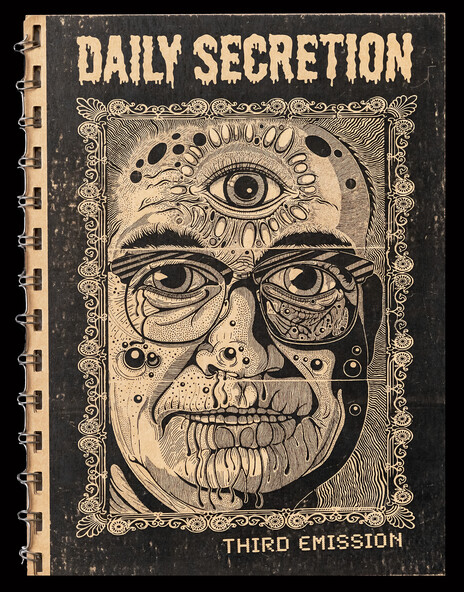
Daily Secretion #3, Hannah Salmon and Ben Knight, 2012
Technology doesn’t get its own chapter, but changes across the board are noted throughout the book. The shift in the mid-2000s to the “blogosphere”, with there being 42 million “bloggers” in 2006 ... who reads that stuff?? I’d rather read a crap zine! The irony (to me at least) is someone saying “Are you still doing that paper blog?”?! Yes, watch out! Submission #666!!!
I need to give a shout out to the zine makers who got left out of the book due to the many challenges that go with trying to pull this off. Around the same time as me, Paul Campbell was doing metal zine Aaaarrghh! Although a lot of punk zines had “No Metal Zine” on the cover, I ain’t got time for that! He started in 1985, got a ton of amazing interviews, mainly overseas, and any local bands he could find (a fledgling scene at the time). Lots of letter writing, tape swapping … Amazing!
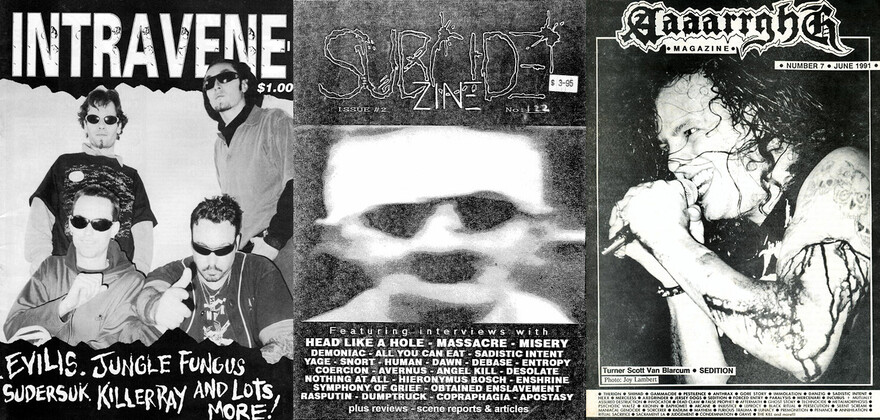
Spoilt for choice: Intravene #11 (Mark Wallbank), Subcide #2 (Chris Rigby), Aaaarrghh #7 (Paul Campbell).
He never finished #8, but I am encouraging him to do so! We are both sitting on unused interviews, him more than me. Let’s go! Ironically, in the mid-80s, speed and thrash metal were infiltrating punk’s music taste, and a few crossed over!
Also in the vein, Subcide by Chris Rigby, three issues, 1993, 94, 96 (most recently in Dying Of The Light, but also a regular promoter).
Then Mark Wallbank (Heironymus Bosch, Bizarre Beats, Haunted Auckland, and much more). He only did two issues of Deadlines goth zine, but before that produced Intravene (10 issues, from 1991-93). I haven’t seen it as I only moved to Auckland in 1996, but it was all different styles of music.
Also in the book – photos, but not indexed – Divided We Fall, a punk zine by Craig Gibson (of the bands Compos Mentis, and Nazgûl) and Michelle (Nazgûl). I couldn’t get a confirmation on the total number produced, but within the pages of Submission it mentions six issues in 12 months, which is pretty dedicated.
The key word throughout every decade is distribution. Zine swapping, distribution Lists – old school in zines or digital catalogues – that part never stops.
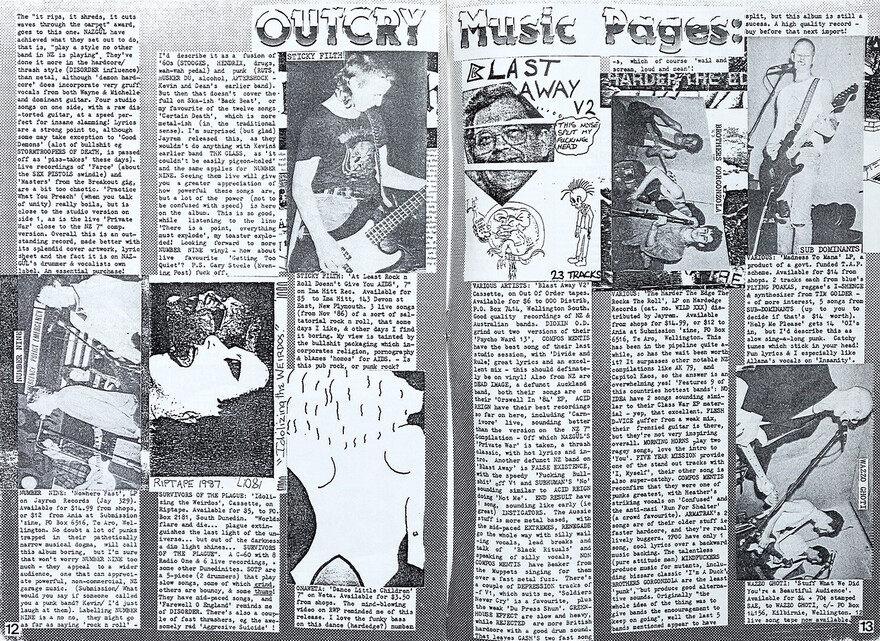
Music reviews from Anti-System #3, edited by Simon Cottle
Another special mention has to go to the thread that runs through the book, mainly from old timers like me. There’s a general agreement that if we still did a zine (we just might!), we wouldn’t do it any other way except old school, cut and paste, glue, scissors and photocopier. Fancy paper and everything is great, and I love the stitching idea (I guess I’ll have to YouTube that one!), but it comes down to the physical process and the individual touch!
Dave White (I know you want to!) makes a lot of comments about how the internet fucks things up, a lot of things just make you not want to bother doing it “that way”. A lot of what he says I agree with. Dave has been a prolific creative – not just Valve zine, but Yellow Bike Records, his band Lung, running The Stomach Studio in Palmerston North, and now Nelson Arts Centre. Some of us old folk are still useful. Don’t write us off!
This is a brilliant compendium of a vastly varied creative genre. I’m especially excited to see and find out about all the output from so many wāhine, especially in the last few decades. Represent!
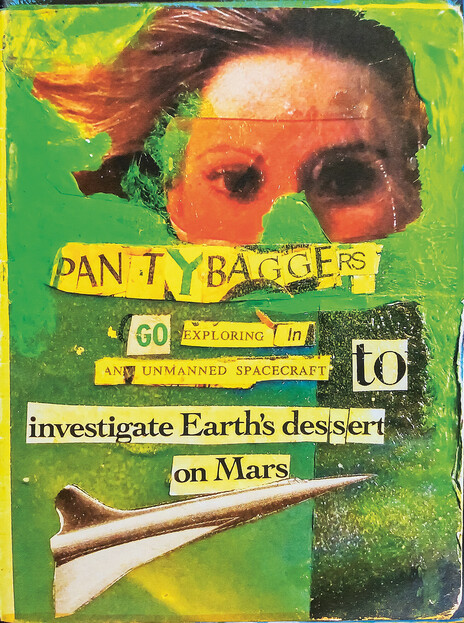
Panty Baggers Go Exploring in an Unmanned Spacecraft to Investigate Earth's Dessert on Mars, Dunedin, 2022.
Zines are collectables, tangibles. Some are really rough and not ready, others are objets d’art! An alternative to mainstream media – you can say/express whatever you want! There are “perzines” (personal zines – like publishing your diary. I’ll skip!). There’s everything! Collaging of knowledge culture jamming, agitprop! Zines represents an explosion of cultural self-determination. It’s “inclusive” in a general sense, there’s no way you’ll like everything or even anything. Make your own! Zines are DIY at their best. That’s what punk is/was. We’ve come full circle!
While it might seem fluffy bunnies and things, there’s still plenty of “politics”. Around zinefests, around (in general) academic institutions that churn out musicians, artists, audio engineers, designers (a zine course anyone?), at the end of the day it’s “what do you want to put out in the world?” This is a great option and you can take your time. For me, it was never about “finding an audience”, “keeping it going” … Besides being a magazine junkie, a fan of print media, writing and words, it was always, “These are my thoughts. You can take it or leave it.” Luckily some people liked it!
With love to all the creators. This book is an INSPIRATION!!
--
Read more: Zines to Be Seen, an AudioCulture gallery
Read more: Spit On Trend – 1980s New Zealand Punk Fanzines, by Andrew Schmidt