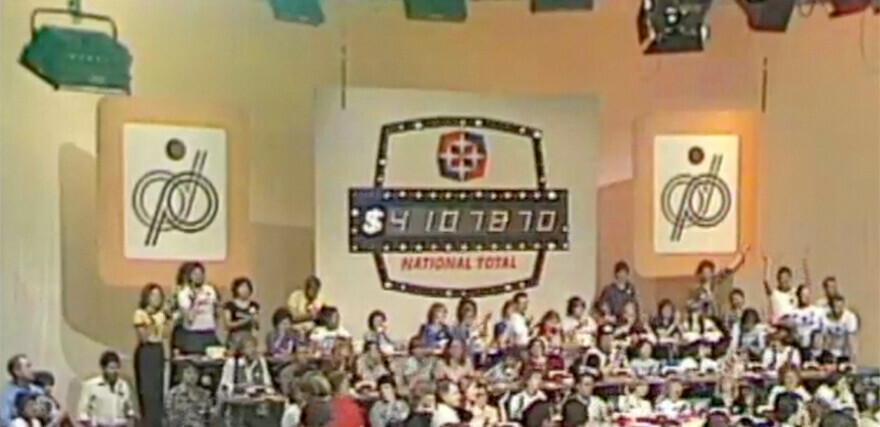
Telethon, 1981
There’s often something a little hackneyed about songs that have been written for the sole purpose of supporting a good cause. Usually, they’re written very quickly and have to cover topics beyond the usual scope of a pop song, so it’s hard to avoid the clunky rhymes and song structures. They also need to appeal to a wide variety of listeners, so the emphasis is on having a catchy chorus while avoiding any elements that are too jarring. This can result in saccharine confections, which make up for their failings by having a star-studded line-up delivering the song. That’s why the best way to appreciate them is usually in video form, so you can enjoy celebrity spotting.
The modern era of the charity single began in 1971 when George Harrison recorded the single ‘Bangla Desh’ to raise money for those affected by the Bhola cyclone in 1970 and the Bangladesh Liberation War the following year. Harrison also gathered together a star-studded line-up for a charity concert to coincide with the release. There had been previous music releases which gave their profits to charity, but nothing on this scale and with this level of international reach.
New Zealand expats Bill & Boyd released their charity single ‘Santa Never Made It Into Darwin’ in 1974, which raised money for victims of Cyclone Tracy, which killed 66 people and destroyed 60% of the buildings in Darwin. The song hit No.1 in Australia, selling 75,000 copies, which had the side benefit of boosting the duo’s profile.
In 1975, New Zealand’s public television broadcaster made its own attempt at using entertainment to raise money for charity when they launched the first 24-hour Telethon.
‘Thank You Very Much’
‘Thank You Very Much’ is so closely associated with the Telethon in New Zealand that it’s hard to believe that it was actually an adaptation of an existing hit, written by Paul McCartney’s brother Mike McCartney for his band, The Scaffold. Mike wanted to avoid skating on his brother’s coattails, so used the surname McGear.
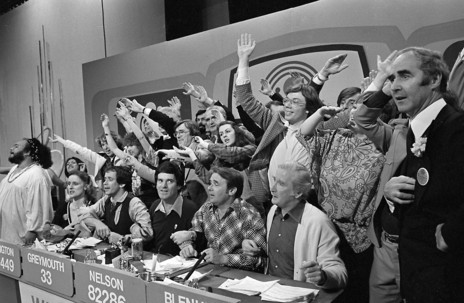
Ray Columbus, Dalvanius and a selection of other familiar faces on Telethon in the mid-1980s
The first Telethon raised money for St John Ambulance, and it coincided with the 1975 launch of TV2 as a new channel. In the years that followed, the event aided a range of different charity organisations and events, from the Arthritis and Rheumatism Foundation through to the International Year of the Disabled. Throughout the show, the amount of money raised would be shown as it slowly went up and each time it hit a round number, the familiar refrain would start up again: “Thank you very much for your kind donation, thank you very very very much!”
Official singles released with proceeds going to Telethon include Sharon O’Neill’s ‘Don’t Say No To Tomorrow’ (International Year of the Child, 1979) and Hamble Gamble’s ‘Somewhere, Somehow Someone Needs A Hand’ (for New Zealand Family Trust, 1983).
‘Let The Children Know’
This song was written for the 1985 Telethon event, which raised money for the Child and Youth Development Trust. It’s credited to the Spot On team, which was Ole Maivia, Terry Gray, Rob Winch and The Muritai School Choir. A year earlier in the UK, Band Aid’s ‘Do They Know It’s Christmas?’ was released, so it’s unsurprising that Telethon wanted a song of its own. The single was fronted by children’s television presenter Ole Maiava, who appears in the video alongside the other hosts of afternoon kids show, Spot On.
The lyrics are so on-the-nose that they sound like a high-school poetry assignment: “Some children are fortunate / that they have a home / other children are not so lucky / they’re the ones alone.” However, it’s no surprise that it sounds more like an advertisement than a pop song, given that the two songwriters involved were a pair of New Zealand’s best jingle writers.
Terry Gray was known for the composing the fondly remembered ‘We Are the Boys’ ad for Chesdale cheese (“We are the boys from down on the farm, we really know our cheese”), while Rob Winch wrote ‘Cruisin’ on the Interislander’ for The Warratahs to record. ‘Let the Children Know’ was less memorable, but the video has a downhome Kiwi quality due to being done on a shoestring budget, like much of our local television at the time.
‘Sailing Away’ – All of Us
Charity singles became even more popular after the 1985 release of ‘We Are The World’ by supergroup USA for Africa, which had a huge line-up of stars. The ‘Sailing Away’ single was a local attempt at doing something similar, though it was created to raise funds for New Zealand’s first America’s Cup bid in 1986. Our country had fewer famous singers, so while it started with Dave Dobbyn, Billy T James, and Tim Finn, it soon got to the point where Barry Crump was singing a line and the amassed crowd of celebrities included newsreaders and sports stars.The song isn’t an original composition – English lyrics about sailing were laid over the melody from ‘Pōkarekare Ana’. The video is an amazing time capsule of who was famous at the time and their questionable fashion choices.
‘The Red Nose Song’ – The Red Nose Day Band feat. Hammond Gamble
‘The Red Nose Song’ from 1992 was also packed with celebrities from outside the music scene, but at least there was no attempt to pretend they were really singing. Instead, a host of Shortland Street stars, sports players, and other local personalities mimed along in black-and-white, while the actual band were shown in colour. The main songwriter was Murray Grindlay, whose career included writing striking ad jingles (‘Give Em A Taste of Kiwi,’ ‘Kiwiburger’), bonafide hit songs (‘Shoop Shoop Diddy Wop Cumma Cumma Wang Dang’), and being a member of one of our coolest 1960s groups, The Underdogs. He worked with Murray McNabb, who was also his partner in writing the theme to Once Were Warriors. The song was performed by local blues legend Hammond Gamble alongside a band that included Peter Warren (DD Smash) and Suzanne Lynch (The Chicks). The resulting song was eminently catchy, rousing, and not too cheesy, so it’s certainly one of the best originals on this list. It was for a worthy cause too – supporting the fight against what was then known as “cot death” but is now referred to as Sudden Infant Death Syndrome (SIDS). The campaign was supported by the sale of red noses, even large ones you could put on your car, though inevitably the latter remained stuck to the front bumper for months beyond the event.
‘Anchor Me’
This campaign saw The Mutton Birds’ classic re-recorded in 2005, marking the 20-year anniversary of the sinking of the Rainbow Warrior, and raising funds for Greenpeace. The smartest aspect of the recording was that instead of trying to cram in a new singer for every line, they gave Kirsten Morrell (Goldenhorse) and Che Fu a verse each, then added parts by Milan Borich (Pluto) and Anika Moa. This meant it sounded like a real song, rather than a collection of artists thrown together.
Don McGlashan had turned down previous offers to use the song for advertisements, so his decision to wait and give it away for free to support a good cause was rewarded by the fact that the new version was a worthy counterpart to the original.
‘Not Given Lightly’
Chris Knox also had his most famous song reimagined for charity. The new version hewed closely to the original – with a similar rhythm and the use of fuzz guitar – but it was odd hearing other singers over a track that was associated so strongly with Knox’s voice. Fortunately the video, by Toa Fraser, manages to invest the required emotion into the piece, with participants holding up photos of the women they love – sometimes celebrities hold the photos, other times it is their relatives holding photos of them. The Topp Twins’ parents look particularly adoring and there’s a cute part where Don McGlashan can’t help singing along, before his daughter Pearl tells him he isn’t meant to. The aim was for viewers to encourage women to undertake regular breast cancer screenings. The message is driven home by former Max TV host Helena McAlpine, who conceived the project after being diagnosed with cancer. Helena died on 23 September 2015.
‘Feel Inside (and Stuff Like That)’
This 2012 project followed on from the original red nose day and enlisted comedians to raise money for health research charity, Cure Kids. Flight of the Conchords’ Bret McKenzie and Jemaine Clement were given the task of writing a charity song, so they interviewed children, filmed their responses, and put their ideas verbatim into a song – the clunkier the better since the aim was unintentional humour. The song’s main aim was to parody the schmaltzy elements that have become associated with charity singles – over-the-top singing and a melancholy verse melody followed by an uplifting chorus line. However McKenzie and Clement created a very convincing sounding pop track with the help of Prinz Board (producer, Black Eyed Peas) and his collaborator Mario Dewann James, who were working with Six60. The slick production allows the cute naivety of the lyrics to stand out. Another key to the song’s success was the commitment to the moment shown by the participants – the incredible high notes delivered by Hayley Westenra contrasting with impressive rap skills of Savage, Young Sid (Smashproof), and PNC.
‘Team Ball Player Thing’
Taika Waititi took the same approach as Bret McKenzie and Jemaine Clement had taken, though he used his skills as a director to exaggerate every step of the process for this 2015 video. Oddly, the song was actually an All Blacks supporters anthem – it was a World Cup year – even though the money raised went towards Cure Kids’ research into Batten disease. The music was created by hit producer Joel Little, while the children’s ideas were turned into lyrics by a group of presenters and comedians – Brooke Howard-Smith, Jesse Griffin, Tom Furniss, and Joseph Moore. Little couldn’t help but write a rousing hit, despite the patchy lyrical turns. Highlights include Brooke Fraser rapping and Daniel Bedingfield repeatedly pitching that they just do one of his songs, then sneaking in a line to the finished version. Extra points for the throwbacks to the original Cure Kids song and Dave Dobbyn referencing ‘Sailing Away’!
‘Time Of The Year’
Shortland Street has always supported local musicians by having them appear on the show. It was still an unusual move when they released an ominous hip hop number as a charity single alongside the Christmas 2016 season finale. Actor Lionel Wellington provided some decent rhymes before fellow cast member JJ Fong broke in with a moody rendition of ‘Silent Night’. The music was created by production duo audioclub – Christiaan Ercolano (House of Downtown) and fellow DJ Dave Ti. The two sections of track provided some nice atmosphere to the finale cliffhanger, though it made for an odd single.
‘Stay’ – Tūtahi
‘Stay’ was released to spread a positive message of unity during the Covid-19 pandemic. It was organised by Loop Recordings Aot(ear)oa, and the song was written by three members of their flagship band L.A.B. (Brad Kora, Ara Adams-Tamatea and Joel Shadbolt), alongside Anna Coddington, Rob Ruha, Scott Tindale, Kings, Tiki Taane, and Rei.
Future generations might view this video as a nice example of how Aotearoa went through the pandemic with a largely unified population, which led to a lower excess mortality relative to population than any comparable country and with fewer periods in lockdown than many other countries (source: Royal Commission Covid19 report). With a plethora of local talent on show, the song hangs together very well. Its upbeat vibe means it’s still popular online to this day.
--