When it comes to rock’n’roll, Nancy Kiel has impeccable credentials.
She fronted a band that may have been the loudest in Aotearoa, mentored The Topp Twins, who called her “the Janis Joplin of Christchurch”, and once landed a punch on Iggy Pop.
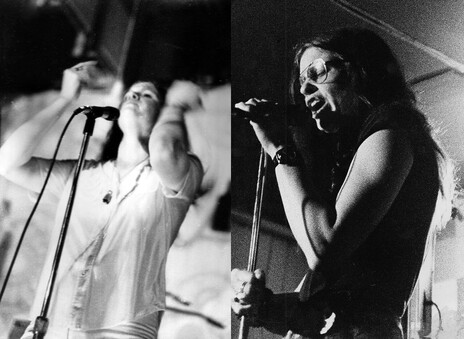
Nancy Kiel fronts Baby, in 1973, and at the Gladstone Hotel, Christchurch, c.1974.
If her name doesn’t resonate more loudly in local rock lore it is only because much of her musical career took place offshore, while the decade or so she spent playing professionally in New Zealand went largely unrecorded.
Nancy Kiel was born in Texas when her father was stationed there with the US Air Force, but spent most of her childhood in Holland, Michigan, a city with a large agricultural sector, where her family ran a blueberry farm.
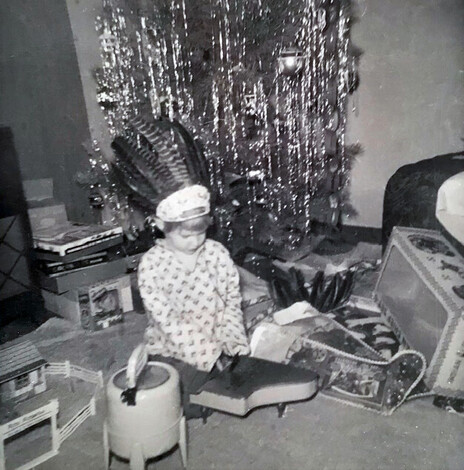
Nancy Kiel, 1956, Holland, Michigan, US. "Christmas on the farm, a fifth-generation blueberry farmer. As you can see I started early. I was three when I got my first piano." - Nancy Kiel Collection
Music was always part of her life. Growing up she learnt classical piano and sang in musical theatre, but it was the height of the 1960s and the lure of rock was inescapable. By her mid-teens she was driving a Bel Air Chevy to Grand Haven on Saturday nights to hear bands from Detroit at a converted movie theatre called The Note. These would include some of the most influential hard rock acts of the era – Alice Cooper, the MC5, Ted Nugent, The Stooges – but back then they were still just local bands with a regional following.
“I ended up punching Iggy Pop. I would have been all of 16.”
“I actually ended up punching Iggy Pop,” she remembers. “It was the Beach Bash in Grand Haven, Michigan, I would have been all of 16. It was The Stooges, and he jumped off stage and grabbed me and went to kiss me and I punched him. I actually met him years and years and years later, and I just had a slight reminisce to him about that moment, and he had a laugh about it.”
She also saw Big Brother and the Holding Company, though by this time Janis Joplin had left the group. “But my love was soul music. The Motown out of Detroit, that was the stuff I loved. My first 45 was ‘Baby Love’. The Supremes and all of the Temptations, the Four Tops, Smokey Robinson, all of that stuff. I used to stand in the barn and make believe I was one of the backing singers and I’d do the routines.
“The only station I could get after dark on the farm was the Black station out of Detroit. It had a higher signal. And the Christian station that was coming out of Holland, Michigan, but I was never much of a believer.”
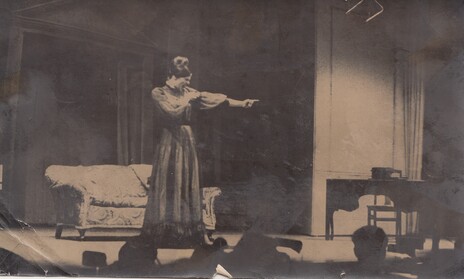
Nancy Kiel as Eliza Doolittle, in a production of My Fair Lady at West Ottawa High School, Holland, Michigan, US, 1970 - Nancy Kiel Collection
Ironically her first gig was with a Christian band. “I was 16, and it was called JB and The Businessman. They were actually a bunch of seminary students, at the seminary just outside Saugatuck, Michigan. Catholic boys. JB – whose name I can’t remember – had seen me singing, because I did a lot of musical comedy theatre in my hometown, and I played Eliza In My Fair Lady. He heard me sing and said, ‘You want to come and sing in my band?’ And I said, ‘Yeah, that sounds great!’ and then realised it was in the seminary! I remember we did ‘You Keep Me Hanging On’ by Vanilla Fudge, and the part where it goes ‘and there’s nothing I can do about it’ – I just remember hearing this ‘Ohhh!’, a groan from the boys in the back, teenage boys, ’cause I was the only girl on the camp.”
“I looked at the map and thought, ‘How far away from this farm in Michigan can I get?”
The stint with JB and the Businessmen only lasted a couple of months. “They weren’t very good, bless their hearts.”
At 18, a chance meeting changed the course of her life. “I met a New Zealand guy, an engineer of some type who worked up in Canada, and he told me about New Zealand. He said, ‘You should go to New Zealand. You’d love it there.’ And I looked at the map and thought, ‘How far away from this farm in Michigan can I get? Gee, New Zealand’s looking good!’ So I applied as it was actually cheaper for me to fly to New Zealand and do a year at university there than it was for me to stay in the States and go to Michigan State University.”
It would take a while to clear the paperwork for studying in New Zealand, so Nancy completed her first university year in Michigan, majoring in theatre and minoring in music, before arriving at the University of Canterbury in 1972. “It was something like 38 hours from Holland, Michigan, to Christchurch and I got off [the plane] expecting someone to meet me. Of course, there was no one there. I was an 18-year-old farm girl and I just instantly got thrown into the deep end, had to find a place to live and had to figure out even simple things like how to get to the airport and the university and all that stuff with my baggage. For the first week I stayed at the YWCA, right in the Square.”
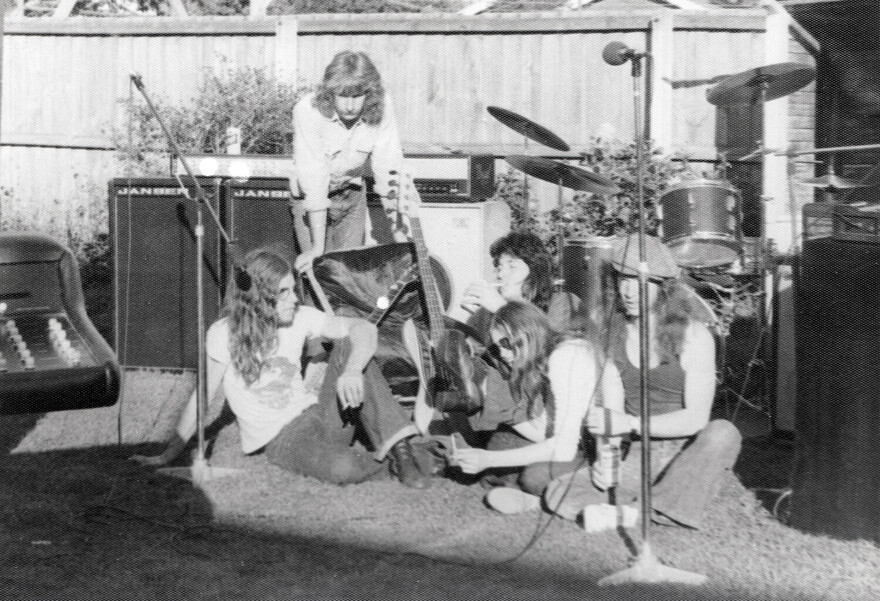
An early incarnation of Baby, at Brett’s Road, Christchurch, c.1974. From left: John Purvis, Liam Ryan (standing), Chris Hudson, Nancy Kiel, Stephen Hudson. - Nancy Kiel Collection
She enrolled to study with the contemporary classical composer and teacher John Cousins. In the first term she sang soprano in the university production of Purcell’s opera The Fairy-Queen, but already rock’n’roll was starting to conflict with academic life. During her first weeks in Christchurch she had encountered a local band, Baby, at the nightclub Mojo’s. “I went to see them play. I just remember their rendition of ‘Oh Well’ by Fleetwood Mac. And I thought, ‘Oh my God, I love this band so much.’”
Nancy introduced herself to the group’s leader John Purvis. “John and I had a bit of a fling and he heard me sing. And he said, because I was singing around the house all the time, ‘Oh my God, you’ve got to be in the band.’”
Soon Nancy had replaced Baby’s vocalist Ann Wigston in a line-up that featured John Purvis and Bill Nichol on guitars, bass player David Shine and drummer Don Bean. Nichol would soon leave, to be replaced by Dave Warring. With a repertoire heavily slanted towards British blues-rock and San Francisco psychedelia, Baby suited both Nancy’s tastes and talents.
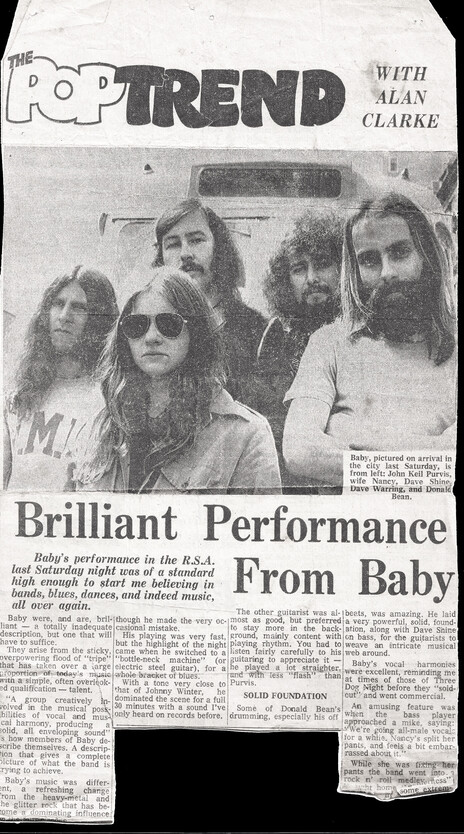
Baby persuades Pop Trend columnist Alan Clarke: "brilliant is a totally inadequate description".
During the season of The Fairy-Queen, Baby had a gig in the campus cafeteria. “I was singing Purcell up in the Ngaio Marsh Theatre, and then went downstairs into the cafeteria and did the Joplin, the Jefferson Airplane and the Grateful Dead, and then ran back upstairs. And John Cousins actually said, ‘Look, you have to make the decision, whether you’re going to do the opera or the rock and roll.’ And I have to tell you, it wasn’t much of a decision. I just said, ‘Sorry, honey!’”
By the year’s end, Nancy had dropped out of university altogether and Baby had become a full-time occupation. With her powerful American-accented vocals and confident stage presence, there was an authenticity about her that stood out in the local rock scene. Her trademark sunglasses only enhanced her aura of rock’n’roll cool.
In Christchurch, Baby found work in pubs like the Gladstone and the Gresham, nightclubs such as Mojo’s, as well as gigs on campus. They began touring nationally, playing the Student Arts Festivals and universities.
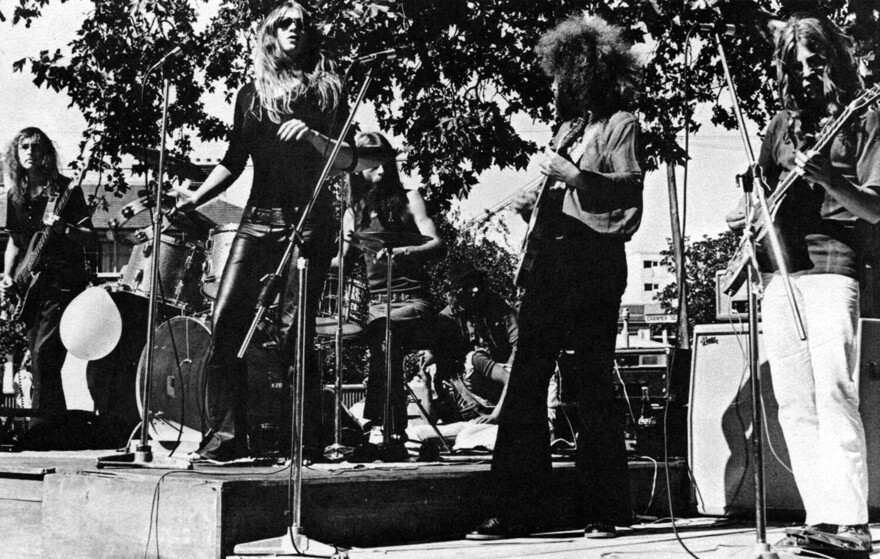
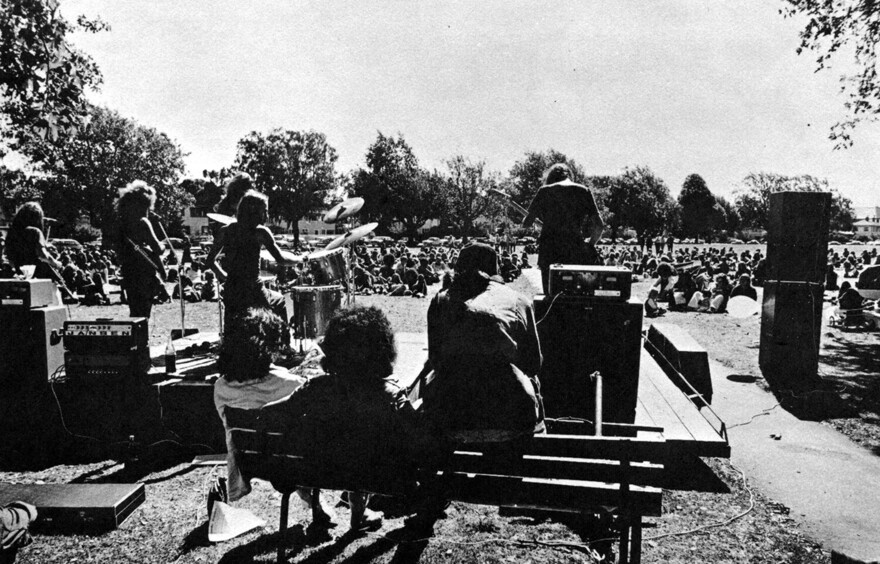
Nancy Kiel with Baby at a concert at Cranmer Square, Christchurch, in 1972. Part of a series taken by Marti Friedlander, for a project called Point of View. Top photo, from left: Dave Shine, Nancy Kiel, Donald Bean, Dave Warring, John Purvis. - Nancy Kiel Collection
Though their primary audience was among the nightclubbers and student underground, Baby were able to plant one foot in the mainstream via the television programme Popco, which was produced in Christchurch. Popco consisted mostly of hits of the day, performed as soundalike covers. Nancy supplied backing vocals for featured singers, unseen at the side of the stage, and on one occasion took the lead for a cover of Suzi Quatro’s ‘Can the Can’.
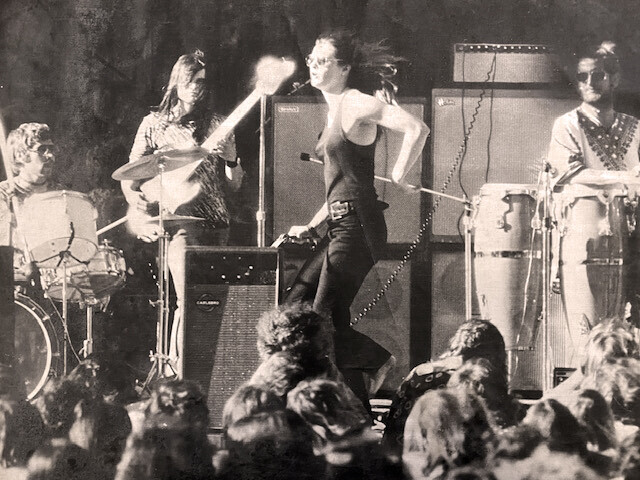
Nancy Kiel with a variety of Christchurch musicians at the Comet Kohoutec concert for Radio Avon, outside the Town Hall, January 1974. The bass player is John Parkinson, on congas is Brian Conway; the drummer is unidentified. - Photo by Kevin Hill
Meanwhile, Baby were earning a reputation on the rock circuit as the loudest band in the land. In fact, volume and sound quality was becoming something of an obsession for John Purvis, who had set about building the group’s own PA system in the kitchen of their Brett Street flat. “Oh my God, this PA was massive! It was all about the sound. John was just obsessed with, you know, bigger PA’s.” On a brief trip back to the States, Nancy picked up some JBL speakers and managed to bring them into New Zealand duty free.
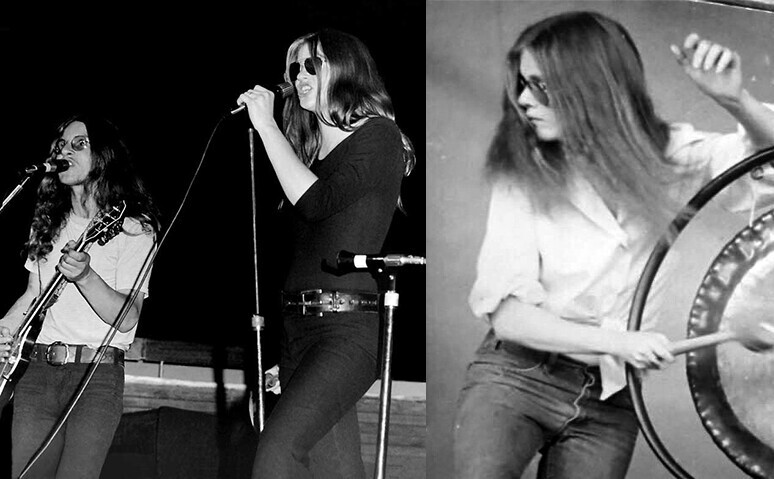
Left: John Purvis and Nancy Kiel with Baby, B B King support, 1974. - Kevin Hill. Right: "When I got my gong" - at the Gladstone Hotel, Christchurch, 1974. - Nancy Kiel Collection
Having what was reputedly the best PA system in the South Island helped Baby secure the support slot for B B King when he played at the Christchurch Town Hall in 1974. “He took the chewing gum out of my mouth as I was waiting, side of stage, to watch him. As he walked away he turned around and said to me, ‘Oh, and by the way, I dug your set, mama.’ I almost fainted with joy.”
For the B B King concert, the promoter hired Baby’s PA along with the band. On the downside, the ever-expanding sound system ate up most of the group’s earnings. One of the reasons Baby never made any records was that recording was expensive and Purvis believed the money was better invested in the group’s live sound. “Again, this is John Purvis and his attitude – bigger, bigger, bigger.”
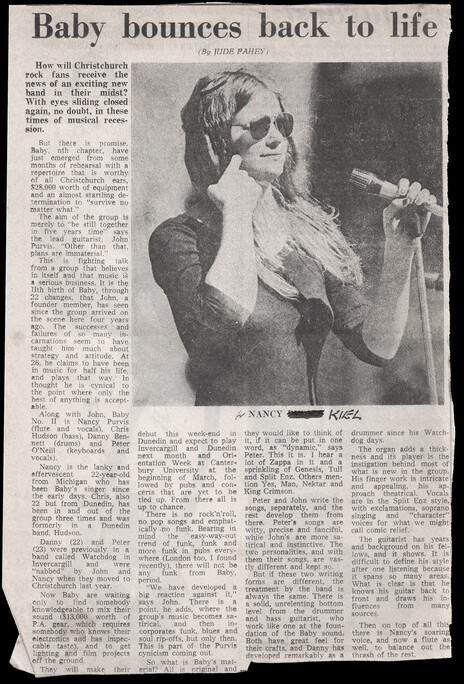
Baby returns with its 11th lineup; thus far, 22 members. - The Press, 29 January 1976
Nancy remembers an interviewer around this time asking John whether the band were planning any recordings. “And he says, ‘No, no, I don’t believe in recording. It just costs too much money. It doesn’t go anywhere.’ I thought, oh my God. That was one of the big problems, and one of the reasons why you don’t know who I am.”
More’s the pity, as by this stage Baby’s repertoire included a healthy quotient of original songs, something few New Zealand bands could boast at the time. Sadly, none of these would ever be released on disc.
Baby’s sound system was considered newsworthy enough to be the subject of newspaper articles. In May 1973 the Christchurch Press reported that “the value of Baby’s gear now totals about $10,000. This includes a 1200-watt PA system, complete with a 16-channel mixer, now being constructed for the band.” The story also noted that the group’s latest acquisition was a synthesiser, “one of only four of its kind in New Zealand,” which would be played by vocalist Nancy Kiel. John Purvis told the reporter that the group would not introduce the new instrument on stage until they could use it properly. “We don’t want to use the synthesiser to make weird and gimmicky noises like sirens and things, as some other groups do,” said John. “We want it to be an integral part of the band, just like another instrument.”
--
Read more in Nancy Kiel, part two: The Topp Twins, to Sydney, The Party Girls, The Nancy Kiel Band