Since its inception in 1996, the Going West festival has traversed West Auckland – literally – in trains. It has also occupied West Auckland halls, restaurants, pubs, a Cozzie club, art galleries, ceramic studios and pubs. And while the focus may have been the written word, Going West has always embraced music as a vital part of Aotearoa literary heritage. Like the festival’s literary programming, diversity is everything. Going West hasn’t just covered genres so much as spanned entire cultures with everything sonic, from punk rock to indigenous soul to taonga pūoro to waiata to jazz to gospel to kapa haka to Croatian laments and much, much more.
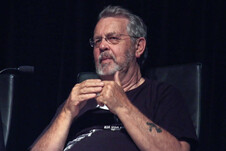
Murray Gray, Going West festival director, 12 September 2010. - Gil Hanly, Going West festival, Auckland Libraries Heritage Collections, NZMS-2475-2010-P248
The creation of the festival drew together two key loves of founder Murray Gray: literature and music. In the 1970s, Gray quit teaching and became a roadie: lugging, plugging and running lights for his mates in Th’ Dudes, Hello Sailor and The Great Ngāruawāhia Music Festival, among others. After that he became a book distributor, and in that role was one of the first to champion the Spiral Collective’s first publication of the bone people. By the time the 1990s rolled around, he was running the bookshop Under Silkwood in Parnell. One day into his shop strolled Waitākere arts manager Naomi McCleary, with whom he promptly fell deeply in love, founded Going West and lived out the rest of his happy days.
The initial plan was simple. Put Maurice Gee on a train heading west and have him read aloud his novel Going West. From that one single idea we now have 30-odd years’ worth of audio recordings, photography and ephemera documenting discussions and performances by the greatest literary artists of Aotearoa, along with some outstanding musicians in performance and kōrero.
And now, the audio recordings are searchable on Kura, Auckland Libraries’ online heritage collections catalogue. Many of the photographs and ephemera are going to take a little longer. This has all been made possible with the support of Auckland Libraries, which gave me a desk for a couple of years, a bloody great hard drive, some Excel templates and miles and miles of very welcome help and advice.
Amongst the hundreds of literary kōrero are many dozens of extraordinary musical recordings, covering an astonishing range, and backed up with thousands of photos. There are abstract soundscapes enriching spoken wordscapes; there are great musicians unpacking their craft; and there’s a multitude of just straight-up amazing live gigs.
Amongst the concerts, one of the big surprises is the 2007 reformation of BLERTA. For younger readers, that’s Bruno Lawrence’s Electric Revelation and Travelling Apparition. It’s a lengthy session, with many band members taking part in a Q&A hosted by Keith Newman and Bill Gruar before knocking out the jams. And yes, ‘Dance All Around The World’ is in there. Sadly, the spirit of Bruno Lawrence departed the material realm some years prior, and Geoff Murphy couldn’t attend either, but the original songwriting team of Corben Simpson and bassist Tony Littlejohn led a who’s who of musical luminaries of the 70s and 80s: guitarist Billy TK, horn player Edwina Thorne, drummer Paul Davies, keyboardist Peter “Melodious Thunk” Dubrowski and legendary vocalist Beaver, aka Beverley Jean Morrison. It’s a glorious session that’s part chat, part gig and part hay-barn hoedown. And to the best of our knowledge, it’s the last ever performance of anything like a recognisable BLERTA line-up.
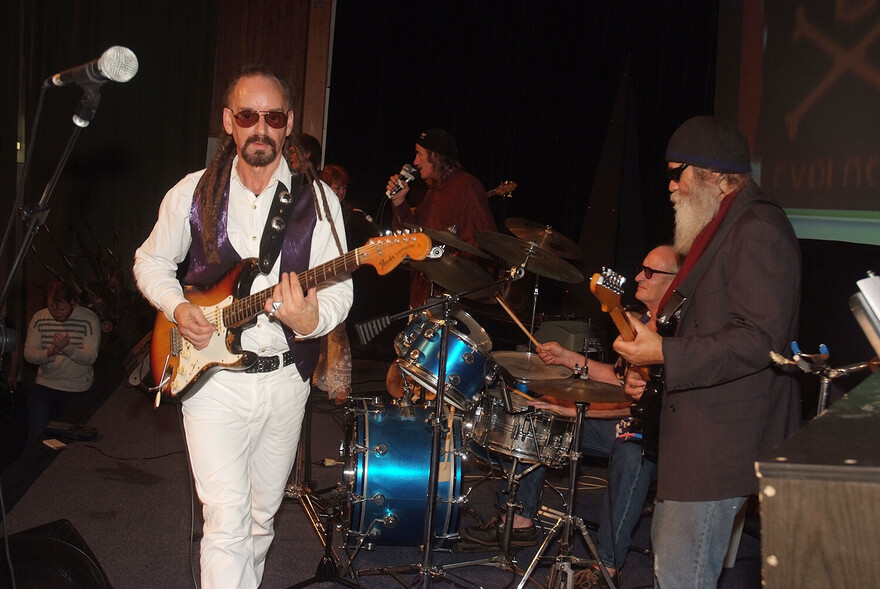
A reunion of BLERTA members at Going West, 2007 (L-R): Tony Littlejohn, Corben Simpson (at back), Paul Davies, Billy T K. - Gil Hanly, Going West festival, Auckland Libraries
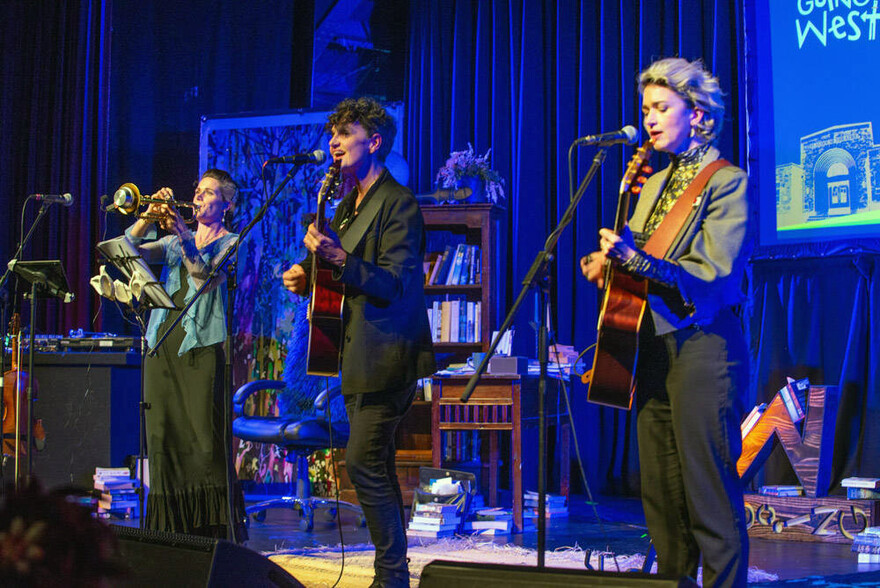
Going West, 2021 (L-R): Show Pony (aka Emily Clemett), Charlotte Yates, and Julia Deans. - John Chapman, Going West festival, Auckland Libraries Heritage Collection, NZMS-2475-2021-P058
Also in the vein of straight-up concerts is a performance by Charlotte Yates with Show Pony (aka Emily Clemett) and Julia Deans performing various pieces from Charlotte’s tribute recordings to Hone Tuwhare, Katherine Mansfield, James Baxter and Witi Ihimaera. Sandy Mill also joins in with a searing performance of Strawpeople’s adaptation of the Tuwhare poem, ‘Covetous’. And in 2005, some of Yates’s Tuwhare album tracks get another live workout from their original artists Te Kupu/Dean Hapeta (Upper Hutt Posse), Graham Brazier and Hinemoana Baker.
Another spectacular concert was in 2018 when Moana Maniapoto and Paddy Free (of Pitch Black) performed as Tū. Going West released that as one of their podcasts during the lockdown years. Maniapoto also appeared in 2017 in a non-musical role, interviewing Anne Salmond on the publication of her book, Tears of Rangi, at about the same time the singer was expanding her career from music into journalism.
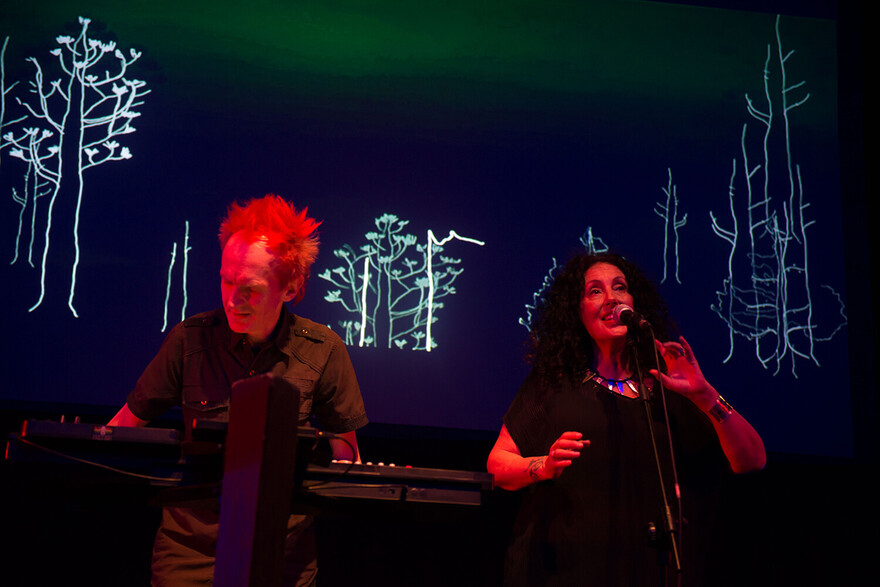
Going West, 2018: Paddy Free and Moana Maniapoto perform as Tū. - Liz March, Going West Writers Festival, Auckland Libraries
Listen to Tū – Paddy Free and Moana Maniapoto, Going West, 2018
Looking further back, there are two very warm and gorgeous performances by multi-guitar harmonisers from the 1970s, Waves. Murray Gray was a friend and west coast neighbour of front man Graham Gash. One of Auckland’s most prominent graphic artists, Gash also drew the original Going West logo. It’s mutated a bit under various hands and over the years, but his distinctive cartoony line work still forms a large part of Going West’s visual DNA.
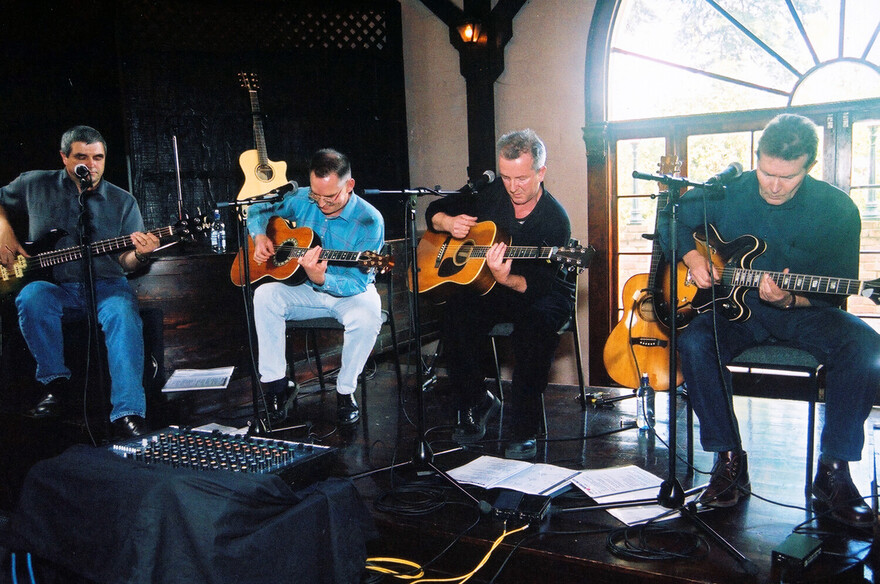
Waves performing at Settlers Lodge at Waimauku, Going West, 21 September 2003. From left: Michael Matthews, David Marshall, Graham Gash, and Kevin Wildman. - Gil Hanly, Going West Writers Festival, Auckland Libraries
Another standout concert was by Wellington jazz/poetry combo Small Holes In the Silence in 2017, with Norman Meehan on piano, Hannah Griffin on (sung) vocals, Blair Latham on saxophone and Bill Manhire reciting poetry from some of the Aotearoa greats – James K Baxter, Janet Frame, Alistair Te Ariki Campbell, David Mitchell, Hone Tuwhare as well as his own. Metro awarded this show “best opening night of the year,” and the recording captures the warmth and intimacy of the moment perfectly.
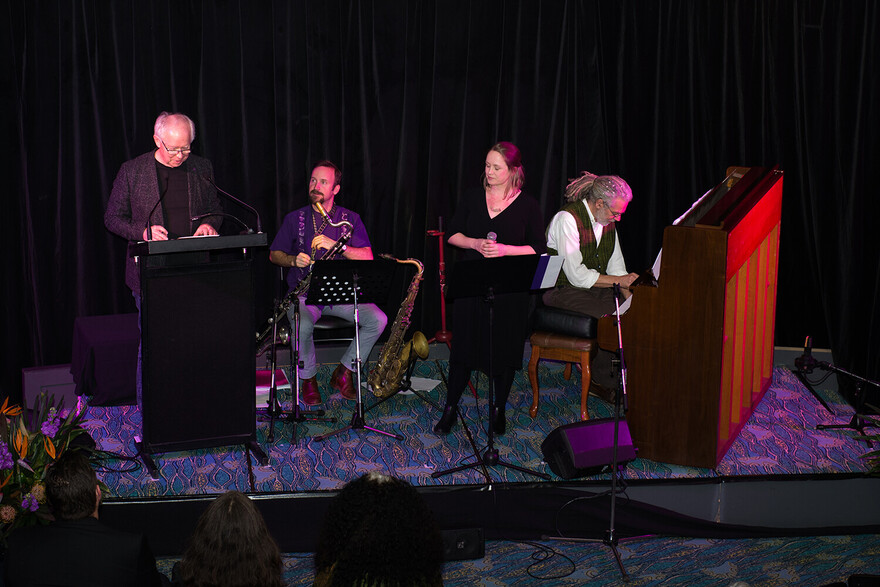
Small Holes in the Silence at Going West, 8 September 2017. From left: Bill Manhire, Blair Latham, Hannah Griffin, Norman Meehan. - Liz March, Going West festival, Auckland Libraries, NZMS-2475-2017-P056
Listen to Small Holes in the Silence, Going West, 2017
Being a LitFest, much of the music takes place within a literary context. Chris Knox and Dave Dobbyn express entertainingly contradictory views on the subject of lyric writing in a 1998 conversation, featuring performances of ‘Hallelujah Song’, ‘Mobile Home’ and ‘Pibroch’. Dobbyn reckons lyrics are easy. Knox reckons they’re hard. If he could get by without them, he would, he says. And there’s some familiarity, which is typical of much of the best of Going West. “Twenty years ago Murray Gray introduced me to recreational drugs,” jokes Dobbyn. Responds Knox, in a room half full of poets, “I hate poetry.” Dobbyn was interviewed again in 2012 by AudioCulture content director Chris Bourke (who also appeared in 2006 discussing research for his book Blue Smoke).
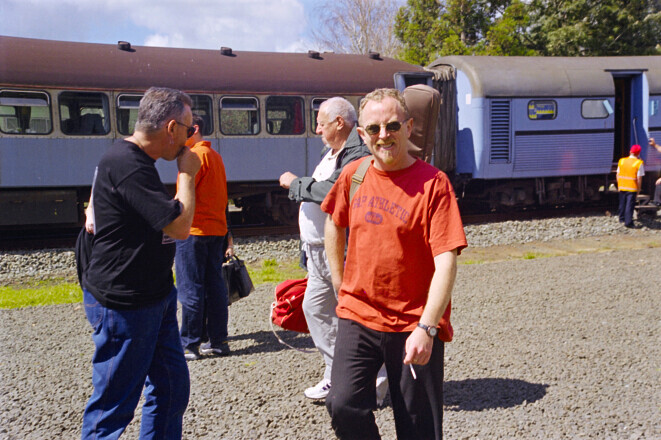
Dave Dobbyn stretches a leg off the Going West train at Waimauku, 1999. At left, in black top, is Going West founder (and former Dudes roadie) Murray Gray; behind them is infamous raconteur John Yelash. - Gil Hanly, Going West festival, Auckland Libraries
Another standout in this chats-with-music format is Graham Brazier and Harry Lyon’s interview with Finlay MacDonald in 2014. The interview itself has some awkward moments. Graham was in a heightened mood that night, and the recording starts out with some really terrible jokes. But as the evening grows deeper, the mood softens, and these giants of Kiwi rock reflect nostalgically on their tumultuous lives in music. And then they sing. The stripped back acoustic line-up of just the two men gives visceral power to some well-known hits. ‘Gutter Black’ manifests as a completely different song from the more joyous cacophony family from the album, radio and TV show. This version is melancholic, nostalgic, vulnerable and very much worth a listen.
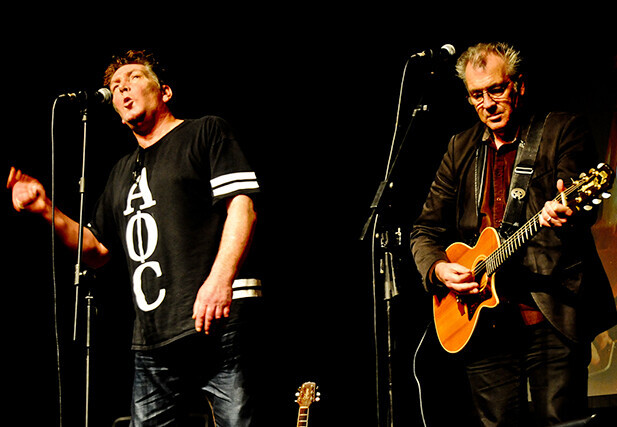
Graham Brazier and Harry Lyon of Hello Sailor, at Going West, 12 September 2014. - Gil Hanly, Going West festival, Auckland Libraries
Māori and Pasifika artists are very well represented in the Going West collection. The first ever session in 1996 features taonga pūoro performed by Bernard Makoare, and there are several sessions featuring work by Richard Nunns, Andrea Tunks, Brian Flintoff, Riki Bennett and Rewi Spraggon. Nunns talks of the extensive primary research he did in conjunction with Hirini Melbourne, and it’s awe-inspiring to hear how the two of them pieced together a lost art from the faintest memory-fragments shared by elders. Taonga pūoro has a narrative sense wholly distinct from Western conventions, and it also speaks an entirely different musical grammar. Nunns’s kōrero illuminates these differences, and in so doing, bridges them.
And in 2008 Going West hosted the spectacular Polynation event, featuring spoken word and instrumental artists who have since become household names. It includes what must be one of the earliest known recordings of Selina Tusitala Marsh performing ‘Fast Talkin’ PI’, along with drumming and ukulele by Tim Page, raps by Daren Kamali and spoken words by Tusiata Avia, Serie Barford, Rev. Mua Strickson-Pua and Kathryn Hayward Nathan.
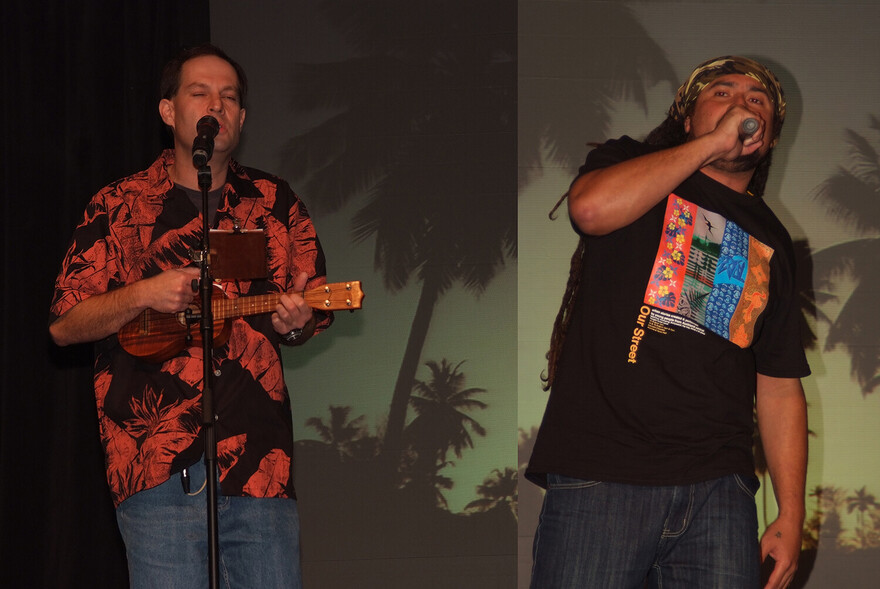
Tim Page (left) and Daren Kamali with Polynation, at Going West 2008. - Gil Hanly, Going West festival, Auckland Libraries
There is more in the way of compelling spoken word performances with extraordinary musical and sonic accompaniment. In 2019, Harriet Allan interviewed Witi Ihimaera about the second volume of his autobiography Native Son. Within the interview Ihimaera reads his own retelling of the pūrākau of Rua-te-pupuke. Kingsley Spargo Melhuish accompanies with layered audio of diverse instruments and loop effects creating something of a sonic vortex, the perfect audio context for Rua-te-pupuke and his unscheduled rescue mission beneath the waves. You can also hear that performance at Going West’s podcast page.
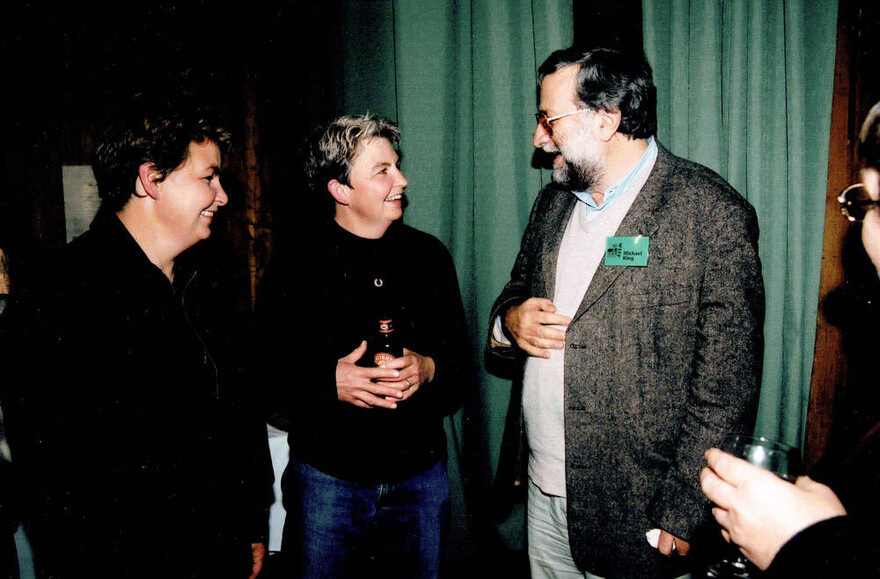
Lynda and Jools Topp talking with historian Michael King, at the Going West festival, September 2002. - Gil Hanly, Going West festival, Auckland Libraries Heritage Collections, NZMS-2475-2002-P002
Also in 2019, Ihimaera and Melhuish take a similar approach to another, somewhat darker and more personal passage from the same book, dealing with Ihimaera’s youthful experiences with self-harm. Yes, it’s a tough listen so please treat it with caution. But it’s also an extraordinarily sensitive performance that gets inside the experience without judgement or violence. As Ihimaera puts it, “This is my way of making [the younger self] right … Of putting him beside me.” It’s also a compelling example of how music and performance can create a safe space around trauma. The reading starts just before the 30-minute mark, but the interview with Sue Orr is equally compelling, revealing and illuminating the complex emotional journeys we traverse from childhood to adulthood.
For another example of music adding context to a spoken word performance, Mahinaarangi Tocker appeared several times, including once in 1998, with Lynda Chanwai Earle performing ‘Honeypants’, and again with Jenny Bornholdt in 2000. In the latter of these, Tocker also performs several of her own songs.
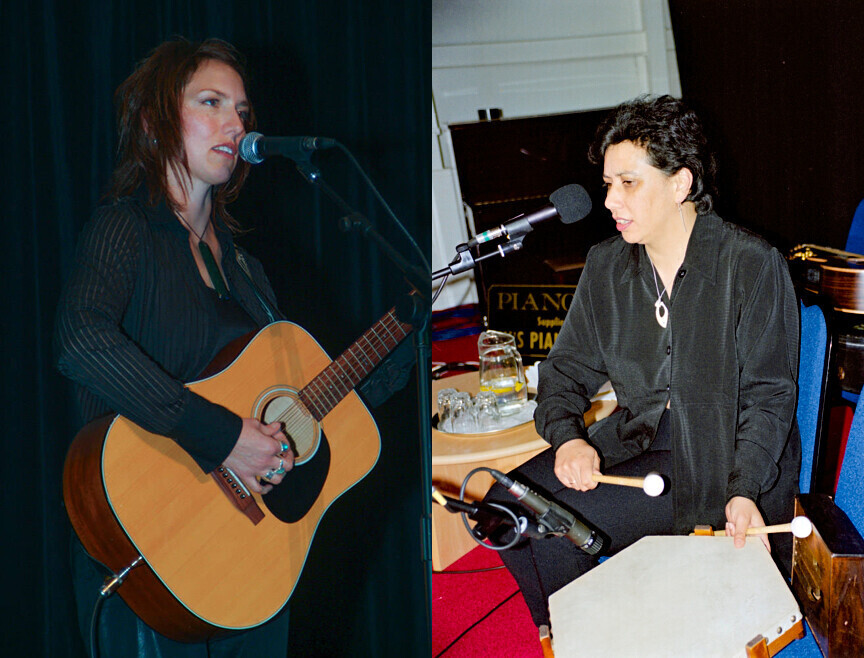
Hinemoana Baker Baker performs her poetry and waiata, 9 September 2005; Mahinaarangi Tocker at Going West, 1998. - Both photos by Gil Hanly, Going West Writers Festival, Auckland Libraries
And there’s just some straightforward good times. If incredible women from Huntly is your hot topic, you’ll want to hear The Topp Twins in discussion with – and performing alongside – cultural gadabout (and erstwhile opera singer) Max Cryer, and we also have a rather unusual recording of none other than Marilyn Waring singing cabaret accompanied by horn artiste Edwina Thorne (who came back for the BLERTA gig a few years later).
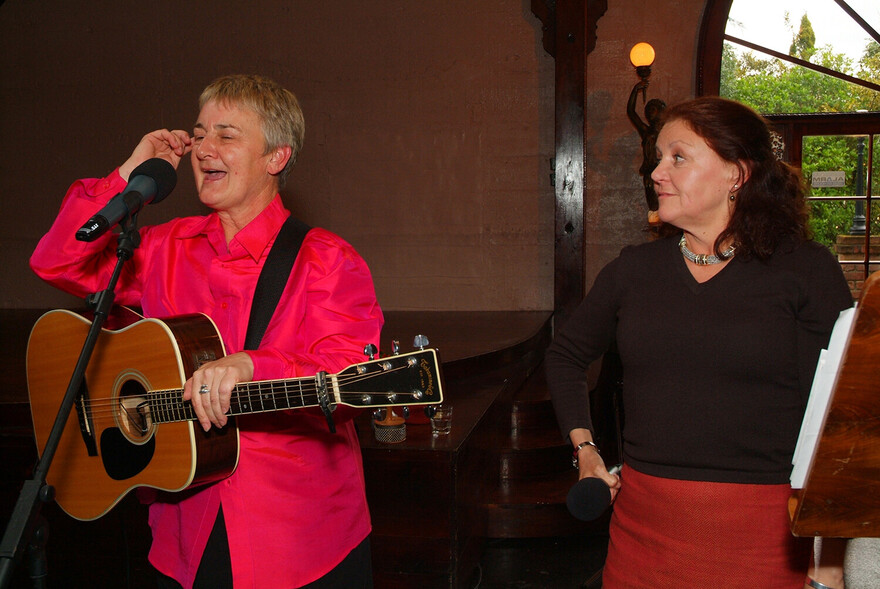
Marilyn Waring and Edwina Thorne, on the Waimauku train for Going West 2005. - Gil Hanly, Going West Writers Festival, Auckland Libraries Heritage Collections, NZMS-2475-2005-P521
There’s much more, so as the archivist who put it all together along with the Going West trust who made it all happen, we urge you to check it out. Whether you’re a cone-headed musicologist or a living room lip-syncher or anything in between, there’s music here you’ll love and kōrero that will inspire.
Roger Shepherd discusses “My life with Flying Nun” with John Campbell – Going West, 2016
At the time of writing, the Going West festival is undergoing a transition. Having acquired the Titirangi house once belonging to novelist Maurice Shadbolt, the festival trust is now developing it into a writers’ residence. In the meantime, they’re curating a series of intimate gatherings – workshops and salons – with more of the greatest literary artists of Aotearoa.
Archiving all this has taken quite a bit of work. Over the last couple of years (with tons of support from Auckland Libraries) I’ve described about a thousand audio recordings, dozens of filing boxes and the thick end of 20,000 photographs. One thing to note: no archive of this magnitude is ever complete. The crowd shots alone put paid to that idea. If you see an item that’s been incorrectly identified, please let us know. There’s a contact form on each item’s own page in Kura, and you can use that to tell the good folks at Auckland Libraries any details that are missing or incorrect.
How does one listen to this audio? For various reasons much of the audio will require you to request a listening link from Auckland Libraries, using the contact form at the specific pages on Kura. It’s worth checking out Going West’s podcasts which, over about 50 episodes, hold some of the gems from the last 30 years; four are incorporated in this article.
--
Link: Going West festival archives
The Going West Festival archives are now discoverable online through Auckland Libraries’ heritage collections database, Kura. There, by searching Going West, or the name of the artist, can be found hundreds of audio recordings, and thousands of photographs from three decades of literary and cultural history. On Soundcloud, James Littlewood discusses the archive, including an acoustic version of ‘Gutter Black’ performed by Graham Brazier and Harry Lyon in 2014.
The archiving project was made possible with the support of Hāpai Hapori Lottery Grants Board and the Auckland Library Heritage Trust.
--