“We want the funk, gotta have that funk!” There was more funk going on in Aotearoa New Zealand than is often realised, argued Grant Smithies at the release of Alright in the City, a collection of local funk he compiled with John Baker in 2015.
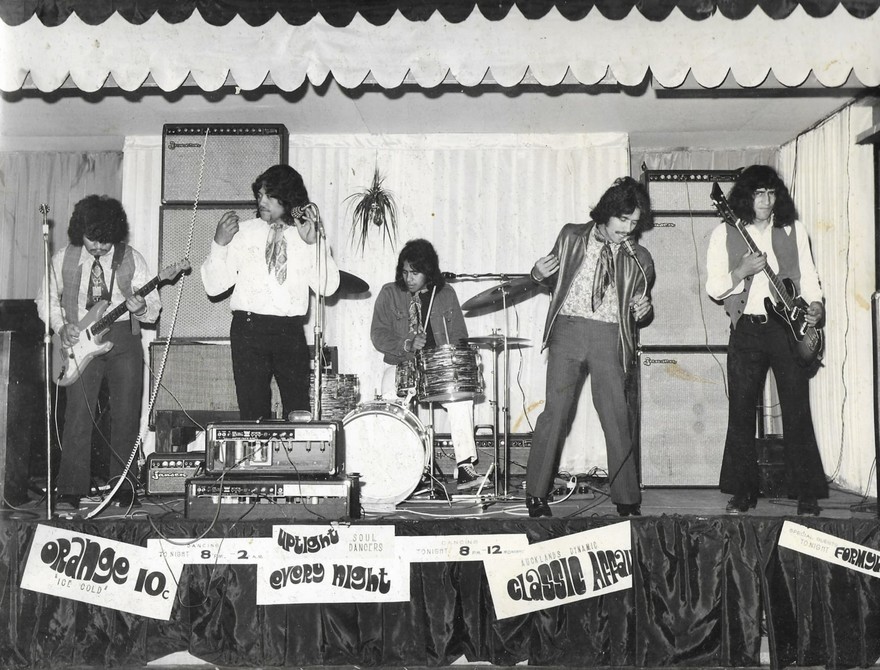
Shriek Machine of Tokoroa get down, c.1971-72. The band would evolve into Collision. From left: Ali Morgan, Ricky Nichols, Colin Tahau Henry, Hira Morgan and George Marsh.
The funk gets its hooks into people in many different ways. Perhaps it’s a killer horn riff in the background of a song on the radio. Maybe it’s a gloriously unreasonable bassline you hear thundering out of the speakers at someone’s party. You might stumble across some classic Soul Train clips while aimlessly trawling YouTube, or wander into a bar just as some groove-monster live band is hitting its stride in the corner. Your first formative funk encounter could happen anywhere, at any time, but regardless of the details, the outcome’s always the same. Next thing you know, you’re addicted, lying on a dirty mattress in some $10 room, craving a hit of Bootsy Collins.
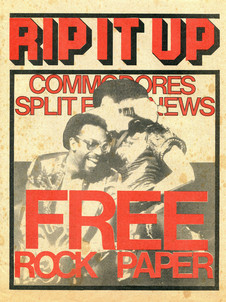
Rip It Up No.1, June 1977.
My own gateway drug was The Commodores. My first-ever favourite band, I had a giant poster of them on my bedroom wall during the mid-70s. These days, of course, Lionel Richie is as cheesy as a fondue, but back then, he was a silver-suited sex machine, hollering and grunting, whistling and groaning, trading lead vocals with bandmate Clyde Orange and thrusting his little hips so vigorously, girls probably got pregnant just being in the same concert hall.
The Commodores’ 1974 debut single ‘Machine Gun’ was the theme tune for local music TV show Ready To Roll for many years, and you best believe I always turned it up. After that, the band kept dropping Top 20 singles like a careless drunk drops pocket change – ‘I Feel Sanctified’, ‘The Bump’, ‘Brick House’, ‘Too Hot Ta Trot’, the resolutely pervy ‘Young Girls Are My Weakness’ – and I fell hopelessly in love with blaring horns and bumping basslines.
I was not alone. In Whanganui’s poor eastern suburbs where I grew up, there lived a large Māori population with a taste for the good groove. Alongside Jimi Hendrix and Bob Marley, funk was the soundtrack to every decent party, and by the time I was a spotty teen, I needed daily maintenance doses of War, Ohio Players, The Commodores, Average White Band, and Earth, Wind & Fire.
Sadly, times have changed, and a lot of bland, antiseptic music is erroneously deemed funky these days. Some people think that all you need to make a modern-day funk record is a trumpet, a third-hand James Brown bassline and a mediocre singer banging on about “soul”. But they’re deeply deluded.
Funk needs to be filthy. It should be sweaty, unhygienic, a little whiffy around the edges.
Funk needs to be filthy. It should be sweaty, unhygienic, a little whiffy around the edges. Ideally, there should be a generous dollop of lust leaking through the lyrics, and the groove should be so dirty you need a shower after hearing it. And it should hit you physically as much as emotionally. A great funk tune energises the mind by stealth, bypassing the conscious brain and working its voodoo directly on your muscles, nerves and sinews, making your body want to buck and twitch, shimmy and snap. It hits you in the hips, sends a spasm down your spine, and causes an alarming stirring in your loins, too.
But were any great 70s funk records made here in New Zealand? When you pore over the written records of our musical history, much is made of our early Māori showbands, our 1960s garage rock bands, our 1970s prog-rock acts, the 1980s golden era of our early indie labels. There are learned essays galore on our notable pop, punk, country, hip hop, and electronic releases, but local funk recordings get just a few lines.
When you go mining through the vaults of local record labels searching for master tapes that might confirm the existence of an indigenous funk scene, they’re very thin on the ground. You’d be forgiven for thinking that when the good groove flowed out from the US to conquer the globe in the early 70s, it lost its way before reaching New Zealand.
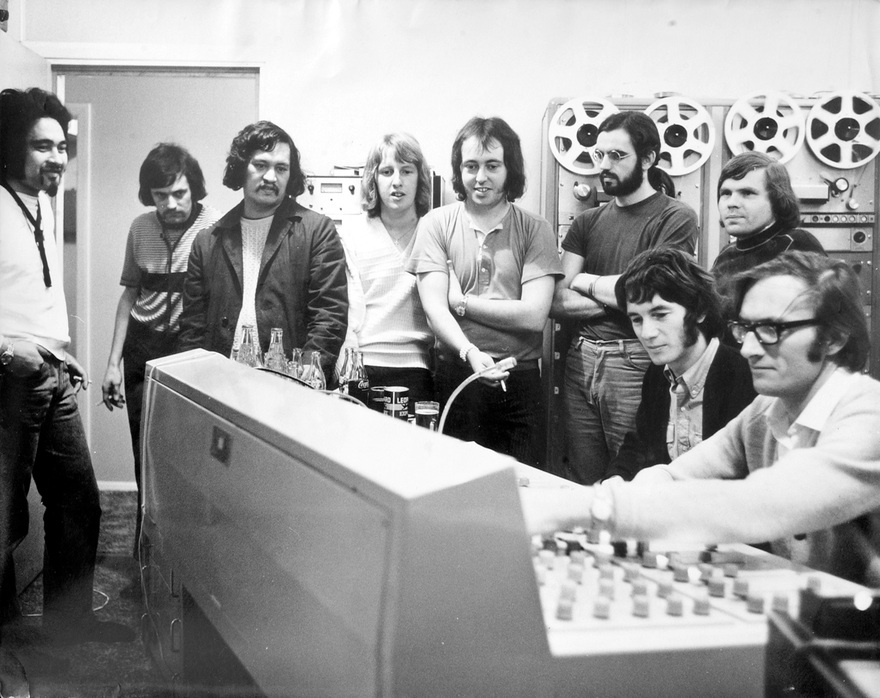
Peter Dawkins with Quincy Conserve at HMV studio in early 1971. From left: Denys Mason, John McCormick, Rufus Rehu, Barry Brown-Sharpe, Dave Orams, Richard James Burgess, and Malcolm Hayman. Seated are Peter Dawkins and engineer Peter Hitchcock.
But you’d be wrong. Funk in 1970s New Zealand was largely live music, with a plethora of bands playing covers and originals in clubs and bars the length and breadth of the country, but most of these bands eventually dissolved without leaving any audio evidence of their existence behind.
In many ways, the story of early funk music in Aotearoa is a story of absence, invisibility, missed opportunity. It is a story of packed venues now long closed, with dynamite resident bands who never got their shot in a recording studio. You hunt in vain for the cracking snares and booming basslines of ghosts.
“Even if the local funk bands of the 70s wrote originals, they generally didn’t get the chance to record them,” says Rip It Up magazine founder and long-time funk fan, Murray Cammick. “Coming out of the 60s, we had a very pop-oriented record industry, with record companies still selecting songs for their artists, and recording sessions also became prohibitively expensive because engineers spent ages overdubbing everything rather than just recording bands live in the studio as they did in the 60s.”
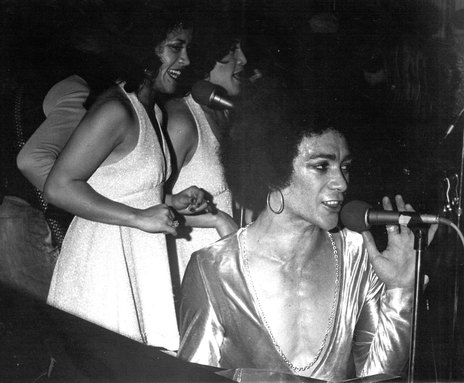
Mark Williams, circa 1975. - Phil Warren Collection
Cammick remembers the 70s as a time when Earth, Wind & Fire, War, the Isley Brothers, and Barry White all got heavy radio play and local funk bands were commonplace. “I once saw Mark Williams play an extraordinary version of Parliament’s ‘Tear The Roof Off The Sucker’ in the Hutt, and lots of Māori and Polynesian bands played perfect funk covers in the clubs around South Auckland, knocking out really complex tracks with ease. We put The Commodores on the cover of Rip It Up in June, 1977, and when they played Auckland Town Hall that year, the place was full of Māori and Polynesian guys with afros. The show started with a confetti canon, so you had white dots stuck all over every afro in the audience! It was a mind-blowing show, and I’m sure it influenced a lot of local players.”
But despite the substantial popularity of the sound throughout the 70s, our studios weren’t exactly throwing open their doors to funk bands. “It wasn’t until the 80s that independent labels such as Propeller, Flying Nun and Wildside provided an opening for bands to record whatever they wanted. During the 70s, a lot of pop-oriented record companies would have decided most original rock and funk stuff wasn’t commercial enough, and it would have been even harder to get recorded if you were a Māori funk or soul band, no matter how good you were. Whether you got studio time was often down to whether an older Pākehā producer or label owner liked your music, and these guys tended to be technician types who loved The Alan Parsons Project.”
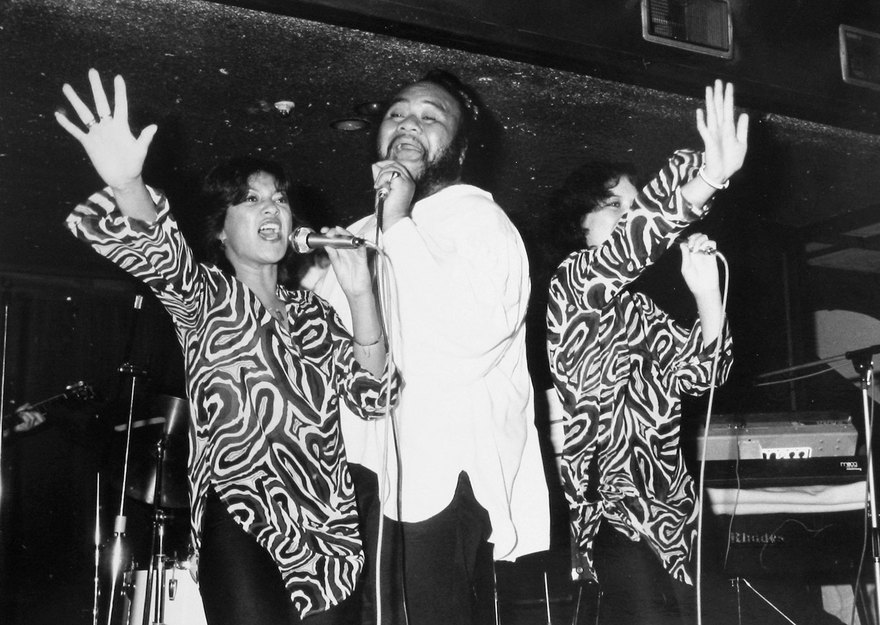
Dalvanius and the Fascinations in Sydney, 1970s
Even so, a scattering of funky bits and bobs slipped through the net. A veteran of Johnny Devlin’s backing band The Devils, Taranaki-born blind organist Claude Papesch put out two mid-70s solo albums which each contained a killer Hammond funk instrumental. With late 70s songs ‘Voodoo Lady’ and the sparkling ‘Checkmate On Love’, Pātea-born singer Dalvanius Prime and his band The Fascinations put a gently funky Māori spin on disco and Philly Soul, and mainstream pop artists such as The Chicks, Bunny Walters, Allison Durbin and The Keil Isles covered soul/ funk tracks by The Isley Brothers, The Temptations, Stevie Wonder, Otis Redding, Ike & Tina Turner, and Tony Joe White.
But listening to them four decades later, many of these recordings err on the side of politeness. Where are all the osteopath-friendly arse-shakers? Mostly on local rock records, as it happens. If an overseas funk connoisseur washed up on these shores looking for crushing drum breaks, razor-sharp horn stabs and dynamite guitar grooves, they’d be best advised to head to a second-hand record store and rummage through a stack of our 70s rock LPs.
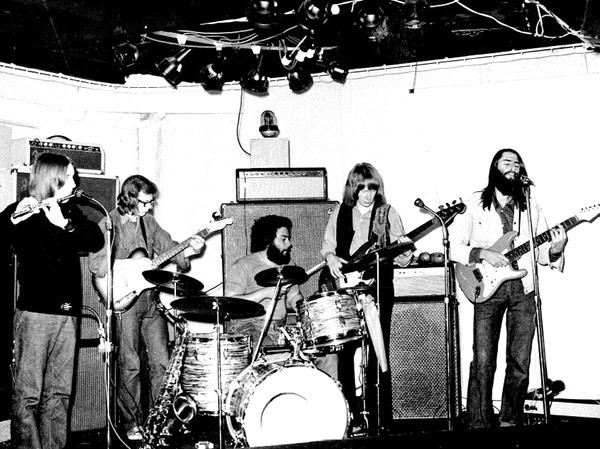
Farmyard, from left: Andrew Stevens, Milton Parker, Tom Swainson, Rick White, Paul Curtis.
While very few American-style black funk cuts were recorded here during the 1970s, many of our rock bands overrode the unspoken studio funk embargo by sneaking one or two funktastic dancefloor scorchers onto their LPs, often cunningly concealed beneath a blizzard of Hendrix-inspired guitar.
On the Alright in the City compilation you’ll find a heaped helping of the best funk-flavoured music made in Aotearoa during the 1970s. Given that many of these cuts lean strongly towards soul, rock, disco and jazz, some might argue whether this stuff is really funk at all, but if you set your conscious mind in neutral, turn it up loud and let your body respond, you’ll realise these tracks ooze funk like a marathon runner drips hot sweat.
Besides, genre pigeon-holes are for chumps. Listening through dozens of possible tracks alongside co-compiler John Baker and Auckland soul specialist Kris Holmes, we gave ourselves just one yardstick when deciding what made the final cut: each track needed a groove so dirty, hearing it made you want to make like a dog and hump somebody’s leg.
--
An edited version of “In a Funk: New Zealand's lamentable history with soulful sounds” from the Sunday Star-Times, 8 December 2015. All rights reserved © Grant Smithies. Alright in the City was released – in a limited edition of 300 vinyl copies – in 2015 on Universal NZ as a single album of 11 tracks.
Tomorrow night on AudioCulture: get down with “Funk Aotearoa 2”. Originally Alright in the City was to have 16 tracks. Grant Smithies backgrounds them all, and an audio playlist is provided.