Formed during the jug band boom of the late 60s, Railway Pie can lay claim to being the last jug band standing. Featuring original members Jack Craw, Jim Crawford and Terry Toohill in the line-up, alongside longtime fellow blues travellers Garry Trotman and Alan Young, they are still playing gigs. With a third album of Memphis-style jug music in the works, they may well be Aotearoa’s longest-running group.
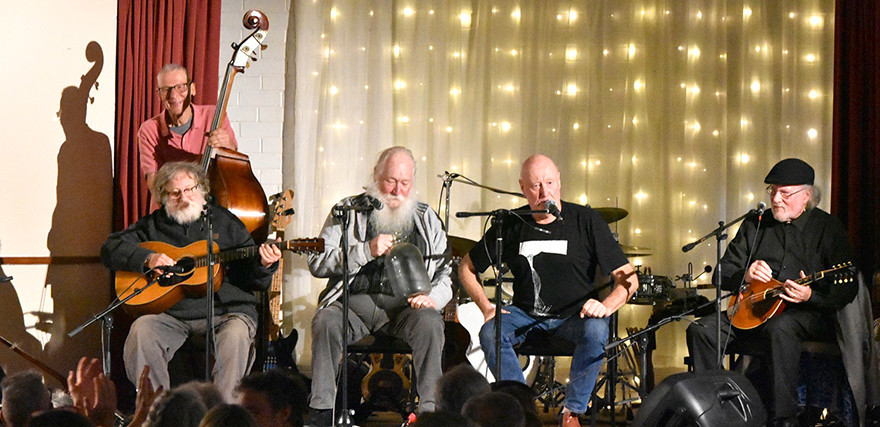
Railway Pie performing at Harmony Hall, Devonport, 11 July 2024. From left: Peter Parnham (standing in for Garry Trotman on bass), Terry Toohill, Jim Crawford, Jack Craw, and Alan Young. - Photo by Dave Perrett
Jack Craw grew up in Linton and Jim Crawford was raised in Pohangina, so – in rural Manawatū terms – they were pretty much neighbours. Jim was exposed to music as a small child, and one of his earliest memories is sitting on his grandmother’s knee while she played Bach on her pump organ.
“My dad decided to learn trombone when he was well into his 30s,” says Jim, “and he made an amateur career out of it, working around Palmerston North playing dixieland, so I got exposed to that music fairly early on, particularly English trad revival stuff. He brought home a Lead Belly LP from the library with his version of ‘Rock Island Line’ on it, and it absolutely knocked me off my feet.”
A hand injury prevented Jim from learning guitar but he could manage a banjo, and by his mid-teens he was learning Lead Belly and John Lee Hooker songs along with classic country numbers. At high school he was taken to task for criticising the musical tastes of the other kids and had to front up and play in front of his peers. “I did these two Lead Belly numbers in front of my school hall full of adolescent boys … and they loved it. They stomped their feet and made a racket, it was really quite an amazing response. It blew me away and I thought, well that was good, I need to do that again!”
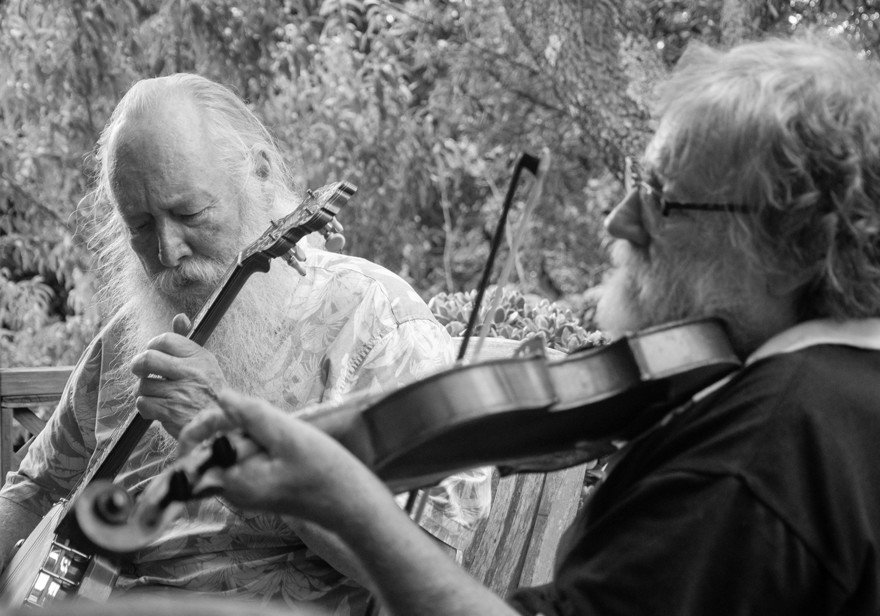
Jim Crawford and Terry Toohill of Railway Pie. - John Pain
Jack: “I remember Jim getting up and doing those Lead Belly songs at school. He was normally a quiet lad, but that was something else! At home my mother would listen to The Sound Of Music or Oklahoma! which did nothing for me, but one night when I was about 14 I heard John Lee Hooker on the radio singing ‘When My First Wife Left Me’, and it completely changed everything. It was just his beautiful dark baritone accompanied by a low guitar, laden with meaning that I didn’t understand. I wasn’t even sure I liked it, but I wanted to hear more. I went to the local record shop and bought the three LPs with ‘blues’ in the title. I was a blues guy from that day on.”
Those records were Me and the Devil, an anthology of British blues featuring artists like Tony McPhee, Jo-Ann Kelly, and Andy Fernbach, and two stone-cold classics – John Lee Hooker Sings Blues on the Regal label, and Robert Johnson’s King of the Delta Blues Singers.
Nash Street jam
Jack, who by then was playing harmonica, fell in with Jim when they started at Massey University, Palmerston North. “One day Jim said ‘come with me to the folk club’. He played a song, and then the Nash Street Jug Band got up, and I thought they were fantastic.” Before long both had joined the line-up, which also featured Rowan Peters on banjo and Trevor McBride on washboard. Terry Toohill, who had already graduated, was playing guitar and living in the eponymous Nash Street flat. There, various musicians and artists – including satirist and cartoonist Tom Scott – came and went. Jack initially played tea-chest bass, as vocalist Lester Mundell already had the harp spot.
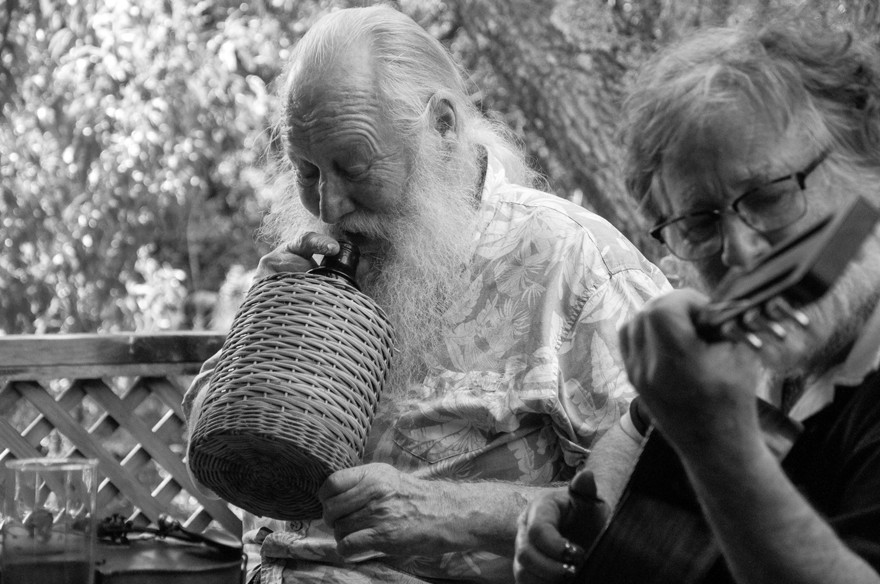
Jim Crawford and Terry Toohill of Railway Pie. - John Pain
“Jim was playing a bit of jug,” says Jack, “Arthur Ranford occasionally joined in on violin – he ran a print shop and ended up joining the NZSO, and Bud Hooper (later in Powerhouse with Billy TK) would sometimes drop in on percussion.”
Terry Toohill: “I was working at Longburn Freezing works in about 1965, and this older guy who had come over from the UK loaned me a few records, John Lee Hooker, Sonny Boy Williamson, and he gave me the address of a record shop in Plymouth, England, that sold these reissued LPs. I bought an anthology record that had a Memphis Jug Band track on it, I think ‘Stealin’ Stealin’, along with Gus Cannon. I went out to Piopio to do my practical uni work on a sheep farm, and there were no distractions so I taught myself to play guitar.”
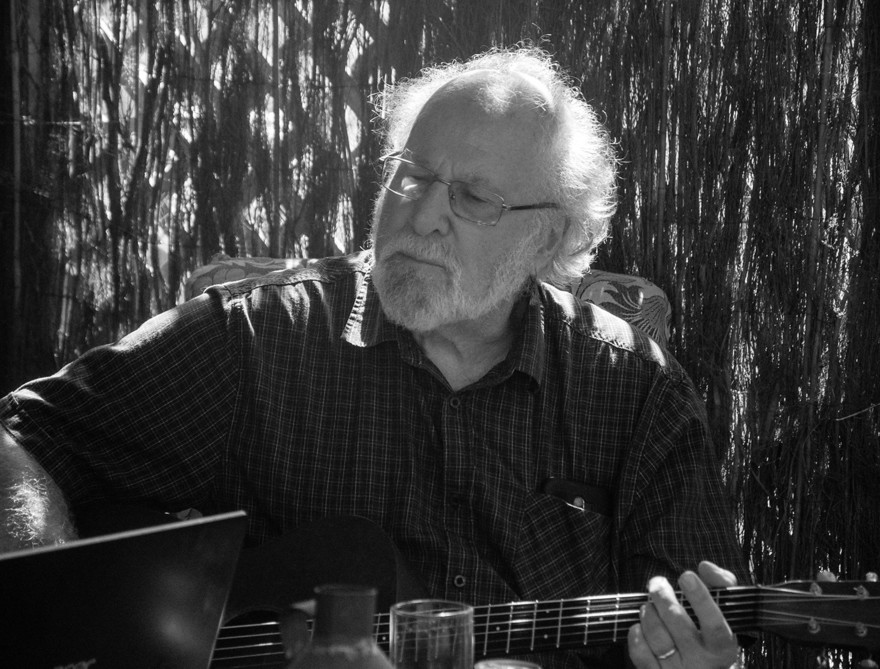
Alan Young, at Shakey Studio in Maungataroto, Northland. - John Pain
Alan Young: “The blues revival broke out, and all of a sudden you could get vinyl reissues of those old 1920s recordings, it was a real windfall. Railway Pie, the Windy City Strugglers, the Band of Hope from Christchurch, and The Mad Dog Jug And Juke Band from Auckland, all of us were listening to those recordings and trying to play that stuff accurately, the way it was performed. Which works both as a sort of homage and a way of improving your own musical skills, because if you play within your own limitations all the time you’re not achieving anything. I suppose there was also an evangelical aspect to it, spreading the word.”
“You’re not as good as Terry Toohill!”
Alan Young: “I wanted to play bass. The bass player from The Action gave me this advice. ‘Get yourself a six-string guitar first and learn your chords.’ So I guess I’m still playing six-string guitar and trying to learn enough chords to be a bass player.
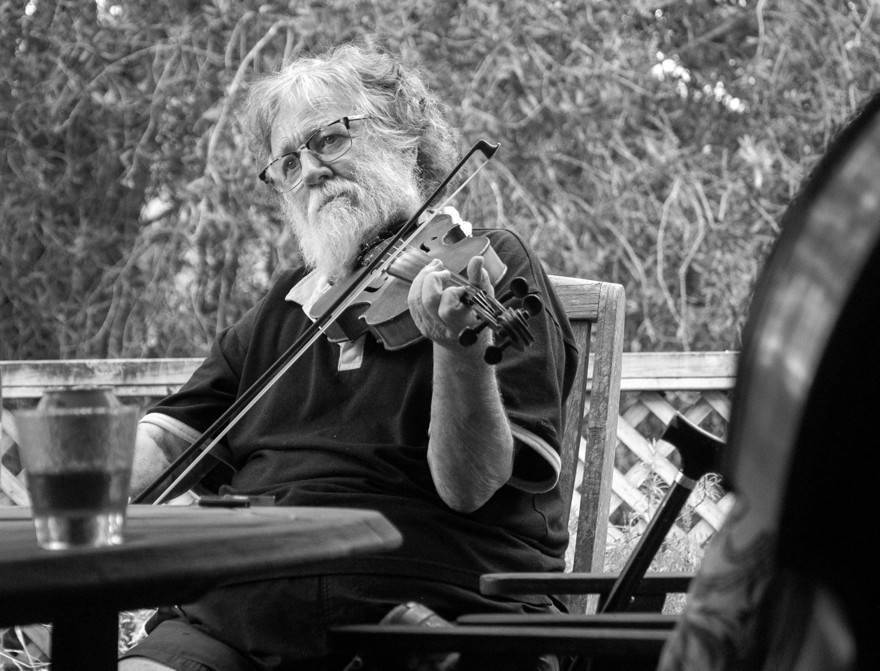
Terry Toohill, at Shakey Studio. - John Pain
Young first met the others when he was on stage at the Great Ngāruawāhia Music Festival in 1973. “I’m up there on my own with my little steel guitar and some guy was yelling from the audience, ‘You’re not as good as …’ He did it two or three times. If he was saying ‘You’re not as good as Blind Blake’ then yes, he’s quite right, but I couldn’t catch the name so I ignored him. I found out later it was Trevor McBride, the washboard player from Railway Pie, and he was shouting ‘You’re not as good as Terry Toohill!’ We met a couple of months later, but I didn’t join the band until after Steve Evans went off to England in the 80s. But I was there all along and we were pretty tight.
“It was hard finding real blues records in New Zealand. We all ordered records from overseas but in those days you had to get a bank draft, and the amount of money you were allowed to send per year was strictly limited, so we’d buy bank drafts under fake names. And the names we used were the names of blues singers because we were young and smart and so smug. Someone once said, ‘All we need is someone in the bank that knows something about blues and it’s all over!’ We were pretty gung-ho.”
Best Bets
The Nash Street Jug Band became popular, playing at folk clubs, protests, and fundraisers for anti-war and activist organisations such as the Committee On Vietnam and SPOHAM – The Society for Promotion of Public Health and Morals. Students made up a large percentage of New Zealand’s burgeoning folk scene and Palmerston North, being a university and teacher’s training college town, had a lot of them.
In the mid-70s the band went electric, following the trend set by many of their folk contemporaries. Adding Derek Burfield on bass guitar when their washboard player shifted to drums, they’d play a set of Rolling Stones, Sonny Boy Williamson, Howlin’ Wolf, Muddy Waters, and a couple of Dylan tunes.
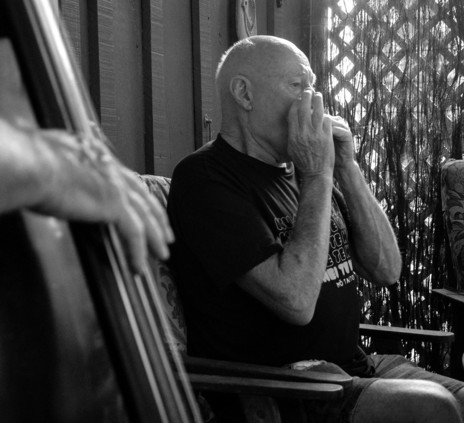
Garry Trotman (bass) and Jack Craw of Railway Pie, recording at Shakey Studio. - John Pain
Jack Craw: “We all got kicked out of Nash Street so we decided we needed another name. In fact, we’d change it every gig. We were the Miss New Zealand Show 1923, Mudstone and the Conglomerates (Terry was a geologist), then our mate Alistair Moir suggested Best Bets and the Railway Pie, which we quickly switched to Railway Pie and the Best Bets. We’d do five or six sets, but opened as the jug band and the crowds went berserk for it, because it was different and just connects with people. We were only playing our old Memphis jug tunes, no ragtime stuff with funny lyrics.” Garry Trotman became co-owner of Beethoven’s nightclub in Palmerston North in 1972, and the Pie played there sometimes as an opening act.
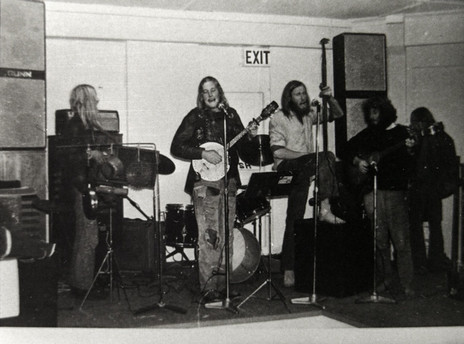
Railway Pie and the Best Bets performing at Beethoven's, Palmerston North
“Garry did that for a year or more, and he hired Mammal, The Underdogs, Butler, BLERTA and other bands. I made toasted sandwiches some nights. I have memories of Harvey Mann at his peak, the wonderful twin guitar and harmonies from Butler, the incredible young Kerry Jacobson who had just joined Mammal, Rick [Bryant]’s voice, Robert Taylor’s guitar …”
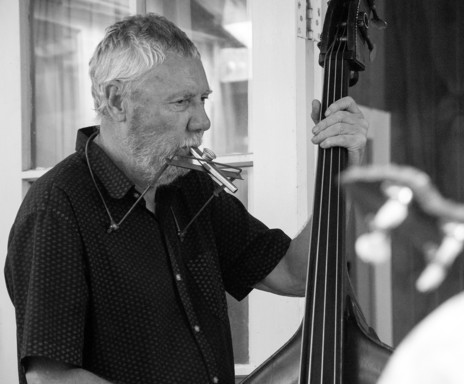
Garry Trotman, of Railway Pie, Shakey Studio, Maungataroto, Northland. - John Pain
This period also saw the band play orientation gigs at Massey and other venues around town, opening for Mammal, BLERTA, Dragon, Billy TK and Powerhouse. “We were a cheap act, but we used to bring them in because we’re a little bit naughty,” says Jack. “I mean we looked horrendous, a rag-tag bunch and scruffy as hell, mostly barefoot. Drug culture was a part of it, the student crowd were big pot smokers and took LSD, but harder drugs didn’t factor in with such a politically motivated crowd.”
North Country Blues
Police interventions into the well-established Palmerston North counter-culture scene saw the band break up for a few years, and in the mid-70s Terry Toohill moved home to Whangārei to get away from it all, and there he met Steve Evans. A little younger than the other Pie players, Evans learned Mississippi John Hurt and Doc Watson tunes from friends and family members.
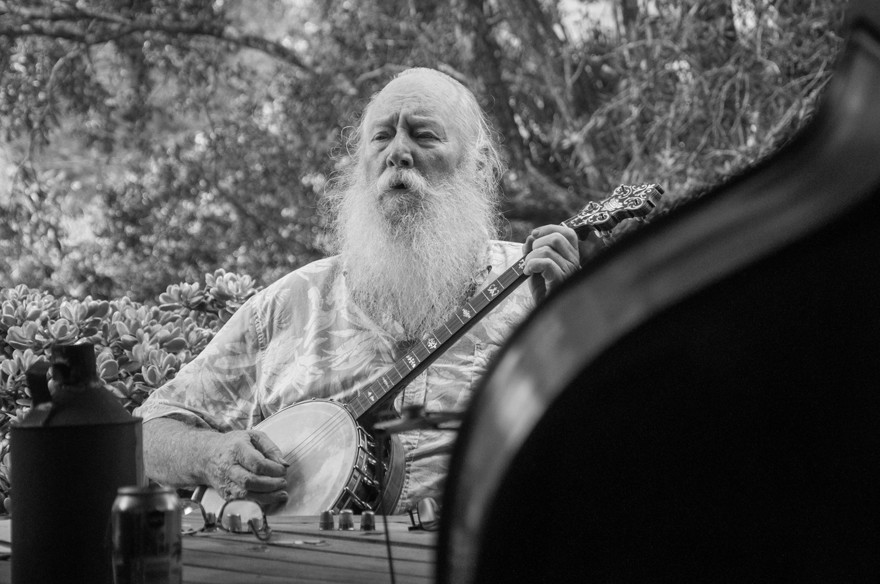
Jim Crawford, at Shakey Studio. - John Pain
Steve: “Terry taught me guitar tunes and loaned me records, and I just soaked it up. I couldn’t get enough. He opened my ears to early country music and blues and jazz, not to mention jug band music.”
In 1981 Evans moved to Leeds in the UK where he met Brendan Croker and Mark Knopfler, travelling with Knopfler as his guitar tech. He began Beltona Guitars, designing and manufacturing resonator guitars and ukuleles made of nickel-plated brass, instruments of renown used by the likes of Knopfler, Eric Clapton, and Keb Mo (the current models use fibreglass resin for the bodies).
He reappeared in Whangārei in 1998 to find Jack and Garry had also moved north, and before long the Railway Pie cart was back on the tracks. Their activities centred around two neighbouring flats on Bank Street, where a shifting roster of musical flatmates and visitors included Steve Evans, Bruce Tuloph, Peter O’Connell, and Fred Renata (the latter three together with Terry made up a band named Whiplash, playing Tuloph’s songs). They found the Whangārei pub scene at the time lacking in original or interesting music, and found Reva’s Pizza Parlour to be a more useful venue than the more traditional local folk club, offering free pizza for musicians and an ever-changing audience.
Jack: “Reva was an American entrepreneur who liked bluesy music and free musicians. I’m not sure she had a liquor licence, but she was sanguine about musicians partaking of various libations and emollients, plus her pizza was outstanding and easily the best in town. The tremendous jazz and boogie pianist Dave Cunis was often in attendance and was great to play with.”
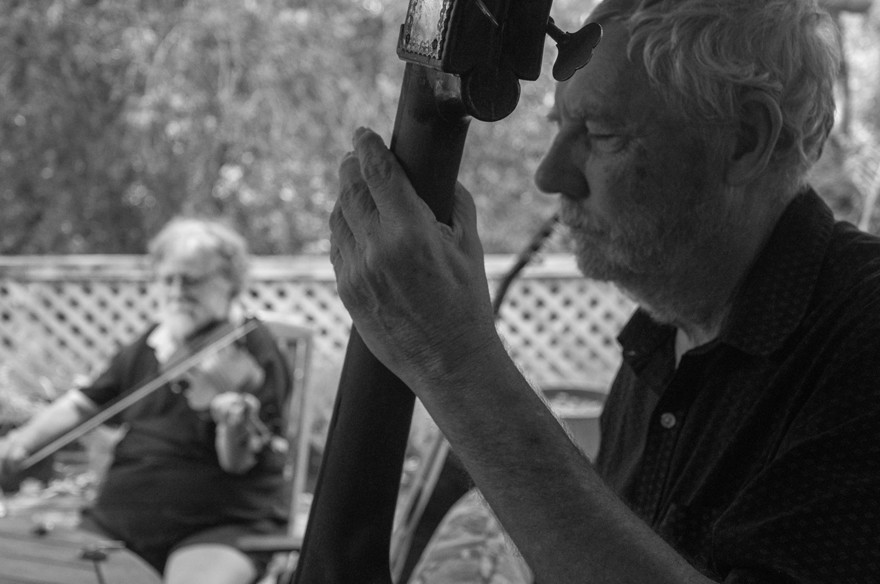
Terry Toohill and Garry Trotman, at Shakey Studio. - John Pain
Railway Pie recorded their first album live at the Grand Hotel in Whangārei in December 1999.
Jack: “l was about to leave for Melbourne and we thought it might be our last chance. We did it in front of an invited audience of 50 or so. Most songs were first take, a few needed a second take because of background noise or interruptions. I recall Roy Phillips [The Peddlers’ vocalist and keyboardist] dropping a bottle of Laphroaig on the floor with a boom and loud oath. We were well rehearsed, and Steve Evans really shone with his mandolin and slide guitar.”
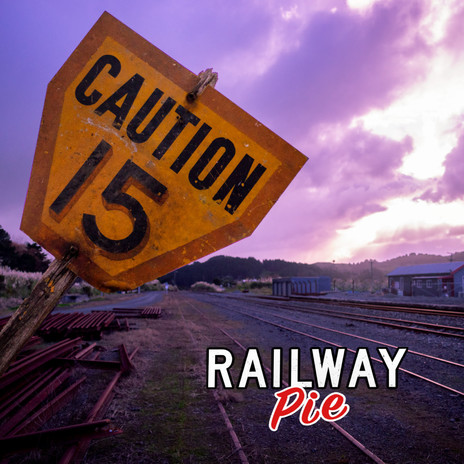
Railway Pie album Caution 15, recorded in 2017 and released on Bandcamp in 2024.
The album featured a slate of tunes from the heart of the Memphis sound, and the follow-up, recorded in 2017 and released in 2023, was likewise pretty much a jug-purist’s songbook. Titled Caution 15, it’s also a live recording, this time captured at Fred Renata’s Shakey Studio, the converted railway bus shed in Maungaturoto where his daughter Erny Belle recorded her debut album in 2019. The studio is over the road from the location of the long-gone station (until 1925 it was the northernmost point on the railway line from Auckland). It once housed Railway Refreshment Room 15, where you could buy a cup of tea and a railway pie. The title and cover photo come from the signage notifying train drivers of the speed limit through the station.
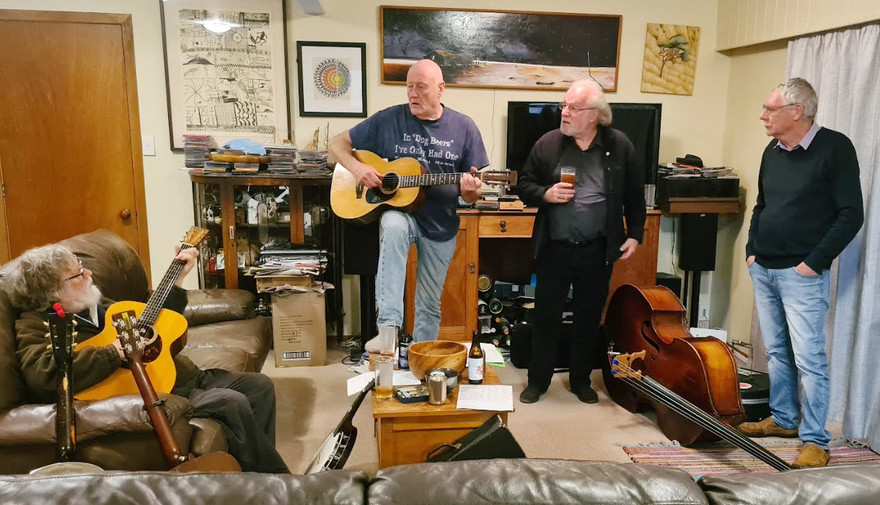
Railway Pie practice, 2025. From left: Terry Toohill, Jack Craw, Alan Young, Garry Trotman (absent is Jim Crawford, who took the photo).
Alan: “When we play together, we don’t try to play it exactly like the gods, but we have spent so long listening to this stuff that it’s just ingrained. Terry and I have a rapport, it probably boils down to if one of us is playing low, the other plays high, but it’ll change in the middle of a verse. And that’s a great feeling.”
Recent recordings at Shakey capture the band playing songs Garry and Jack have written in the Memphis style. They also reveal a band of folk whose decades-long association results in an effortless and resonant style, evident as much in the vocals as the playing. When they join together on a chorus it is quite something to witness.
Railway Pie’s musical family tree
Jack Craw played harmonica and sung in Smokestack, a band featuring Chris Grosz on resonator guitar and vocals, Richard Jones on drums, Alf Rose on bass and Roland Schwarz on guitar. They released the album Excess In Moderation in 2008. Jack also made an album with Chris Grosz under the moniker Ruff & Tumble. Craw has played with Katchafire, Roy Phillips, and was featured on the 2007 Ode Records CD Harmonica Masters of New Zealand.
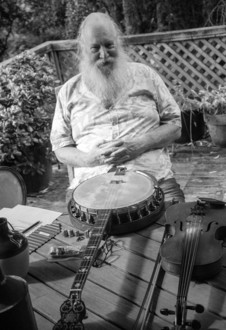
Jim Crawford, at Shakey Studio. - John Pain
Jim Crawford played and recorded with Graeme Wooller and Liv McBride in Invercargill’s folk-alt country band Into The East. He plays bass in a big band in Invercargill.
Garry Trotman has played and/or recorded with The Remarkables (featuring Robbie Lavën, Neil Finlay and Bryan Christianson), Wires And Wood (also with Bryan Christianson, they won the 2011 Tūī award for Best Folk Album for Over The Moon), Whiplash, Al Hunter, and Beverley And The Clench Mountain Boys (featuring Alan Young and his wife Beverley). In 2012 he released a solo album as Gaz, titled Brand New Tradition.
Alan Young started playing in folk venues in the late 1960s. Between the 1970s and the 2000s, he played in blues-oriented bands in Auckland and Sydney, and today he is still doing folk gigs and occasional pub outings. He won the Tūī award for best Folk Album in 1985 for That’s No Way To Get Along, and his wife Beverley won the same award in 1987 for her album Bushes and Briars.
His other musical interest is African-American gospel music, and he is the author of The Pilgrim Jubilees (2001) and Woke Me Up This Morning: Black Gospel Singers and the Gospel Life (1997), both published by the University Press of Mississippi.
Terry Toohill has played in Whiplash, The Tree Fellers, the Basin Big City Band, the Red Arrows and others. His ears have led him on extensive international travels. Jack Craw notes that “Terry was always the first to discover music. Jug band, country blues, New Orleans jazz, reggae, African music, zydeco, Tex-Mex, Appalachian … we all learnt from Terry.”
--